
 Français
 Español
 عربى
Plastic stools are among the most widely used injection-molded household and commercial products. They are expected to be affordable, lightweight, durable, easy to clean, and stable during everyday use. Although a stool may appear to be a simple product, producing it consistently requires carefully engineered tooling. The mold must manage wall thickness, shrinkage, cooling, ejection, surface appearance, dimensional stability, and production-cycle efficiency at the same time.
Plastic Stool Mold 029 is designed for manufacturers seeking dependable tooling for plastic stool production. It represents a practical mold solution for household furniture, utility seating, workshops, schools, retail environments, outdoor applications, and other high-use settings. The mold can be developed around the customer’s product drawings, material requirements, appearance standards, production equipment, and expected order volume.
The value of a stool mold is not determined only by its initial purchase price. A lower-cost mold can become expensive if it produces inconsistent parts, requires frequent repairs, causes long cycle times, or creates excessive scrap. A professionally designed and manufactured mold should support stable production, predictable maintenance, repeatable dimensions, and a long service life. These are the key principles behind Plastic Stool Mold 029.
Chenghui Mould, the manufacturer of this product, has more than 30 years of experience in injection mold design and manufacturing. Its capabilities cover household products, furniture, storage products, industrial containers, daily-use plastic articles, and other injection-molded applications. With an in-house production workshop, advanced processing equipment, mold-testing injection machines, standardized procedures, and quality controls, the company provides tooling intended for commercial mass production rather than short-term sampling alone.

CHENGHUI Plastic Stool Mold 029
Understanding the Role of a Plastic Stool Mold
A plastic stool mold is the forming tool used to create the finished stool body or its individual components. Molten plastic is injected into the mold cavity under controlled pressure. After filling and cooling, the solidified part is ejected and transferred to the next production step. The mold therefore determines many aspects of the final product, including shape, dimensions, texture, parting lines, gate marks, draft angles, ribs, leg geometry, and surface quality.
For a stool manufacturer, mold performance directly affects productivity. If the mold fills unevenly, certain areas may be underfilled or show weld lines. If cooling is poorly balanced, the stool may warp or become unstable. If the ejection system is not properly designed, parts may stick, deform, or develop visible marks. If the mold structure is not strong enough for the intended production volume, maintenance costs may increase over time.
Plastic Stool Mold 029 is intended to address these practical production requirements through a structured tooling-development process. The final mold configuration can be adapted according to the stool design. Important variables may include the product’s overall dimensions, seat shape, leg arrangement, reinforcing ribs, handle openings, stacking requirements, color, plastic material, injection machine, and target cycle time.
The mold is especially suitable for manufacturers that need a repeatable solution for a reusable stool product. Whether the stool is intended for homes, cafés, schools, event venues, factories, laboratories, or general utility use, the tooling must deliver reliable results across many production cycles. A well-engineered mold helps the manufacturer maintain a consistent product identity across different batches and markets.
Product Characteristics and Application Value
Plastic Stool Mold 029 is positioned as a custom injection-mold solution rather than a one-size-fits-all tool. Stool designs differ considerably. Some products use a wide seat and short legs, while others are taller, stackable, reinforced, or designed for outdoor service. For this reason, the mold-making process begins with the product concept and technical requirements rather than with a fixed mold structure.
The tooling can be planned to support common stool-production objectives such as:
Consistent seat dimensions and comfortable surface geometry.
Stable leg positioning and reliable load-bearing performance.
Suitable draft angles for smooth demolding.
Controlled wall thickness for reduced deformation and material efficiency.
Reinforcing ribs in areas that require additional strength.
Clean visual surfaces for consumer-facing products.
Repeatable production for large orders and continuing supply programs.
Efficient maintenance access for wear components and replacement parts.
Depending on the customer’s product design, the mold may be developed for different plastics commonly used in furniture and household products. Material selection should be determined by the required strength, impact resistance, stiffness, surface finish, environmental conditions, color, cost, and processing behavior. The tooling design must then be checked against the selected resin because different materials have different shrinkage and flow characteristics.
The mold can also be developed to suit a customer’s existing injection molding machine. Machine compatibility is important because the available clamping force, platen dimensions, injection capacity, ejector stroke, mold height, and nozzle position influence the tooling design. A mold that is technically well made but unsuitable for the customer’s machine may not deliver its expected performance.
Advantages Compared with Basic or Poorly Engineered Stool Molds
Plastic stool molds compete not only on purchase price but also on total production value. A basic mold may appear attractive at the quotation stage, yet problems can emerge once production begins. Common issues include uneven filling, excessive flash, difficult ejection, visible sink marks, unbalanced cooling, premature wear, and inconsistent part dimensions. These defects can increase labor, scrap, rework, and customer complaints.
A professionally engineered stool mold offers several advantages over a poorly designed alternative.
More Consistent Product Quality
Consistent quality is essential when stools are sold through wholesalers, distributors, retailers, or project suppliers. Products from different production lots should have similar dimensions, appearance, stacking behavior, and stability. Mold precision helps control the cavity shape and reduces variation during injection molding.
When the mold is produced according to approved drawings and inspection requirements, the manufacturer has a reliable reference for future production. This is particularly valuable for OEM and private-label programs where the buyer expects the same product to remain available for an extended period.
Better Control of Warpage and Distortion
Stool bodies often contain broad surfaces, hollow sections, legs, and reinforcing structures. These features can cool at different rates and create internal stresses. If the mold is not designed with balanced cooling and suitable wall-thickness transitions, the finished stool may warp or rock on a flat surface.
Through mold-flow consideration, cooling-channel planning, and suitable product geometry, the tooling can help reduce the risk of distortion. The final result depends on the resin, machine settings, product design, and processing conditions, but high-quality mold engineering provides a stronger foundation for stable production.
Improved Ejection Performance
Stools may have deep legs, internal ribs, recessed areas, or textured surfaces that affect demolding. The ejection system must release the molded product without damaging its appearance or structure. Proper draft angles, ejector locations, lifter arrangements, and release surfaces can minimize sticking and deformation.
Reliable ejection contributes to shorter interruptions and less manual handling. It also protects the mold from damage caused by forced removal or incorrect machine operation.
Longer Tooling Service Life
A mold is a production asset. Its service life depends on structural design, material selection, machining accuracy, surface treatment, operating conditions, maintenance, and production volume. A well-built mold is more likely to maintain its performance across repeated cycles than a tool made with insufficient process control.
Longer service life reduces the need for early replacement and helps spread tooling investment across a larger number of parts. It also supports stable supply planning for businesses that sell stools continuously rather than seasonally.
Lower Total Cost of Ownership
The most economical mold is not always the mold with the lowest initial quotation. Total cost includes mold purchase, trial adjustments, production downtime, scrap, maintenance, labor, replacement components, and the financial impact of delayed deliveries. A stable mold can reduce these indirect costs.
For distributors and wholesalers, reliable tooling also helps prevent supply interruptions. A mold that supports predictable production makes it easier to plan inventory, respond to customer orders, and maintain consistent product availability.
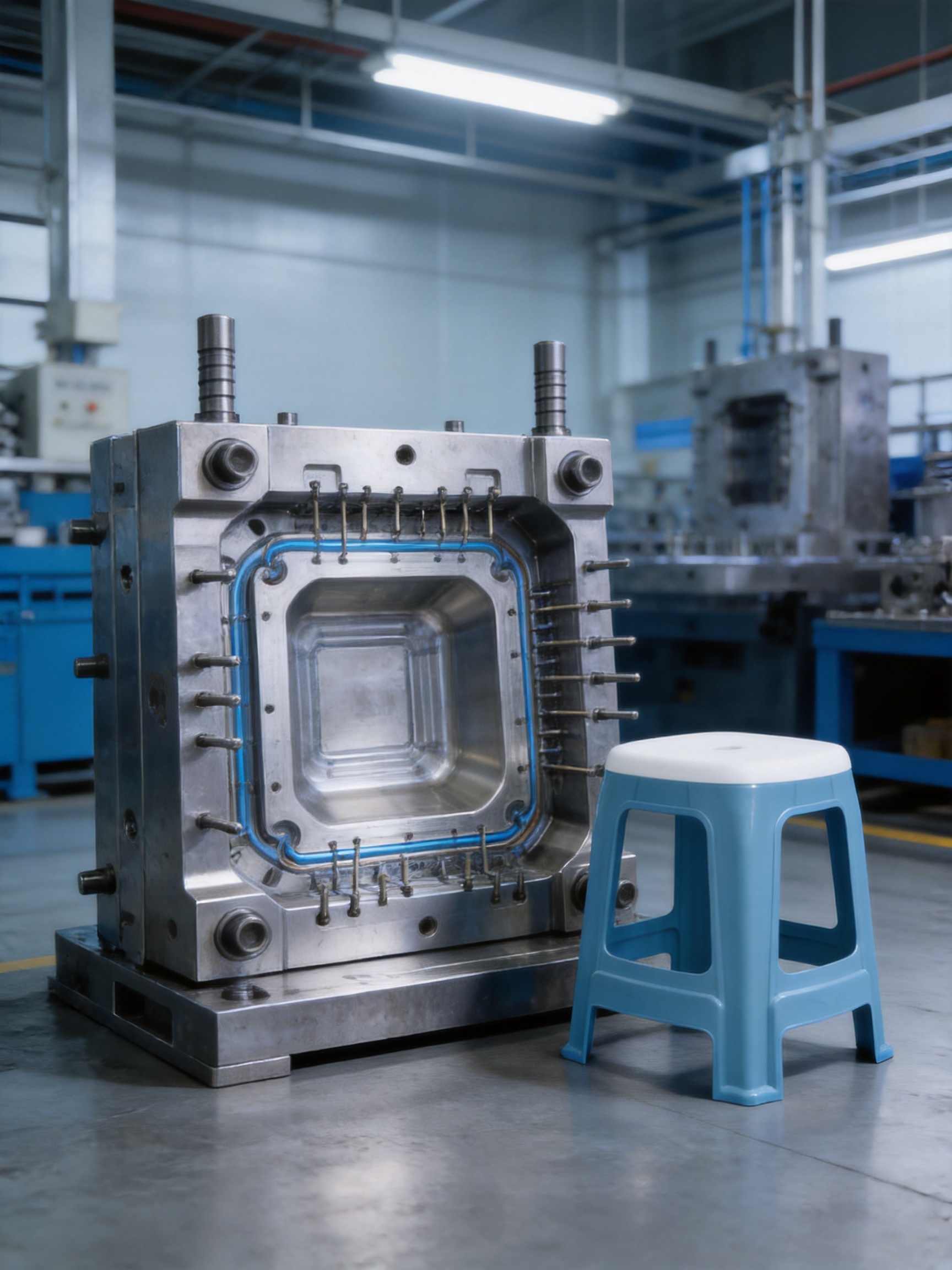
Design Engineering for Plastic Stool Mold 029
The design stage has a major influence on the performance of the finished mold. Before machining begins, the manufacturer reviews the product drawings, three-dimensional data, material information, production requirements, and injection machine specifications. Any unclear areas should be discussed with the customer before the mold structure is finalized.
The design review generally considers the following questions:
What are the overall dimensions and intended load requirements of the stool?
Is the stool designed for stacking, nesting, or compact transport?
Which areas require a smooth appearance or a specific texture?
Where should the parting line be placed to minimize visible marks?
What plastic material and color will be used?
What type of gate and runner arrangement is appropriate?
How will air be released from the cavity during filling?
Which surfaces require ejector support?
What injection machine will be used for mold trials and mass production?
What production volume and expected cycle time should the mold support?
Are there special requirements for labeling, logos, inserts, or product identification?
These questions help transform a product idea into a practical tool design. A stool that looks simple externally may have complex internal requirements. For example, the seat must be sufficiently rigid without becoming unnecessarily heavy. The legs must maintain their shape under load. Ribs should improve strength without creating excessive sink marks. The base should sit evenly, and the product should be easy to remove from the mold.
Parting Line Planning
The parting line is the boundary where mold sections meet. Its location influences appearance, mold construction, ejection, flash control, and manufacturing cost. For a consumer product such as a stool, the parting line should be positioned thoughtfully so that it does not create an unacceptable visual defect or interfere with the product’s use.
The final location depends on the product geometry. In some designs, the parting line may be placed around the outer perimeter. In others, additional slides, lifters, or inserts may be needed to form undercuts, openings, or complex leg details. The design team balances appearance, functionality, mold complexity, and maintenance requirements.
Draft Angles and Demolding
Draft angles allow the molded part to separate from the cavity and core. Without sufficient draft, textured or deep surfaces may grip the mold and make ejection difficult. Excessive draft, however, can affect the product’s dimensions or appearance. The correct amount depends on the surface texture, depth, material, and product geometry.
For Stool Mold 029, draft analysis should be completed during design review. This helps identify areas that may require modification before machining and reduces the risk of costly changes later in the project.
Wall Thickness and Structural Ribs
Wall-thickness balance is important for both appearance and performance. Very thick sections may cool slowly and develop sink marks or internal voids. Very thin sections may be difficult to fill and may not provide sufficient strength. Gradual transitions are generally preferred over abrupt changes.
Ribs can increase stiffness while reducing the need for excessive wall thickness. However, ribs must be designed carefully because they may create visible sink marks on the opposite surface. Their height, thickness, connection points, and distance from cosmetic surfaces should be evaluated together with the selected material and molding conditions.
Gate and Runner Considerations
The gate is the point through which molten plastic enters the product cavity. Its position affects filling balance, weld-line location, packing, pressure requirements, gate marks, and the visual appearance of the finished stool. The best gate arrangement depends on the product geometry and the selected injection process.
For larger stool components, filling balance is especially important. An unsuitable gate position may cause one section to fill much earlier than another, leading to uneven packing or trapped air. The mold design should therefore consider flow direction, pressure distribution, venting, and expected shrinkage before final approval.
Cooling System Planning
Cooling is one of the most important factors influencing cycle time and dimensional stability. After injection, the plastic must cool enough to retain its shape during ejection. If cooling is inefficient, the cycle may need to be extended, reducing productivity. If cooling is unbalanced, different areas may shrink at different rates and cause warpage.
Cooling channels should be planned to provide practical coverage around the major product surfaces. Their arrangement must also allow convenient connection, cleaning, inspection, and maintenance. The final cooling performance will depend on water temperature, flow rate, mold design, plastic material, and machine settings, but the mold itself should provide a sound thermal foundation.
Manufacturing Process and Production Strengths
Chenghui Mould has operated in the injection mold industry since 1994. Over more than three decades, the company has developed experience in tooling for household goods, furniture, storage products, industrial containers, and daily-use plastic articles. This background is directly relevant to stool mold production because many of the same engineering challenges apply to large, functional, durable injection-molded parts.
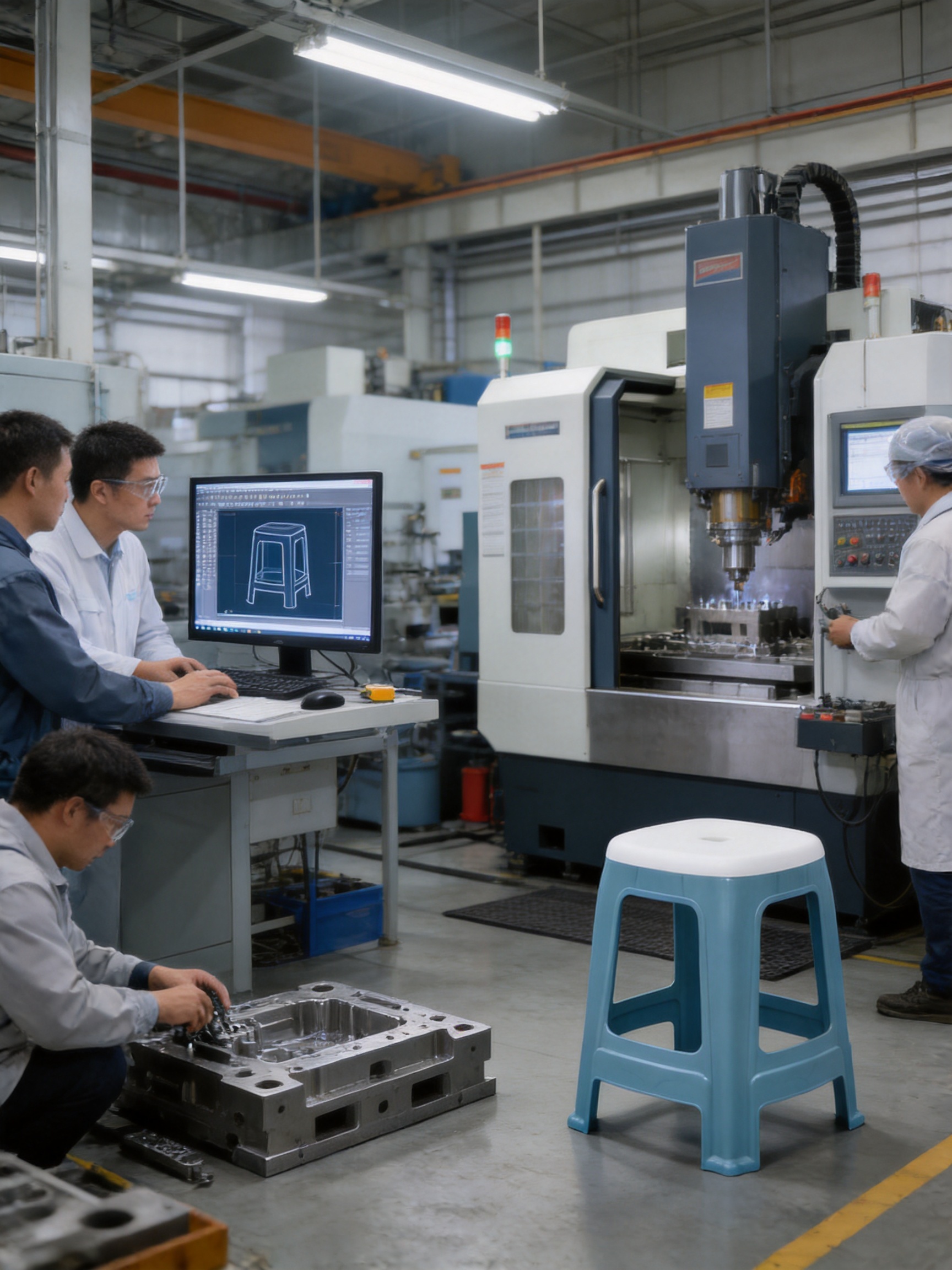
The company operates its own production workshop and has 104 advanced processing machines. This equipment base supports multiple stages of mold manufacturing, including rough machining, precision machining, drilling, electrode processing, finishing, fitting, assembly, and inspection. In-house production can improve communication between design, machining, fitting, and quality teams because technical issues can be addressed within one coordinated organization.
The company also has professional injection molding machines for mold testing. Trial molding is a critical stage because it reveals how the mold performs with actual plastic under controlled production conditions. During trials, the manufacturer can evaluate filling, venting, ejection, cooling, parting-line quality, dimensions, surface appearance, and cycle behavior.
Design and Technical Review
The process begins with the customer’s product concept, drawings, or samples. Engineers review the product for manufacturability and identify potential problems before the mold is built. Where necessary, the product structure may be adjusted to improve filling, reduce deformation, support ejection, or simplify production.
Tooling design is developed around the customer’s requirements rather than around a generic template. The design team considers the number of cavities, mold dimensions, parting structure, gates, runners, cooling passages, ejection mechanisms, inserts, and maintenance access.
Precision Machining
After design approval, mold components are manufactured using suitable processing equipment and controlled procedures. Precision machining is essential because small dimensional errors can affect part fit, appearance, and repeatability. The machining plan is selected according to the component’s function and required accuracy.
Different operations may be used for different areas of the mold. Rough machining removes excess material efficiently, while finishing operations create the required cavity geometry and surface quality. Drilling and milling produce cooling channels, mounting features, ejector holes, and other functional details. Electrical discharge machining may be used for shapes or areas that are difficult to produce through conventional cutting.
Fitting and Assembly
Machined components must be fitted and assembled carefully. The mold must open and close smoothly, maintain alignment, support the cavity and core, and allow the ejection system to operate without interference. Skilled fitting is especially important in areas where several components meet or where the mold includes movable mechanisms.
Assembly checks may include alignment, sliding action, parting-line contact, ejector movement, cooling connections, insert seating, fastener security, and component identification. These checks help reduce the possibility of avoidable problems during mold trials.
Mold Trial and Adjustment
A mold trial provides practical evidence of performance. The trial team uses a suitable injection machine and material to evaluate the molded part. Trial results may identify the need for adjustments to venting, gate dimensions, ejection, cooling, fit, surface finish, or process settings.
Trial molding is not simply a demonstration. It is a technical validation stage that connects design assumptions with real production behavior. For a stool mold, the team can inspect the product for visible defects, dimensions, stability, leg formation, seat appearance, flash, sink marks, weld lines, and release performance.
If adjustments are needed, they should be documented and completed systematically. A controlled correction process makes it easier to verify that the final mold meets the approved requirements.
Quality Inspection and Final Approval
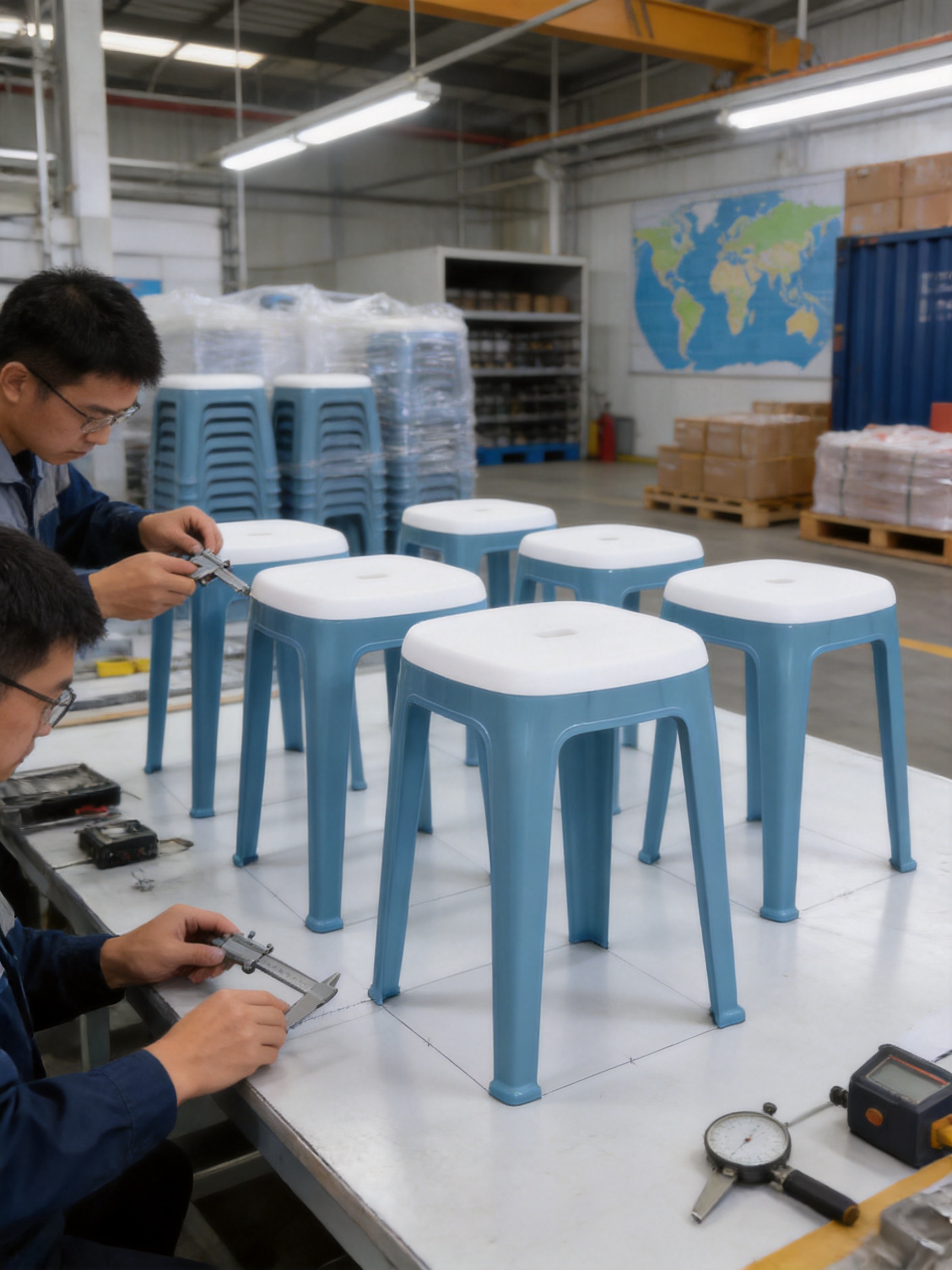
Quality inspection may include dimensional checks, visual examination, assembly verification, mold-opening tests, ejection checks, and inspection of the trial parts. The inspection scope should be agreed with the customer according to the product’s application and quality expectations.
Important product checks may include overall dimensions, seat flatness, leg alignment, base stability, wall appearance, parting-line condition, gate location, and consistency between samples. Important mold checks may include cooling connections, ejector operation, cavity condition, component fit, and identification markings.
Quality Management for Reliable Mass Production
Quality management is most effective when it is integrated into every stage of the project. It should not be limited to a final inspection after machining is complete. Early design review, controlled procurement, process monitoring, in-process inspection, assembly verification, trial molding, and final approval all contribute to reliable tooling.
For Plastic Stool Mold 029, a quality-oriented workflow can help reduce risks in several areas:
Design risk is reduced by reviewing product geometry and machine compatibility before construction.
Machining risk is reduced through suitable equipment, process planning, and dimensional verification.
Assembly risk is reduced through fitting checks and functional testing.
Production risk is reduced through mold trials using an appropriate injection process.
Delivery risk is reduced through documented inspections and customer confirmation.
After-sales risk is reduced by providing technical communication, adjustment support, and maintenance guidance.
Chenghui Mould’s stated production philosophy emphasizes precision, integrity, customer commitment, standardized processes, and continuous improvement. These principles are important for buyers that require more than a basic tool shipment. A professional mold supplier should remain available to discuss installation, trial results, processing conditions, maintenance, and future modifications.
Why In-House Production Matters to Buyers
In-house manufacturing provides several practical benefits. When design, machining, assembly, testing, and inspection are coordinated within the same company, technical communication can be faster and more direct. Engineers can communicate with machining operators and mold fitters without relying entirely on multiple external suppliers.
This structure may also improve responsibility management. If an issue appears during a mold trial, the manufacturer can trace the problem through the relevant design, machining, or assembly stage. Corrective actions can then be planned with a clearer understanding of the tooling history.
For overseas customers, centralized production can simplify project management. Instead of coordinating separate design, machining, testing, and inspection companies, the buyer works with one mold manufacturer responsible for the complete tooling process. This is particularly useful for OEM and ODM projects involving product development, sampling, and continuing production support.
The manufacturer’s annual capacity of more than 1,500 mold sets demonstrates experience with organized production scheduling and multiple tooling projects. Capacity alone does not guarantee quality, but it indicates that the company has established processes for handling repeated design, machining, assembly, trial, and inspection activities.
Customization Options for Different Stool Programs
Plastic Stool Mold 029 can be adapted to a customer’s specific product program. Customization may involve the stool’s external shape, dimensions, surface texture, branding, color strategy, structural features, packaging requirements, and production equipment.
Product Shape and Dimensions
Customers may require a compact stool for small homes, a wider stool for commercial use, a tall utility stool, or a stackable design for storage efficiency. Each format affects the mold’s cavity dimensions, core structure, ejection plan, and cooling arrangement.
Surface Texture and Appearance
The surface may be designed with a smooth finish, matte texture, patterned texture, or functional grip treatment. Texture influences draft requirements and demolding behavior. It may also affect the visual identity of the product and its resistance to scratches or visible handling marks.
Structural Reinforcement
Stools intended for heavier use may require reinforced legs, additional ribs, thicker connection areas, or a stronger seat structure. The mold must form these features accurately while maintaining balanced filling and acceptable appearance.
Branding and Identification
Some customers require logos, product codes, recycling marks, size information, or other identification features. These elements may be formed directly in the mold or added through a secondary process. The chosen method depends on the customer’s branding requirements, product volume, and desired appearance.
Color and Material Planning
Plastic stools may be produced in multiple colors for different markets or customer groups. Material and colorant selection should be reviewed together because some additives can affect flow, shrinkage, surface finish, or processing temperature. The mold supplier can take the selected material into account during design and trial planning.
Application Areas
Plastic Stool Mold 029 can support a broad range of market applications. Household stools are commonly used in kitchens, bathrooms, bedrooms, balconies, gardens, workshops, and storage areas. Commercial stools may be used in cafés, restaurants, classrooms, retail environments, waiting areas, and event venues.
Industrial and institutional users often value stools that are easy to clean, resistant to moisture, simple to move, and economical to replace. Injection-molded plastic can meet these requirements when the product design and material are properly selected.
For wholesalers and distributors, a stool mold can support private-label products, regional product lines, promotional programs, and repeat purchase contracts. The ability to customize dimensions, colors, surface treatment, and packaging can help a buyer differentiate the product from standard market offerings.
For manufacturers already producing household plastic goods, the mold may also complement existing product families such as storage boxes, laundry baskets, buckets, trash cans, tables, chairs, racks, and turnover containers. A supplier with experience across these categories may better understand the common requirements of daily-use injection molding.
Production Efficiency and Commercial Benefits
Production efficiency depends on several factors, including mold design, injection machine selection, plastic material, cooling performance, automation, operator skill, and process settings. The mold is one of the central factors because it determines how quickly the part can be filled, cooled, and ejected.
A well-designed mold can help manufacturers pursue shorter and more stable production cycles. It can also reduce manual intervention by supporting consistent ejection and minimizing the need for frequent cleaning or adjustment. When the part is produced with fewer defects, the manufacturer can reduce scrap and improve material utilization.
Stable production provides commercial benefits beyond the factory floor. Predictable output supports more accurate delivery schedules. Lower rejection rates protect margins. Consistent appearance strengthens the buyer’s brand. Repeatable dimensions reduce complaints from downstream customers. These benefits are particularly important for distributors and retailers that need dependable supply across multiple markets.
Manufacturers should evaluate the mold together with the complete production plan. A mold intended for high-volume use may require different design priorities from a tool intended for occasional production. The correct cavity configuration, cooling approach, automation level, and maintenance plan depend on the customer’s annual demand and business model.
| Evaluation Area | Importance for Stool Production | Expected Benefit of Suitable Tooling |
|---|---|---|
| Product dimensions | Controls fit, stability, stacking, and appearance | More consistent finished stools |
| Filling balance | Influences weld lines, short shots, and packing | Reduced molding defects |
| Cooling design | Affects cycle time and warpage | Improved productivity and dimensional stability |
| Ejection system | Controls part release and surface protection | Fewer deformed parts and interruptions |
| Surface finish | Influences consumer appeal and cleaning behavior | More uniform product appearance |
| Mold structure | Supports repeated opening, closing, and injection cycles | Improved service life and maintenance efficiency |
| Trial validation | Confirms actual molding performance | Lower production risk before shipment |
| After-sales support | Helps resolve installation and process questions | Faster problem solving after delivery |
Recommended Customer Information for a Successful Project
Customers can improve project efficiency by providing complete technical information at the beginning. Useful documents may include product drawings, three-dimensional files, sample products, material specifications, expected annual output, injection machine details, preferred surface finish, color requirements, packaging dimensions, and applicable quality standards.
The customer should also explain how the stool will be used. A product designed for light household use may have different structural and material requirements from one intended for commercial or industrial environments. Information about load expectations, temperature exposure, moisture, ultraviolet exposure, cleaning chemicals, and transport conditions can help guide the design review.
It is also helpful to clarify whether the buyer needs a single prototype mold, a production mold, replacement tooling, or a mold intended for long-term supply. The expected production volume affects decisions about cavity count, wear resistance, spare components, maintenance access, and validation procedures.
Communication about acceptance criteria is equally important. Customers should identify which dimensions are critical, what visual defects are unacceptable, how the parting line should appear, and whether the molded stool must meet particular stability or load-testing requirements. Clear expectations help the manufacturer prepare a more appropriate inspection and trial plan.
Maintenance and Long-Term Mold Care
Even a high-quality mold requires proper maintenance. Regular cleaning helps prevent residue from affecting the cavity surface, venting, or parting line. Cooling channels should be monitored to identify reduced flow or blockage. Ejector pins, slides, guide components, and other moving parts should be inspected according to production volume and operating conditions.
After production stops, the mold should be cleaned and stored according to a suitable preservation procedure. Exposed surfaces may require protection against corrosion, especially in humid environments. Cooling water should be managed carefully because poor-quality water can contribute to deposits or corrosion within the cooling system.
Maintenance records can help identify recurring problems. A record may include production cycles, lubrication dates, replaced components, trial observations, repairs, and dimensional checks. This information supports preventive maintenance rather than waiting for an unexpected failure.
Customers should also train operators to open, close, install, and remove the mold correctly. Improper handling can damage parting surfaces, ejector components, connectors, and alignment systems. Correct machine settings are equally important because excessive pressure, unsuitable speed, or incorrect ejection timing can increase stress on both the mold and the molded product.
Export Support and International Cooperation
Chenghui Mould exports its products to the Middle East, Europe, America, Africa, Southeast Asia, and other regions. International mold projects require more than manufacturing capability. They also require clear communication, accurate documentation, packaging suitable for long-distance transportation, and an understanding of different customer expectations.
For overseas buyers, the project may include remote design review, digital drawing confirmation, trial video communication, sample approval, inspection documentation, and shipping coordination. A structured communication process helps reduce misunderstandings about product dimensions, mold operation, spare parts, and acceptance standards.
International customers may also use different injection machines, materials, electrical standards, and maintenance practices. These differences should be discussed before mold construction. The supplier can then consider the intended production environment when preparing the mold and technical documents.
After delivery, the manufacturer’s technical support can help the customer with installation, initial trials, processing adjustments, and troubleshooting. Continued communication is valuable when the mold is used in a new factory or with a different machine from the one used for the original trial.
Frequently Asked Questions
What type of product is Plastic Stool Mold 029 designed to manufacture?
It is designed for producing injection-molded plastic stools. The final stool shape, dimensions, structural details, surface treatment, and material are determined by the customer’s approved product design.
Can the mold be customized?
Yes. The mold can be developed according to product drawings, three-dimensional data, samples, material requirements, injection machine specifications, surface standards, and production volume. Customization may include the stool shape, dimensions, texture, ribs, branding features, and ejection arrangement.
What information should be provided for a quotation?
Customers should provide the product drawing or sample, approximate dimensions, plastic material, expected annual quantity, injection machine information, surface requirements, color requirements, and any special packaging or quality standards. More complete information allows a more accurate technical and commercial evaluation.
Why is mold testing important?
Mold testing verifies how the tool performs under actual injection conditions. It helps identify issues involving filling, venting, cooling, ejection, dimensions, surface appearance, flash, sink marks, and warpage before the mold is shipped or placed into regular production.
Can the mold be used for high-volume production?
The suitability for high-volume production depends on the final mold structure, material, cavity configuration, expected cycle count, injection machine, and maintenance plan. The tooling should be designed around the customer’s expected production volume so that service-life and efficiency requirements are addressed from the beginning.
What materials can be used for plastic stools?
The material should be selected according to the required strength, stiffness, impact resistance, appearance, environmental exposure, and cost. Common furniture-grade injection materials may be considered, but the final choice should be confirmed by the customer and evaluated during mold design and trial production.
How does the mold help prevent stool instability?
Stability depends on accurate leg geometry, balanced cooling, controlled shrinkage, proper product design, and suitable processing conditions. A precisely manufactured mold provides consistent cavity dimensions and supports better control of these factors, although the complete molding process must also be properly adjusted.
Can the mold include a product logo?
Yes. Logos and identification details may be incorporated into the mold or added through another production method. The preferred approach depends on the logo design, required appearance, production quantity, and customer branding plan.
Does the manufacturer provide mold trials?
Chenghui Mould has professional injection molding machines for mold testing. Trial production is used to evaluate the mold and molded parts, identify required adjustments, and support final approval before delivery.
What are the main benefits of working with an experienced mold factory?
An experienced mold factory can combine product design review, tooling engineering, machining, fitting, testing, inspection, and after-sales communication. This integrated capability can reduce coordination problems and help the customer obtain a mold that is more suitable for repeatable production.
How should the mold be maintained after delivery?
The mold should be cleaned regularly, lubricated according to its operating requirements, inspected for wear, and protected from corrosion during storage. Cooling systems, ejector components, guide systems, slides, parting surfaces, and cavity areas should be checked as part of a documented maintenance routine.
Is Plastic Stool Mold 029 suitable for OEM and ODM projects?
Yes. The mold can support customers that have their own stool design, private-label product, or product concept requiring engineering assistance. OEM and ODM cooperation may include design review, mold construction, sample development, trial molding, inspection, and technical support.
Conclusion
Plastic Stool Mold 029 is a practical tooling solution for manufacturers that need reliable, repeatable, and customizable production of plastic stools. Its value lies in the complete manufacturing approach behind the product: careful design review, suitable mold engineering, precision machining, skilled fitting, injection testing, quality inspection, and continued technical support.
Compared with basic tooling, a professionally engineered mold can provide stronger control over product consistency, warpage, ejection, surface quality, cycle efficiency, and long-term maintenance. These advantages help reduce total production costs and support dependable supply for wholesalers, distributors, retailers, and industrial users.
Chenghui Mould brings more than 30 years of experience, an in-house production workshop, 104 advanced processing machines, professional injection molding equipment, and an annual production capacity exceeding 1,500 mold sets. Its experience in household products, furniture, storage products, and industrial plastic goods provides a suitable foundation for developing stool tooling for different markets.
For customers evaluating a plastic stool mold, the most important step is to connect the tooling design with the complete production plan. Product geometry, material, machine capability, annual output, quality standards, maintenance expectations, and export requirements should all be considered before approval. When these elements are aligned, Plastic Stool Mold 029 can become a dependable foundation for efficient and long-term plastic stool manufacturing.
References
1. General principles of plastic injection mold design and moldability analysis.
2. Standard practices for injection molding process control, cooling, venting, and ejection.
3. Technical guidance on thermoplastic material selection for household and furniture products.
4. Manufacturing quality-management principles for precision tooling and production validation.
5. Industrial guidelines for mold maintenance, corrosion prevention, lubrication, and storage.
6. Product-development practices for OEM and ODM plastic injection molding projects.
7. Chenghui Mould company information and product-development materials supplied for this article.