
 Français
 Español
 عربى
Plastic stools are widely used in homes, offices, schools, restaurants, workshops, retail spaces, warehouses, and outdoor environments. Their popularity comes from a combination of affordability, easy cleaning, low weight, stacking convenience, and resistance to everyday handling. However, the quality of a plastic stool depends heavily on the quality of the injection mold used to manufacture it. A well-designed mold determines the stool’s appearance, strength, dimensional stability, cycle efficiency, surface finish, and long-term production cost.
Plastic Stool Mold 019 is designed for manufacturers and distributors seeking a dependable tooling solution for plastic seating products. It is part of a product category that requires careful attention to structural balance, wall thickness, draft angles, ribs, corners, legs, load-bearing areas, and demolding performance. When these elements are correctly engineered, the resulting stool can combine a clean appearance with the strength required for repeated daily use.
The mold is manufactured by Zhejiang Chenghui Mould Co., Ltd., a China-based injection mold manufacturer with more than 30 years of experience in tooling for daily necessities, furniture, storage products, industrial containers, and related household goods. The company’s capabilities cover product analysis, mold design, precision machining, mold assembly, trial production, inspection, and after-sales support.
This article explains the product value of Plastic Stool Mold 019, the design considerations behind a high-quality stool mold, the company’s manufacturing process, the advantages of working with an experienced mold factory, and the questions buyers should ask before ordering custom tooling.
1. The Role of a High-Quality Plastic Stool Mold
An injection mold is more than a cavity that gives plastic its shape. It is a precision production system that controls how molten material enters, fills, cools, solidifies, and exits the mold. For a plastic stool, the mold must reproduce the seat, legs, support structures, decorative features, and surface details consistently from one cycle to the next.
A plastic stool may look simple compared with a complex automotive or medical component, but its mold can present several engineering challenges. The product must often be large enough to support an adult while remaining lightweight and economical. It may also need to stack efficiently, resist impact, tolerate temperature changes, and maintain a stable shape after molding. These requirements place significant demands on the mold design.
If the mold is poorly designed, manufacturers may encounter short shots, weld lines in critical locations, sink marks, warpage, flash, uneven gloss, difficult ejection, or inconsistent dimensions. Such problems can increase scrap rates and make the stool unsuitable for assembly, stacking, packaging, or customer inspection.
A properly developed stool mold addresses these problems before steel machining begins. The mold designer studies the product geometry, identifies areas where material may accumulate, evaluates filling behavior, plans the gate and runner system, positions ejectors, and determines the most appropriate cooling layout. The goal is to create a mold that is stable in mass production rather than merely capable of producing an initial sample.
2. Product Overview of Plastic Stool Mold 019
Plastic Stool Mold 019 is intended for the production of molded plastic stools used in residential, commercial, institutional, and industrial settings. Its design can be adapted according to the customer’s product drawings, 3D data, material selection, target weight, surface requirements, and production volume.
The tooling concept is suitable for manufacturers that need a repeatable production platform for a recognizable stool design. Depending on the customer’s requirements, the mold may be configured for different plastic materials, color options, branding features, surface textures, reinforcement structures, and production targets.
The mold can support the production of stools made from commonly used injection molding materials such as polypropylene, high-density polyethylene, ABS, or other approved thermoplastics. The final material selection should be confirmed through product testing because each material has different shrinkage, flow behavior, stiffness, impact performance, and processing requirements.
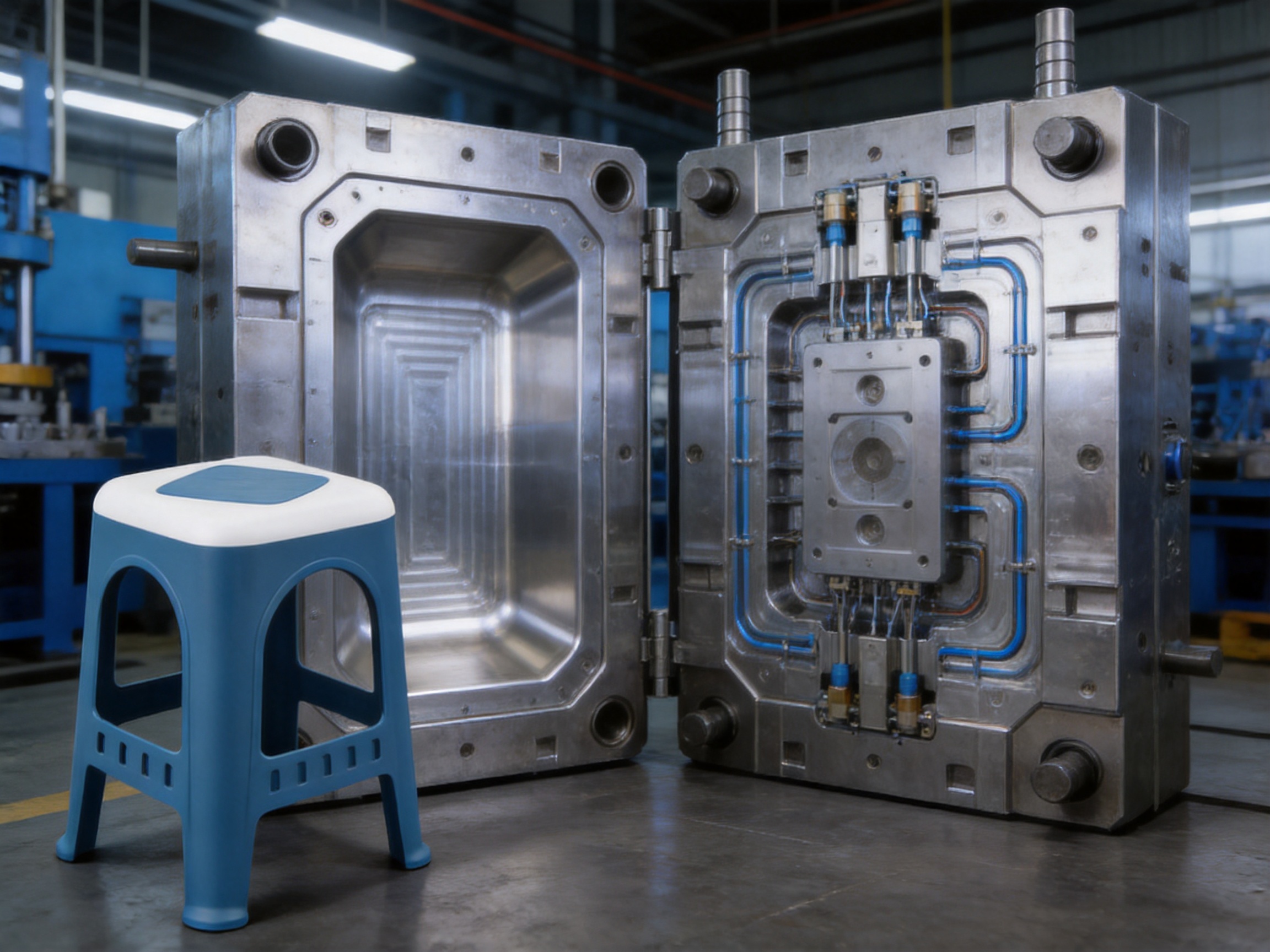
For a plastic stool, the mold must reproduce functional areas with particular care. These areas may include the seating surface, outer rim, underside ribs, leg transitions, feet, stacking interfaces, and any central reinforcement structure. The relationship between these elements affects both product strength and production performance.
| Evaluation Area | Importance for a Plastic Stool Mold | Expected Tooling Benefit |
|---|---|---|
| Product structure | Controls load distribution and resistance to deformation | More stable and dependable finished stools |
| Wall thickness planning | Influences filling, cooling, shrinkage, and appearance | Lower risk of sink marks and warpage |
| Gate and runner layout | Determines how plastic enters and fills the cavity | More balanced filling and improved consistency |
| Cooling system | Controls cycle time and dimensional stability | More efficient production and reduced distortion |
| Ejection system | Releases the molded stool without damage | Fewer scratches, deformation problems, and sticking issues |
| Steel and surface treatment | Influences mold life and product appearance | Improved durability and easier maintenance |
| Inspection and trial molding | Confirms performance before shipment | Lower commissioning risk for the buyer |
The final mold configuration should always be developed from the customer’s approved product design. A stool mold designed for a thin, lightweight stool may require different tooling decisions from a heavy-duty industrial stool. Production quantity, machine capacity, material, expected service life, and target market all influence the engineering solution.

CHENGHUI Plastic Stool Mold 019
3. Structural Design Considerations for Plastic Stool Production
3.1 Seat Surface and Load Distribution
The seating surface must be comfortable, stable, and resistant to bending. Its geometry may include a slightly curved upper surface, a reinforced underside, or a perimeter rim. The mold must reproduce these features without creating excessive thickness changes that could cause uneven cooling.
When a stool is loaded, force is transferred from the seat into the legs and supporting ribs. If the load path is not balanced, stress may concentrate around the leg joints or corners. The product designer and mold engineer must therefore consider how the seat geometry, underside structure, and leg arrangement work together.
The cavity and core surfaces should be carefully matched to preserve the intended shape. Small errors in alignment can lead to visible parting lines, uneven edges, or dimensional differences between production batches. Precision machining and careful mold fitting are especially important around the seat perimeter and other visible areas.
3.2 Legs and Support Transitions
The legs are among the most important structural features of a plastic stool. They must be sufficiently strong, evenly formed, and connected to the seat through transitions that minimize stress concentration. Sudden changes in section thickness can create shrinkage marks or internal stress, while sharp internal corners can weaken the molded component.
For this reason, the mold design may use rounded transitions, carefully positioned ribs, and controlled wall thicknesses. Draft angles must also be sufficient to release the legs from the core without scuffing or deformation. If the legs include tapering or stacking features, those details require accurate core machining and precise ejection planning.
Uneven cooling in the legs can cause warpage, especially when the legs are long, narrow, or positioned far from the main cooling channels. The cooling system must be planned around the actual product geometry rather than applied as a generic layout.
3.3 Ribs, Reinforcements, and Underside Details
Ribs allow designers to improve stiffness without making the entire stool excessively thick. They can reinforce the underside of the seat, connect the legs, or support the outer rim. However, ribs that are too thick may create sink marks on the visible upper surface. Ribs that are too thin or poorly positioned may not provide sufficient reinforcement.
The mold manufacturer must evaluate rib thickness, height, draft, and connection points. The rib design should support the product’s functional requirements while maintaining reasonable filling and cooling conditions. The use of proper steel machining and polishing also helps prevent plastic from sticking around narrow rib details during ejection.
3.4 Draft Angles and Demolding
Draft angles are essential for removing a molded stool from the core and cavity. A part with insufficient draft may stick, require excessive ejection force, or develop surface marks during production. Draft requirements depend on the material, texture, depth of the feature, and direction of mold opening.
Textured surfaces generally require more draft than polished surfaces because the texture increases resistance during release. The mold designer should review draft angles during the product design stage. Correcting draft problems after steel machining is expensive and may affect the appearance or dimensions of the product.
A skilled mold factory identifies these risks before manufacturing begins. Design feedback at the beginning of the project can help the customer make practical changes that improve mold life and production reliability.
4. Advantages of Plastic Stool Mold 019
4.1 Designed for Repeatable Production
The primary advantage of Plastic Stool Mold 019 is its focus on repeatable production. A commercial mold must deliver more than a satisfactory first sample. It must continue to produce consistent parts after many production cycles, provided that it is operated, maintained, and stored correctly.
Repeatability depends on the relationship between steel quality, machining accuracy, mold alignment, cooling balance, ejection performance, and process control. Each of these areas is addressed through the company’s structured design and manufacturing workflow.
4.2 Suitable for Custom Product Development
Plastic stool buyers often require their own dimensions, colors, textures, logos, packaging specifications, or market-specific designs. A custom mold factory can adapt the tooling to these requirements rather than forcing the customer to use a standard product.
Customization may include changes to seat size, stool height, leg configuration, stacking features, logo placement, surface texture, edge shape, or underside reinforcement. The feasibility of each modification should be reviewed through product drawings and mold-flow considerations before the design is finalized.
4.3 Balanced Attention to Appearance and Strength
Some low-cost molds focus primarily on producing a shape quickly, while a high-quality stool mold must balance visual appeal with structural performance. Visible surfaces should remain clean and consistent, while hidden structures must provide sufficient support.
Plastic Stool Mold 019 is positioned as a tooling solution that considers both requirements. The mold development process addresses parting lines, gate marks, ejector locations, surface finish, and texture while also considering ribs, legs, load paths, and cooling behavior.
4.4 Support for Efficient Mass Production
For wholesalers, distributors, and furniture manufacturers, production efficiency has a direct effect on profitability. A mold that fills evenly, cools effectively, and ejects smoothly can reduce cycle interruptions and minimize unnecessary material waste.
The correct production configuration depends on the customer’s injection molding machine, material, product weight, annual volume, and required cycle time. During the project, the mold manufacturer can evaluate the gate system, cooling arrangement, ejection design, and mold layout to support the intended production conditions.
4.5 Professional Trial and Inspection
Trial molding is an important stage in mold manufacturing. It allows the manufacturer to confirm filling behavior, product dimensions, ejection performance, surface quality, and overall mold operation before shipment.
During a trial, the team may inspect the molded sample for short shots, flash, weld lines, sink marks, warpage, color variation, and other issues. If necessary, adjustments can be made to the mold or processing conditions. This approach reduces the risk that the customer will receive a mold requiring extensive correction at the production site.
4.6 Long-Term Serviceability
A production mold should be designed with maintenance in mind. Wear components, ejector elements, cooling connections, guide systems, and replaceable inserts should be accessible and serviceable where practical. Good maintenance design can reduce downtime and extend the useful life of the tooling.
The manufacturer’s experience with household and industrial molds supports practical decisions regarding mold construction, spare parts, inspection points, and routine care. These details may not be visible in the first sample, but they become increasingly important during long-term production.
5. Manufacturing Strengths of the Mold Factory
Zhejiang Chenghui Mould Co., Ltd., also known as CH Mould, was founded in 1994 and has more than three decades of experience in injection mold design and manufacturing. Its product coverage includes daily necessities, furniture products, storage boxes, turnover boxes, laundry baskets, buckets, trash cans, storage racks, PET storage products, tables, chairs, and other household and industrial items.
This broad product experience is valuable because a plastic stool mold shares many engineering principles with other large household injection molds. These include controlling warpage, balancing filling, designing durable ribs, positioning ejectors, managing surface quality, and developing efficient cooling systems.
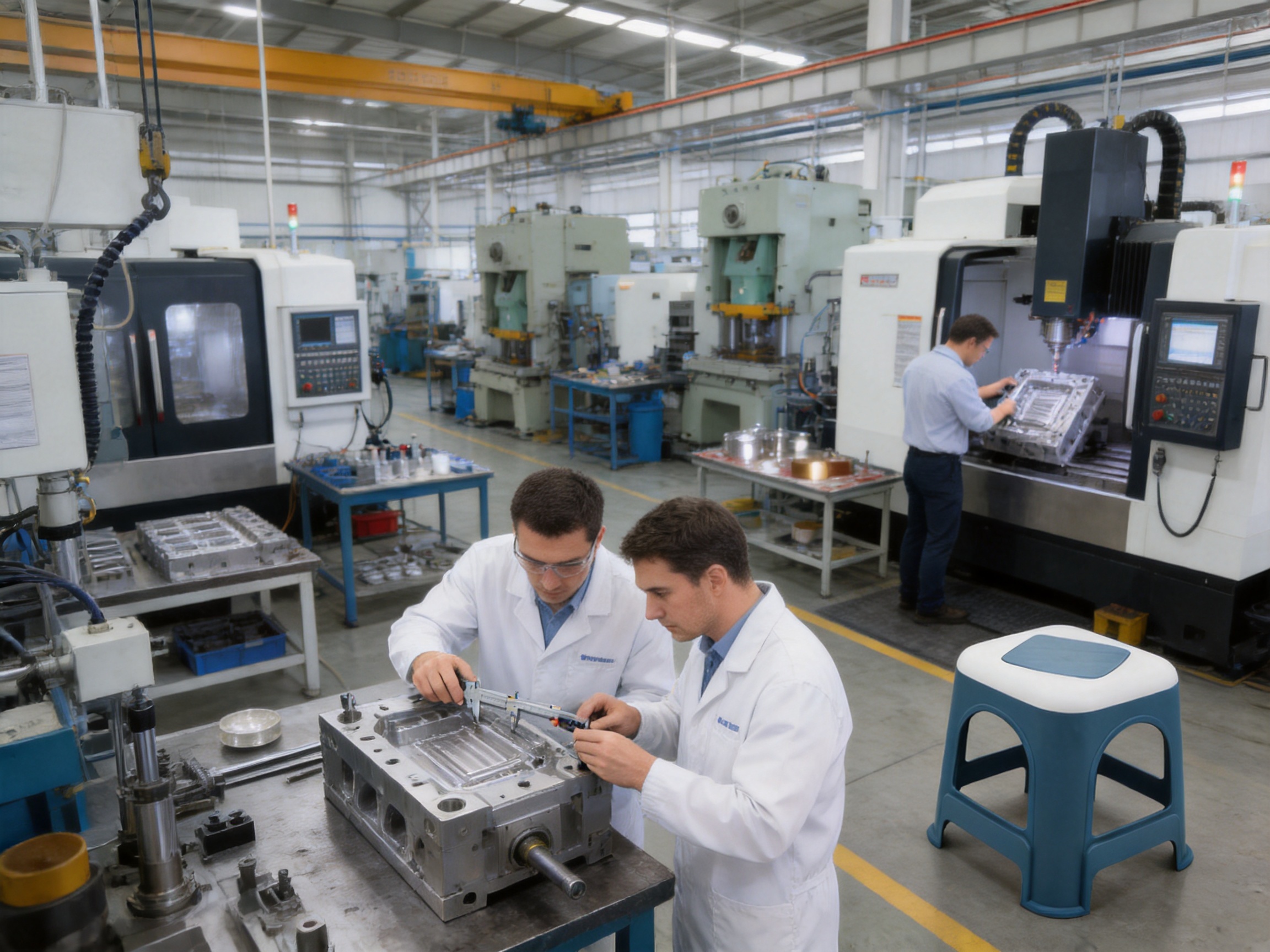
The company operates its own production workshop and has 104 advanced processing machines, together with professional injection molding machines used for mold testing. The combination of machining equipment and in-house trial capability allows the manufacturing team to maintain closer control over the tooling process.
With an annual production capacity of more than 1,500 mold sets, the company is equipped to support both individual custom projects and broader tooling programs. Capacity alone does not guarantee quality, but it provides an operational foundation for organized scheduling, specialized production stages, and repeatable manufacturing procedures.
5.1 Integrated Project Management
An integrated project workflow reduces communication gaps between design, machining, assembly, and trial molding. When these stages are managed separately by unrelated suppliers, important information can be lost. An integrated mold factory can coordinate design decisions with actual machining and production requirements.
For Plastic Stool Mold 019, an integrated workflow may include product drawing review, mold design confirmation, steel selection, CNC machining, electrical discharge machining where necessary, drilling, grinding, polishing, fitting, assembly, testing, and inspection.
5.2 Modern Processing Equipment
Advanced processing machines support the accurate production of cavity and core components, mold bases, inserts, sliders, lifters, cooling channels, and other tooling elements. The exact equipment used depends on the mold structure and tolerance requirements.
CNC machining is commonly used for complex three-dimensional surfaces, while electrical discharge machining can support narrow slots, deep ribs, sharp internal features, and details that are difficult to produce by conventional cutting. Grinding and polishing operations help achieve the required dimensional accuracy and surface finish.
The value of equipment is maximized when it is combined with skilled operators, effective programming, proper workholding, calibrated measurement tools, and documented inspection practices. The company’s manufacturing strengths include both machinery and the personnel needed to operate the production system effectively.
5.3 Internal Mold Testing
Testing molds with professional injection molding equipment provides an opportunity to evaluate the complete tooling system. A mold may appear correct during assembly but reveal filling or ejection issues during actual injection molding. Internal testing helps identify these problems before the tooling is delivered to the customer.
Trial production can also provide reference data for the customer’s future process setup. Processing conditions such as injection speed, holding pressure, cooling time, and mold temperature may vary depending on the selected material and machine, but trial results provide a useful starting point.
5.4 Quality Management
Quality management begins with the review of customer requirements and continues through design, procurement, machining, assembly, testing, inspection, packaging, and after-sales support. A well-organized quality system helps ensure that the mold conforms to approved drawings and agreed technical requirements.
Typical inspection activities may include checking critical dimensions, mold alignment, parting line condition, cooling channel integrity, ejector movement, cavity surface quality, and molded sample dimensions. The inspection plan should be adapted to the product and customer requirements.
6. The Custom Mold Manufacturing Process
6.1 Requirement Collection
The project begins with a clear understanding of the customer’s requirements. Useful information includes the product’s 2D drawings, 3D model, target material, color, surface finish, annual production quantity, injection machine information, expected mold life, packaging method, and delivery schedule.
If the customer does not have a complete 3D model, the mold factory may assist with product development based on sketches, reference samples, measurements, or functional requirements. However, the final tooling design should be approved before machining begins.
6.2 Product Design Review
The engineering team reviews the product for draft, wall thickness, sharp corners, undercuts, ribs, holes, parting line locations, ejection areas, and potential molding defects. This stage is especially important for stools because the product may combine large surfaces with structural legs and reinforcement features.
Design review can identify problems that would otherwise lead to expensive mold modifications. For example, an unsuitable rib thickness may create visible sink marks, while an insufficient draft angle may cause sticking. Early correction is generally faster and less costly than modifying completed steel.
6.3 Mold Design
After the product design is confirmed, the mold structure is developed. The design may include the mold base, cavity, core, inserts, guide pillars, guide bushes, runner system, gates, cooling channels, ejector system, return pins, support plates, and safety features.
The choice between a cold runner and other runner configurations depends on the product size, material, machine, production volume, and cost objectives. A stool mold may require careful consideration of gate location to achieve balanced filling and reduce visible marks on important surfaces.
6.4 Flow and Filling Considerations
Molten plastic must travel through the runner system and fill the cavity before premature cooling occurs. Large or complex stool geometries may require more than one filling path or a carefully positioned gate. The objective is to reduce pressure imbalance, minimize weld lines in high-stress areas, and support even packing.
Where appropriate, mold-flow analysis can help predict filling patterns, air traps, pressure requirements, cooling behavior, and warpage tendencies. Analysis is not a replacement for practical experience, but it can support better decisions before steel machining.
6.5 Steel Selection
Mold steel must be selected according to the expected production volume, plastic material, surface finish, corrosion risk, maintenance requirements, and budget. Different components may use different grades or treatments depending on their function.
For high-volume production, wear resistance and dimensional stability are important. If the plastic contains abrasive additives, the mold may require more durable steel or surface treatment. If the product requires a polished or textured appearance, the steel must also support the intended finish.
6.6 CNC Machining and Precision Processing
CNC machining produces the main cavity and core surfaces as well as many structural components. Accurate programming, stable fixturing, appropriate cutting tools, and controlled machining conditions help achieve the required geometry.
Complex stool features such as curved seating surfaces, tapered legs, ribs, rounded corners, and stacking details may require multiple machining operations. Each operation must be coordinated with the final assembly and parting strategy.
6.7 EDM, Grinding, and Polishing
Electrical discharge machining can be used for details that are difficult to reach with cutting tools. Grinding supports the accuracy of mating surfaces and critical components, while polishing produces the required visual finish on specified areas.
The finishing method depends on the customer’s product requirements. A high-gloss stool, a fine matte stool, and a textured stool require different surface treatment approaches. The mold surface should be evaluated together with the chosen plastic material because processing conditions can affect the final appearance.
6.8 Assembly and Fitting
After machining, the mold components are assembled and fitted. The team checks the movement of guide systems, ejectors, slides, lifters, inserts, and other moving elements. Parting surfaces are inspected to ensure proper contact and to reduce the risk of flash.
Fitting is a skilled stage of mold production. Even precisely machined components may require careful adjustment to achieve smooth operation and consistent parting. Good fitting contributes to mold longevity and reduces the possibility of damage during production.
6.9 Mold Trial
The assembled mold is installed on an appropriate injection molding machine for trial production. The trial confirms whether the mold fills correctly, ejects the product, maintains acceptable dimensions, and produces the required surface quality.
Trial samples may be measured and compared with the approved product drawings. The mold may undergo adjustments if the samples reveal flash, warpage, sink marks, poor venting, uneven filling, or other issues. The objective is to deliver a mold that is ready for the customer’s production environment.
6.10 Final Inspection and Delivery
Before shipment, the mold is cleaned, protected, inspected, and prepared for delivery. Documentation may include mold drawings, trial records, sample parts, operating notes, spare parts information, and maintenance recommendations according to the agreed project scope.
Proper packaging is important because molds are heavy precision tools. Anti-rust protection, secure fastening, moisture control, and impact protection help preserve the tooling during transportation and storage.
7. Comparison with Lower-Quality or Less Specialized Tooling
Buyers often compare molds primarily by initial price. However, the lowest quotation may not represent the lowest total cost. Tooling quality affects scrap, maintenance, cycle time, product consistency, machine utilization, and the risk of delayed market delivery.
| Comparison Factor | Experienced Custom Mold Factory | Low-Cost or Less Specialized Supplier |
|---|---|---|
| Product analysis | Reviews draft, wall thickness, filling, ejection, and structural risks | May begin machining with limited design review |
| Tooling accuracy | Uses coordinated machining, fitting, and inspection procedures | Accuracy may vary between components |
| Surface quality | Matches polishing or texturing to product requirements | Surface finish may be inconsistent or difficult to reproduce |
| Cooling design | Plans channels around product geometry and cycle objectives | Cooling may be basic or poorly balanced |
| Trial molding | Tests the mold internally and evaluates sample quality | Testing may be limited or transferred to the buyer |
| Maintenance planning | Considers serviceable components and long-term operation | Future maintenance may be more difficult |
| Communication | Provides technical coordination from design to delivery | Customer may need to manage multiple disconnected stages |
| Total production value | Focuses on reliability, repeatability, and lifecycle cost | Focus may be concentrated on purchase price |
Not every low-priced mold is unsuitable, and not every expensive mold is automatically superior. The important issue is whether the tooling matches the customer’s production objectives. A simple, low-volume stool may not require the same investment as a high-volume commercial product. An experienced supplier helps determine the appropriate balance between mold complexity, service life, product quality, and budget.
8. Benefits for Different Customer Groups
8.1 Furniture Manufacturers
Furniture manufacturers can use Plastic Stool Mold 019 as a foundation for expanding their plastic seating product line. A reliable mold supports predictable output and helps maintain consistent appearance across large orders.
Manufacturers may request different stool heights, colors, textures, or reinforcement structures for different market segments. A custom mold program can help them develop products for homes, schools, restaurants, workshops, and commercial facilities.
8.2 Wholesalers and Distributors
Wholesalers and distributors often need products that meet local market preferences. Custom tooling allows them to differentiate their product range through exclusive dimensions, visual details, logos, or packaging-related features.
For distributors, a dependable mold supplier also reduces the risk of inconsistent replacement orders. Once the tooling and product specifications are approved, future production can follow a controlled standard.
8.3 Importers and Trading Companies
Importers working with contract manufacturers may benefit from a complete tooling service that includes design review, sampling, inspection, and technical documentation. This can simplify communication between the importer, mold factory, and injection molding plant.
Importers should provide clear requirements regarding ownership, mold storage, maintenance responsibility, approved samples, production locations, and future modifications. These commercial and technical details are important for protecting the value of the tooling investment.
8.4 Injection Molding Companies
Injection molding companies can order customized tooling according to their available machine size, clamping force, injection capacity, automation system, and production schedule. The mold should be designed for the actual machine rather than an assumed production setup.
Machine compatibility affects mold dimensions, runner balance, injection pressure, ejection stroke, water connections, and handling arrangements. Supplying accurate machine information at the beginning helps the factory design a more practical mold.
9. Material and Production Considerations
The material selected for a plastic stool affects mold design and processing. Polypropylene is commonly valued for its low density, chemical resistance, and balance of stiffness and toughness. High-density polyethylene can offer impact resistance and durability. ABS may provide a different surface appearance and rigidity profile, although its cost and processing behavior may differ.
The appropriate material depends on the required load capacity, impact performance, outdoor exposure, color, temperature range, chemical contact, cost target, and local regulations. Material suppliers should provide technical data, and the final product should be tested under realistic conditions.
Recycled content may be considered where appropriate, but it can influence color consistency, shrinkage, odor, mechanical properties, and processing stability. If recycled material is used, the mold and process should be evaluated using the actual grade intended for production.
Colorants and additives can also affect molding. Some pigments may influence flow or surface appearance, while glass fiber or mineral fillers can increase wear on the mold. The tooling supplier should be informed about additives before steel and surface treatment are finalized.
10. Quality Control for Finished Plastic Stools
A mold can produce a consistent product only when it is combined with controlled injection molding conditions. Quality inspection should cover both visual and functional characteristics.
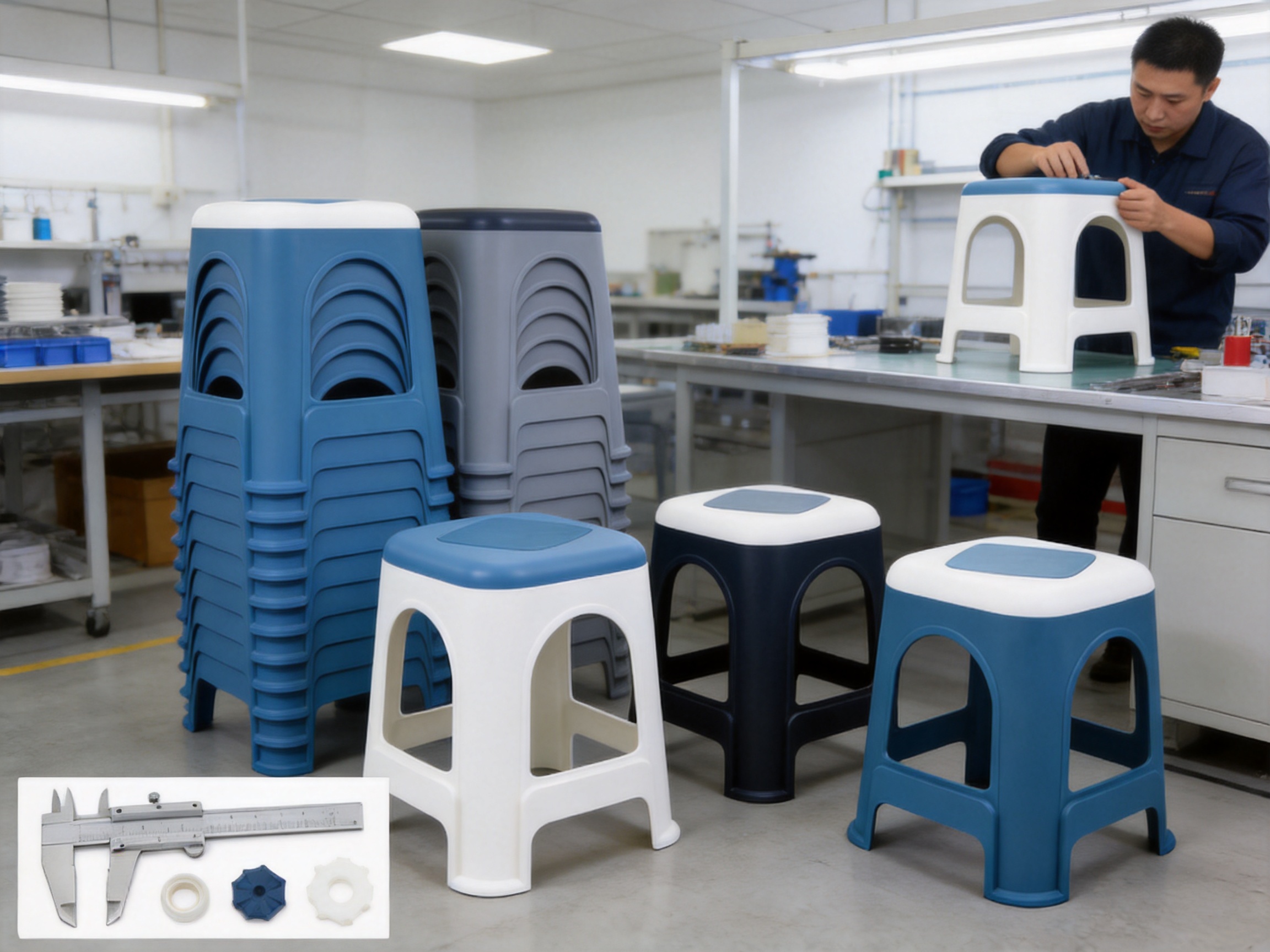
Typical visual checks include color uniformity, surface gloss, texture, flash, sink marks, weld lines, burn marks, flow marks, scratches, and gate appearance. Dimensional checks may include seat width, stool height, leg spacing, stacking clearance, rim thickness, and other critical dimensions.
Functional testing may include static load testing, impact testing, repeated loading, stability testing, stacking tests, and environmental exposure. The correct test method depends on the intended application and applicable market standards.
The customer and mold manufacturer should distinguish between mold-related defects and process-related defects. For example, warpage may be influenced by mold cooling, material shrinkage, injection speed, holding pressure, mold temperature, cooling time, or uneven machine conditions. Effective troubleshooting requires reviewing the entire production system.
11. Maintenance and Mold Life
Regular maintenance helps preserve the performance of Plastic Stool Mold 019. After production, the mold should be cleaned, dried, protected against rust, and inspected for abnormal wear. Cooling channels should be monitored because scale or blockage can reduce cooling efficiency.
Ejector pins, guide components, slides, lifters, and other moving parts should be lubricated according to the manufacturer’s recommendations. Excessive lubrication should be avoided because it may contaminate the product or attract dust.
The parting line should be checked for damage and contamination. Even a small foreign particle can cause flash or prevent proper mold closure. Operators should also monitor unusual noises, increased ejection force, longer cycle times, or changes in product dimensions.
Maintenance records are useful for identifying trends. Recording production cycles, repairs, component replacements, and inspection results allows the owner to plan preventive maintenance rather than waiting for a serious failure.
12. Project Information Buyers Should Prepare
Customers requesting a quotation for Plastic Stool Mold 019 should prepare as much technical information as possible. This allows the mold factory to recommend an accurate structure and provide a more reliable quotation.
Approved 2D drawings and 3D product files, if available.
Target plastic material and any recycled or reinforced content.
Product weight, dimensions, and expected load capacity.
Required surface finish, texture, gloss level, and logo details.
Expected annual production volume and target mold life.
Available injection molding machine information.
Preferred gate location and any restricted visual areas.
Desired delivery date and sampling requirements.
Packaging, spare parts, documentation, and ownership requirements.
Destination country and any applicable product standards.
If some information is not yet available, the customer should explain the current development stage. A professional mold factory can often assist with product refinement, but decisions should be documented before manufacturing begins.
13. Why Experience Matters in Mold Manufacturing
Experience is valuable because injection mold development involves many interconnected decisions. A change to the product wall thickness may affect filling, cooling, ejection, and strength. A change to the gate location may improve appearance but increase weld lines in another area. A change to the rib design may improve stiffness but create sink marks.
A company that has worked with stools, chairs, tables, containers, baskets, boxes, buckets, and other daily-use products is familiar with these trade-offs. It can apply lessons from previous projects while still developing a solution tailored to the new product.
More than 30 years of experience also supports the development of production procedures, inspection habits, supplier coordination, and customer communication practices. These systems help transform a product concept into a mold that can be used in commercial production.
The company’s experience serving customers in the Middle East, Europe, America, Africa, Southeast Asia, and other regions also provides exposure to different product preferences, order structures, technical expectations, and logistics requirements. Export experience can be particularly useful for customers ordering tooling internationally.
14. Sustainability and Lifecycle Value
A durable plastic stool mold can contribute to more efficient use of material and energy. Consistent filling and reduced scrap mean that fewer parts need to be rejected. Stable cycle performance can reduce unnecessary machine operation and improve production planning.
Product lightweighting is another area where mold engineering can contribute to sustainability. By using ribs and optimized structural geometry, designers may be able to reduce material consumption without compromising required performance. Any reduction must be confirmed through practical load and durability testing.
Long mold life also has lifecycle benefits. A mold that remains accurate for many production cycles reduces the need for early replacement and avoids the energy and material associated with repeated tooling manufacture.
Where recycling is part of the product strategy, the mold and process should be developed around the selected recycled material grade. Consistency of the material supply is important because variation can affect color, shrinkage, surface quality, and mechanical properties.
15. Ordering and Communication Process
The ordering process normally begins with an inquiry containing the product drawings, material requirements, target quantity, and machine information. The mold factory reviews the project and may request clarification before preparing a technical proposal.
The proposal may include mold structure, estimated dimensions, recommended steel, runner and gate concept, expected production capacity, trial arrangements, delivery schedule, and commercial terms. The customer should review the proposal carefully and confirm the points that affect future production.
After approval, the factory prepares the detailed mold design. Design approval is a significant milestone because it confirms the product geometry, parting line, ejection concept, cooling arrangement, and other major features before machining.
During production, progress updates may include design confirmation, steel preparation, rough machining, finishing, assembly, first trial, modifications, final trial, and shipment. Clear communication at each stage reduces uncertainty and supports better project control.
16. Frequently Asked Questions
Q1: What type of product is Plastic Stool Mold 019 designed to manufacture?
Plastic Stool Mold 019 is designed for injection molding plastic stools. The final dimensions, structure, surface finish, material, and mold configuration can be customized according to the customer’s product drawings and production requirements.
Q2: Can the mold be customized with a customer logo?
Yes. Logo details may be incorporated into the product design through raised, recessed, engraved, or insert-based features. The proposed logo location should be reviewed for visibility, filling behavior, draft, demolding, and product appearance.
Q3: Which plastic materials can be used?
Common options may include polypropylene, high-density polyethylene, ABS, and other suitable thermoplastics. The final choice depends on the required strength, weight, impact resistance, surface quality, cost, and operating environment. The material should be confirmed before mold design is finalized.
Q4: Can the mold produce different colors?
The mold itself generally produces the shape, while color is controlled through the selected plastic compound, masterbatch, or production process. The mold can normally be used for different colors if the material and processing conditions are compatible.
Q5: How does the factory reduce warpage and sink marks?
The factory addresses these risks through product design review, wall thickness planning, rib optimization, gate positioning, cooling layout, mold-flow considerations, and trial molding. Process settings such as holding pressure and cooling time must also be optimized during production.
Q6: Why is the cooling system important?
The cooling system controls how quickly and evenly the molded stool solidifies. A balanced cooling system can improve cycle efficiency, reduce distortion, support dimensional stability, and help produce more consistent parts.
Q7: Does the mold undergo testing before shipment?
The company has professional injection molding machines for mold testing. Trial molding allows the team to evaluate filling, ejection, surface quality, dimensions, and general mold operation before delivery.
Q8: What information should be sent for a quotation?
Customers should provide product drawings or samples, material information, target production volume, product weight, surface requirements, available machine details, expected mold life, delivery requirements, and any branding or packaging needs.
Q9: Can the mold be designed for a customer’s existing injection machine?
Yes. Machine information should be provided during the design stage. Clamping force, platen dimensions, tie-bar spacing, injection capacity, mold height, ejection stroke, and available water connections can all influence the mold design.
Q10: How long can a plastic stool mold last?
Mold life depends on steel, plastic material, production conditions, maintenance, cycle frequency, product geometry, and required quality level. A specific service-life estimate should be based on the approved design, selected materials, expected production volume, and maintenance plan.
Q11: Can the stool design be changed after mold manufacturing begins?
Changes may be possible, but the cost and schedule impact depend on when the change is requested and how deeply it affects the mold structure. Product changes should therefore be reviewed and approved before steel machining whenever possible.
Q12: Does the company provide after-sales support?
The company provides customized mold services covering design, manufacturing, mold trials, quality inspection, and after-sales support. Specific support arrangements should be confirmed in the commercial and technical agreement.
Q13: Is this mold suitable for export production?
The company exports molds and related products to the Middle East, Europe, America, Africa, Southeast Asia, and other regions. Export requirements, packaging, documents, shipping terms, and destination standards should be discussed for each project.
Q14: How can a buyer compare two mold quotations?
A buyer should compare more than price. Important factors include steel grade, mold structure, expected service life, cavity and core accuracy, cooling design, ejection system, trial policy, inspection standards, spare parts, delivery schedule, warranty terms, and technical support.
Q15: What makes an experienced mold factory valuable?
An experienced factory can identify design risks earlier, coordinate the stages of production, apply practical solutions to filling and ejection problems, conduct internal trials, and support the customer after delivery. This can reduce the total risk and cost of bringing the stool into mass production.
17. Conclusion
Plastic Stool Mold 019 represents a practical tooling solution for manufacturers seeking dependable production of injection molded plastic stools. Its value lies not only in reproducing the stool’s basic shape but also in supporting structural performance, visual consistency, efficient cycle operation, reliable demolding, and long-term serviceability.
The success of a stool mold depends on careful product analysis, accurate mold design, appropriate steel selection, precision machining, balanced cooling, effective ejection, skilled fitting, and thorough trial molding. Each stage contributes to the quality of the final product and the total value of the tooling investment.
Zhejiang Chenghui Mould Co., Ltd. brings more than 30 years of experience, an extensive product range, its own production workshop, 104 advanced processing machines, professional mold testing equipment, and an annual capacity exceeding 1,500 mold sets. These capabilities support the company’s role as a custom plastic injection mold manufacturer for household, furniture, storage, and industrial products.
For wholesalers, distributors, furniture manufacturers, importers, and injection molding companies, the most effective approach is to provide complete product information and discuss technical requirements early. With a clear design, suitable material, appropriate mold structure, and controlled manufacturing process, Plastic Stool Mold 019 can support stable production and create a strong foundation for a competitive plastic seating product.
References
1. General principles of thermoplastic injection molding, including filling, packing, cooling, shrinkage, and ejection control.
2. Design guidance for injection-molded plastic products, including draft angles, wall thickness, ribs, bosses, corners, and parting lines.
3. Mold engineering practices for household furniture products and large daily-use plastic components.
4. Quality control methods for injection molding, including visual inspection, dimensional verification, functional testing, and process monitoring.
5. Material supplier technical data for polypropylene, high-density polyethylene, ABS, and other injection molding thermoplastics.
6. Standard maintenance practices for injection molds, including cleaning, lubrication, corrosion protection, cooling system care, and preventive inspection.
7. Internal company information supplied for Zhejiang Chenghui Mould Co., Ltd., including company history, equipment capacity, product coverage, export markets, and custom mold manufacturing services.