
 Français
 Español
 عربى
Plastic chairs are among the most widely used molded products in the world. They serve homes, schools, offices, restaurants, event venues, public facilities, and outdoor spaces. Although a plastic chair may appear simple, its mold must satisfy demanding requirements related to strength, comfort, dimensional stability, surface appearance, production efficiency, and long service life. A well-designed chair mold directly influences the quality, cost, and commercial success of the finished product.
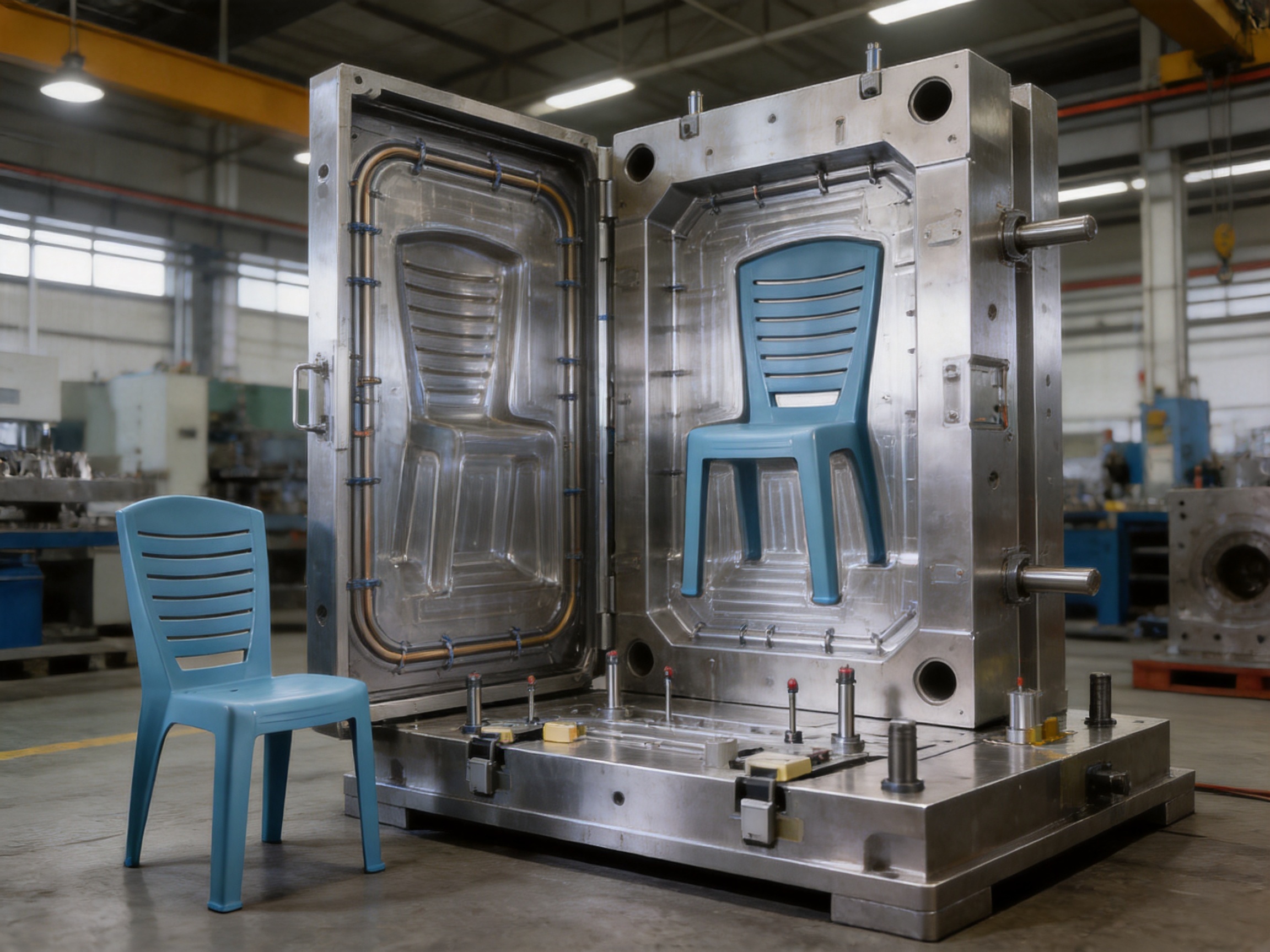
The CHENGHUI Plastic Chair Mold 005 is developed for manufacturers seeking a dependable solution for high-volume plastic chair production. It belongs to the plastic chair injection mold category and is designed to support efficient molding of durable chair components with consistent quality. Its value is not limited to the mold structure itself. The complete solution is supported by professional product analysis, precision machining, controlled assembly, mold trials, inspection, and after-sales service.
For wholesalers, distributors, furniture manufacturers, and brand owners, selecting the right mold supplier is as important as selecting the right mold design. A low-cost mold may create hidden expenses through frequent maintenance, inconsistent parts, flash, warpage, difficult ejection, or excessive cycle times. In contrast, a carefully engineered mold can help manufacturers reduce production interruptions, protect product quality, and maintain stable output over many production cycles.
This article examines the key characteristics, manufacturing advantages, application value, and purchasing considerations associated with an advanced plastic chair injection mold. It also explains how Zhejiang Chenghui Mould Co., Ltd. supports customized OEM and ODM tooling projects through an integrated manufacturing process and more than three decades of industry experience.

CHENGHUI Plastic Chair Mold 005
1. Product Overview
The CHENGHUI Plastic Chair Mold 005 is a custom injection mold intended for the production of plastic chairs and related seating components. It is suitable for manufacturers that require repeatable molding performance, reliable part quality, and a practical path from product concept to mass production.
Plastic chair molds must generally manage large part surfaces, curved contours, reinforcing ribs, ergonomic transitions, and relatively thin wall sections. The mold must also guide molten plastic evenly through the cavity while controlling cooling and shrinkage. These requirements make chair tooling more complex than its simple external appearance may suggest.
A well-engineered chair mold should provide a balanced combination of the following characteristics:
• Stable cavity filling with suitable gate and runner design.
• Effective cooling for consistent cycle times and dimensional control.
• Smooth and reliable ejection without visible damage to the molded chair.
• Adequate support for load-bearing areas and structural ribs.
• Controlled parting lines and reduced risk of flash.
• Appropriate steel selection for the expected production volume.
• Maintainable construction that allows inspection, repair, and replacement of wear components.
• Compatibility with the customer’s selected injection molding machine and production material.
The exact mold configuration can be customized according to the chair design, resin, annual production target, machine parameters, surface requirements, and market positioning. A basic stackable chair, an outdoor chair, a dining chair, and a reinforced commercial chair may require different approaches to gating, ejection, cooling, and mold construction.
2. Why Plastic Chair Mold Quality Matters
The injection mold is the foundation of the chair manufacturing process. Once a mold is completed, it may be used repeatedly to produce thousands or millions of parts. Any design weakness can therefore be multiplied across the entire production run.
For example, an unsuitable gate location can create weld lines in visible or high-stress areas. Poor cooling channel placement can result in uneven shrinkage, warpage, or long cooling times. Insufficient venting can cause burn marks, short shots, or trapped gas. Inadequate ejection support can leave white marks, distortion, or deformation on the molded chair.
These problems affect more than appearance. A warped chair may rock on the floor. A weak backrest may crack during use. A poorly formed joint or rib may reduce load-bearing performance. A rough surface may increase finishing costs or cause customer complaints. When defects occur repeatedly, manufacturers may face higher scrap rates, lower productivity, delayed delivery, and damage to their reputation.
High-quality tooling reduces these risks by addressing product behavior before steel is cut. Mold engineers review the chair geometry, identify potential filling challenges, evaluate wall thickness, study draft angles, plan the parting line, and determine how the chair should be ejected. This preventive approach is generally more effective than correcting defects after mold completion.
3. Main Product Advantages
3.1 Designed for Consistent Chair Quality
The mold is developed around the principle of repeatability. Every production cycle should produce a chair with stable dimensions, consistent surface quality, and predictable structural performance. This is especially important for manufacturers supplying large orders, retail chains, contract furniture projects, or distributors that require uniform products across multiple batches.
Consistency depends on many factors, including cavity accuracy, mold alignment, cooling balance, venting, ejection, and processing conditions. The manufacturing process must therefore combine accurate design with careful machining and assembly. A mold that looks acceptable during a visual inspection may still produce unstable parts if its internal systems are not properly balanced.
3.2 Suitable for High-Volume Production
Plastic chairs are typically produced in large quantities. A mold designed for high-volume use should be capable of repeated operation without excessive downtime or frequent corrective work. Mold components must be manufactured accurately, assembled correctly, and tested under realistic molding conditions.
High-volume suitability also depends on maintainability. Wear parts, ejector components, guide systems, sliders, inserts, and other functional elements should be arranged so that maintenance can be performed efficiently. A maintainable mold helps production teams shorten service intervals and reduce the impact of unexpected stoppages.
3.3 Support for Customized Chair Designs
Chair products vary significantly in shape and application. Customers may request different backrest patterns, leg structures, armrests, surface textures, stackability features, reinforcing ribs, or decorative details. A professional mold manufacturer must be able to convert these requirements into a practical tooling solution.
Customization may include the complete chair, individual chair parts, or a family of related components. The mold can be planned around the customer’s product drawings, samples, three-dimensional data, or early-stage concept. When the design is not fully developed, the mold supplier can contribute engineering suggestions related to draft, wall thickness, rib design, gate location, and production feasibility.
3.4 Improved Surface and Appearance Control
The appearance of a plastic chair influences its perceived value. Smooth surfaces, clean edges, uniform texture, and controlled gloss are important for both household and commercial products. Mold surface preparation and finishing must therefore match the chair’s design intent.
Depending on the product requirements, the cavity may require polishing, texturing, etching, or a combination of surface treatments. The selected finish must be applied consistently across the relevant areas. Particular attention is needed around visible surfaces, curved transitions, logo areas, and regions near the parting line or ejector locations.
3.5 Reduced Risk of Defects
Injection molding defects can arise from both mold and process conditions. A professional mold design helps reduce common problems such as short shots, sink marks, weld lines, flash, burn marks, distortion, uneven gloss, and ejection marks.
It is important to recognize that no mold can eliminate every defect under every processing condition. Resin type, moisture level, melt temperature, injection speed, holding pressure, cooling time, machine condition, and operator settings all affect the final part. However, good tooling gives the production team a stable foundation and a wider process window.
3.6 Practical Balance Between Performance and Cost
The most expensive mold is not automatically the best mold, and the lowest quoted price is rarely the lowest total cost. A practical tooling solution considers the required production volume, expected mold life, chair complexity, maintenance needs, cycle-time targets, and acceptable level of automation.
Chenghui Mould’s customized approach helps match the mold structure to the customer’s actual requirements. For a moderate-volume chair, the mold may be optimized for reasonable investment and straightforward maintenance. For a high-volume product, more durable materials, enhanced cooling, replaceable inserts, or additional automation features may be justified.
4. Product Design Considerations
4.1 Chair Geometry and Moldability
The first stage of successful tooling is understanding the chair geometry. A chair may contain broad surfaces, deep contours, narrow ribs, hollow sections, undercuts, and intersecting structural features. These details influence the parting line, cavity layout, mold opening direction, core construction, and ejection method.
Draft angles are essential for allowing the molded chair to release from the cavity and core. If the draft is too small, the part may drag against the steel, become scratched, or require excessive ejection force. If the draft is increased without considering appearance, it may change the product design. Engineers must therefore balance release performance with the customer’s visual and functional requirements.
Ribs and bosses should also be reviewed carefully. They provide stiffness and support but may create sink marks or localized shrinkage if they are too thick. A sound design generally uses appropriate rib proportions and transitions so that the chair obtains structural strength without producing unacceptable surface defects.
4.2 Gate and Runner Planning
The gate is the point where molten plastic enters the cavity. Its position affects filling balance, weld-line location, packing, appearance, and the ease of gate removal. Large chair parts require careful flow analysis because the melt may need to travel across broad surfaces and around complex structural details.
Depending on the design and production requirements, the tooling solution may use different gate arrangements. The final choice can be based on resin behavior, part geometry, cosmetic expectations, machine capacity, and desired cycle time. In some applications, a hot runner may help reduce runner waste and improve process control. In other applications, a cold runner may offer a simpler and more economical structure.
Gate design should be considered together with venting and cooling. A good filling plan is not effective if trapped air cannot escape or if the filled region cannot cool evenly. Integrated analysis helps reduce the need for repeated modifications after the first mold trial.
4.3 Cooling System Design
Cooling is one of the most important factors in chair injection molding. Plastic must remain in the mold long enough to solidify sufficiently for ejection, but excessive cooling time reduces productivity. Uneven cooling can create differential shrinkage and deformation.
Cooling channels should be arranged to serve the main cavity and core surfaces as evenly as practical. Large flat areas, thick intersections, legs, armrests, and backrest structures may require special attention. The cooling design must also respect the mold’s mechanical structure so that channels do not weaken critical areas or interfere with inserts and moving components.
Effective cooling can help stabilize cycle time, improve dimensional consistency, and reduce warpage. It can also support more predictable production planning because the manufacturer can operate closer to a repeatable process window.
4.4 Ejection System
The ejection system must remove the molded chair without causing cracks, whitening, distortion, or visible marks in unacceptable locations. Since chairs often have large surfaces and structural ribs, ejection force should be distributed carefully.
Ejector pins, sleeves, lifters, stripper structures, or other mechanisms may be selected according to the chair’s geometry. The system should provide sufficient contact area while avoiding thin or cosmetically sensitive regions. Ejection timing and mold-opening sequence are also important, especially when the chair includes deep features or areas that may grip the core.
A reliable ejection system improves automation potential. When the part releases cleanly and consistently, it is easier to use conveyors, robotic take-out equipment, or other production aids. This can reduce manual handling and improve workplace efficiency.
4.5 Venting and Air Management
Air trapped inside the cavity can cause incomplete filling, burn marks, gas marks, or surface imperfections. Large chair molds often require careful venting at the end of the flow path, around ribs, near deep pockets, and in areas where air may become compressed.
Vents must be designed to allow air and gas to escape while minimizing the risk of flash. Their dimensions and locations depend on the resin, injection conditions, surface requirements, and mold structure. Venting should also be reviewed after mold trials because actual filling behavior may reveal areas requiring adjustment.
5. Advanced Manufacturing Process
Zhejiang Chenghui Mould Co., Ltd., also known as Chenghui Mould or CH Mould, has more than 30 years of experience in mold design and manufacturing. Founded in 1994, the company focuses on injection molds for daily necessities, household products, furniture, storage products, and industrial applications.
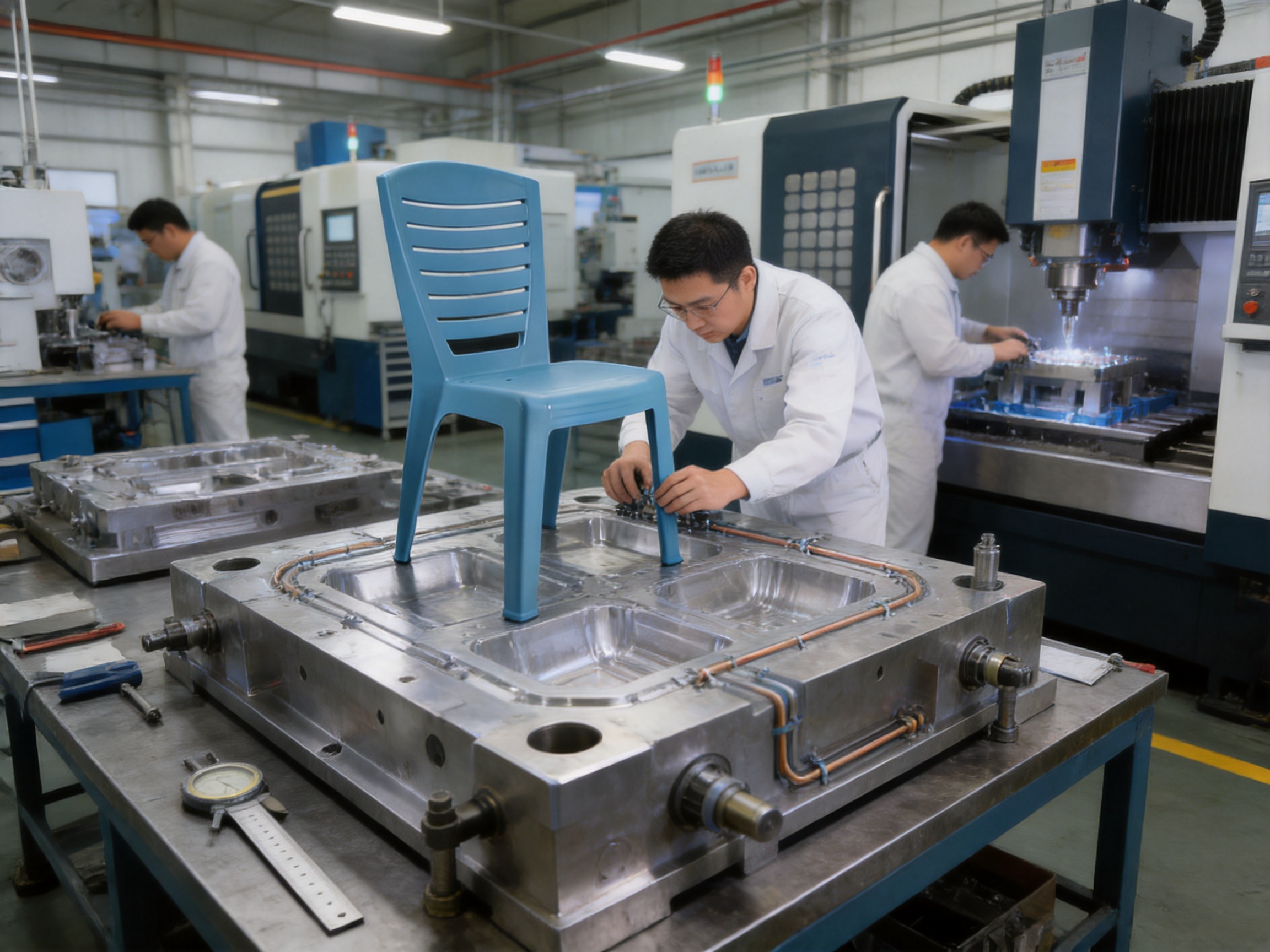
The company operates its own production workshop and has 104 advanced processing machines. It also has professional injection molding machines for mold testing. This combination supports a coordinated workflow from engineering development to machining, assembly, trial molding, inspection, and delivery.
5.1 Product and Requirement Review
Each project begins with a review of the customer’s product requirements. Engineers consider the chair’s intended use, material, dimensions, appearance, production volume, target machine, expected delivery schedule, and quality standards.
During this stage, the team may identify potential design risks. Examples include insufficient draft, excessively thick sections, difficult undercuts, unfavorable gate positions, limited cooling access, or ejection locations that may affect appearance. Resolving these concerns before machining can save time and reduce the need for expensive modifications later.
5.2 Three-Dimensional Mold Design
After product requirements are clarified, the mold structure is developed in three dimensions. The design typically includes the cavity, core, parting line, runner system, gates, cooling channels, guide components, ejection system, inserts, sliders, and mold base.
Three-dimensional design allows engineers to inspect the relationship between the product and the tooling. It helps identify interference, confirm opening and closing movements, check accessibility for machining, and evaluate maintenance requirements. The design can also support discussion with the customer before production begins.
5.3 Mold Flow and Filling Analysis
For larger or more complex chair designs, flow analysis can provide useful insight into filling behavior. It may help estimate the filling sequence, identify potential weld-line positions, observe pressure distribution, and locate areas that may require improved venting or modified gating.
Analysis does not replace practical engineering experience, but it strengthens decision-making. The results can be used to compare alternative gate locations, runner concepts, or cooling arrangements. This is particularly valuable for a chair with large visible surfaces or strict appearance requirements.
5.4 Precision Material Preparation
Material selection influences mold life, performance, maintenance, and final cost. Mold steel and component materials should be matched to the expected production volume, resin characteristics, cavity pressure, surface requirements, and customer budget.
Steel preparation includes cutting, rough machining, heat treatment where applicable, and finish machining. The material must be handled carefully to maintain dimensional stability. Proper preparation reduces the possibility of distortion or inconsistency during later machining and assembly stages.
5.5 CNC Machining
CNC machining is used to produce accurate cavity, core, mold base, and component features. Modern machining equipment supports controlled cutting paths and repeatable dimensional results. For a chair mold, CNC work may include large curved surfaces, structural recesses, rib details, parting surfaces, and mounting features.
Machining strategy is important because the chair cavity may contain both broad surfaces and detailed transitions. Rough machining removes material efficiently, while semi-finishing and finishing operations gradually improve accuracy and surface quality. Tool selection, cutting parameters, workholding, and inspection are coordinated to reduce errors.
5.6 Electrical Discharge Machining
Electrical discharge machining can be used for deep, narrow, or difficult-to-cut features. It is useful when conventional cutting tools cannot easily reach a geometry or when a controlled surface is needed in a specific area.
EDM operations must be integrated with the overall mold design. Electrodes are prepared according to the required cavity details, and the process is monitored to reduce dimensional deviation. Proper EDM planning contributes to accurate ribs, slots, corners, and other complex features.
5.7 Wire Cutting and Component Processing
Wire cutting supports the accurate production of inserts, precision plates, and other components with defined profiles. It may be used where tight fit, clean geometry, or repeatable alignment is required.
Different processing methods are selected according to the specific feature. Using the appropriate equipment for each operation helps improve efficiency while protecting accuracy. Chenghui Mould’s broad equipment base allows the production team to coordinate multiple machining requirements within its own workshop.
5.8 Surface Finishing and Polishing
Surface finishing directly influences the appearance of the chair. Polishing must be controlled carefully because over-polishing may alter a corner or dimension, while insufficient finishing may leave machining marks or uneven texture.
The required finish depends on the customer’s product design. Some chairs may require a smooth glossy surface, while others may use a matte texture or patterned finish. The mold surface is prepared to match the intended product appearance and to support consistent reproduction during injection molding.
5.9 Mold Assembly
Assembly brings together the machined components, guide systems, ejector mechanisms, cooling circuits, inserts, fasteners, and other elements. Assembly accuracy is essential. Even small alignment errors may affect parting-line quality, movement, ejection, or mold life.
During assembly, technicians inspect component fit, sliding movement, ejector travel, cooling connections, and mold-opening action. Moving systems should operate smoothly without excessive looseness or binding. Fixed components must be secured correctly, and functional clearances must remain within the intended range.
5.10 Trial Molding and Correction
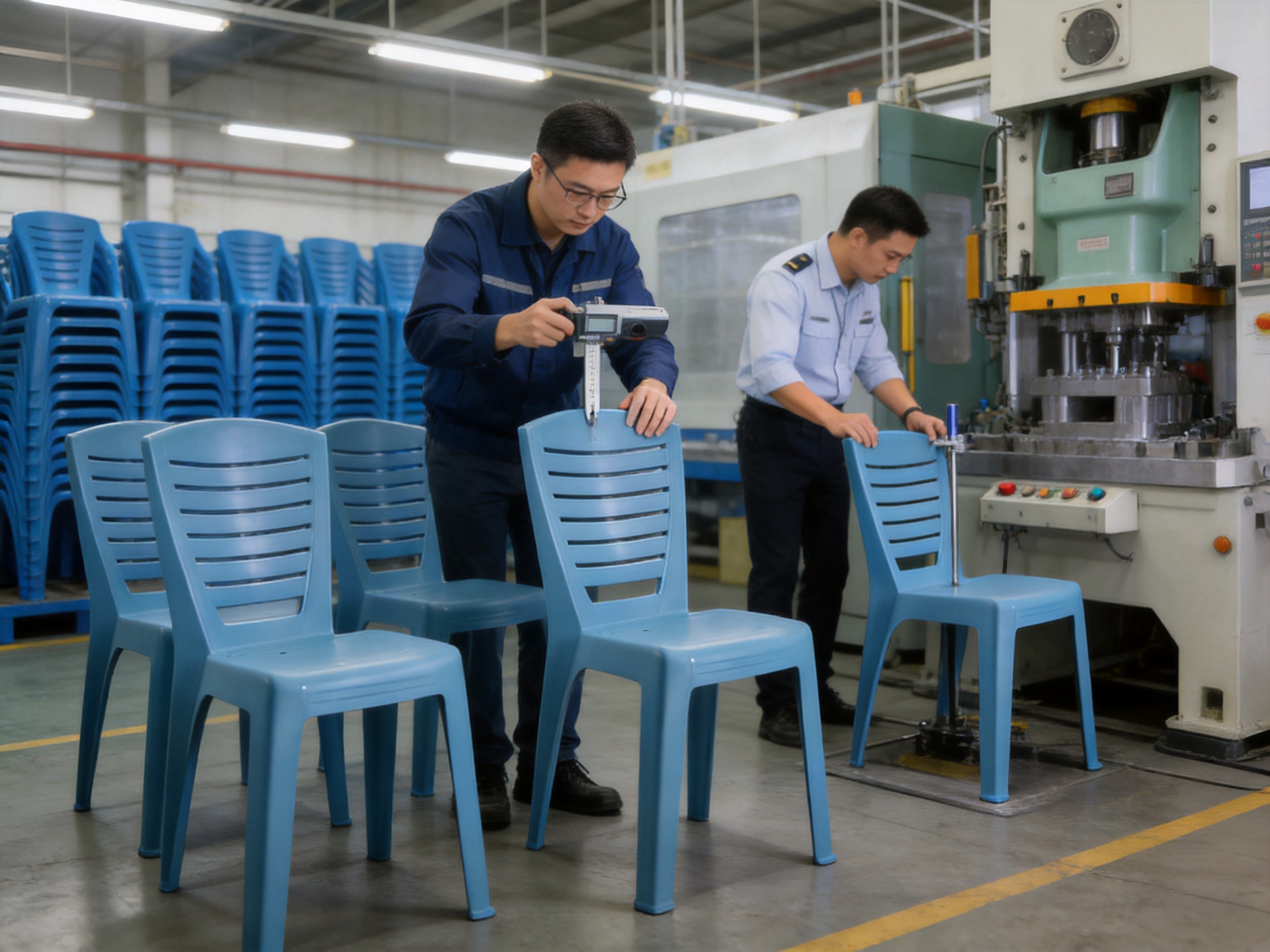
Trial molding is a critical step before final delivery. The assembled mold is installed on a suitable injection molding machine and used to produce sample parts. Engineers and technicians examine filling behavior, part release, dimensions, surface quality, flash, weld lines, sink marks, and cycle performance.
If an issue is identified, the team evaluates whether the cause relates to mold geometry, processing conditions, material behavior, or machine settings. Corrective work may include polishing, vent adjustment, gate refinement, ejection modification, cooling improvement, or controlled steel correction.
The purpose of trial molding is not merely to produce a sample. It is to verify that the mold can support practical production. A mold that works only under unusually narrow settings may create difficulties for the customer. Trial evaluation therefore helps improve the stability and usability of the final tooling solution.
6. Quality Management and Inspection
Quality management must continue throughout the mold manufacturing process rather than being limited to the final inspection. Chenghui Mould uses standardized processes and strict quality management to support accurate, reliable, and production-ready molds.
6.1 Dimensional Inspection
Machined components are checked against design data and manufacturing requirements. Inspection may include the mold base, cavity, core, inserts, ejector plates, guide systems, and other critical components. Dimensional control helps confirm that the mold will close accurately and reproduce the intended chair geometry.
6.2 Fit and Movement Inspection
Fixed and moving components are checked for proper fit. Sliders, lifters, ejectors, guide pillars, guide bushes, and other mechanisms must move smoothly and return to their correct positions. Poor movement may increase wear, create uneven loading, or cause production stoppages.
6.3 Cooling and Leakage Inspection
Cooling circuits are inspected for correct connection, flow, and leakage resistance. A damaged or blocked circuit can reduce cooling efficiency and create inconsistent molding conditions. Proper inspection helps protect both mold performance and production equipment.
6.4 Mold Trial Evaluation
Trial parts are reviewed for dimensions, appearance, ejection marks, flash, warpage, filling completeness, and structural details. Where necessary, multiple trial rounds may be used to confirm improvements and establish more stable processing conditions.
6.5 Documentation
Clear documentation supports future maintenance and production. Useful records may include mold drawings, component information, trial findings, recommended processing notes, inspection results, and modification history. Good documentation helps the customer’s production and maintenance teams manage the mold throughout its service life.
7. Comparison with Lower-Quality or Less Specialized Tooling
Customers often compare molds primarily by quotation price. However, a meaningful comparison should consider the complete cost of ownership and the production risks associated with each supplier.
| Evaluation Factor | Advanced Chair Mold Solution | Basic or Poorly Engineered Tooling |
|---|---|---|
| Product consistency | Designed for stable dimensions and repeatable appearance | May show variation between cycles or production batches |
| Cooling performance | Planned around geometry and cycle requirements | May have uneven cooling or insufficient capacity |
| Ejection reliability | Distributed ejection with attention to part protection | Higher risk of marks, distortion, or sticking |
| Maintenance | Components are arranged for inspection and service | Repair may require extensive disassembly or modification |
| Surface quality | Finishing is matched to the chair’s appearance requirements | Visible machining marks, inconsistent texture, or flash may occur |
| Production support | Includes design review, trial molding, inspection, and technical communication | Support may end after basic mold delivery |
| Long-term cost | Higher initial engineering value can reduce scrap and downtime | Lower purchase price may be offset by repairs and unstable output |
This comparison does not mean that every economical mold is unsuitable. A properly specified basic mold may be appropriate for a limited production project. The important point is that the tooling structure should match the customer’s actual requirements. A professional manufacturer helps define that match instead of applying the same solution to every project.
8. Application Areas
The plastic chair mold can support multiple market segments where durable, repeatable, and cost-effective seating products are needed.
8.1 Household Furniture
Residential chairs are used in dining rooms, kitchens, balconies, gardens, and multipurpose areas. Household products often require attractive surfaces, comfortable contours, easy cleaning, and reliable daily performance.
8.2 Restaurants and Cafés
Commercial seating must withstand frequent use, repeated movement, cleaning, and exposure to different environments. Molded plastic chairs can provide a practical combination of light weight, durability, and design flexibility.
8.3 Schools and Public Facilities
Schools, training centers, community facilities, and public venues often require large quantities of standardized chairs. Dimensional consistency is important because chairs may be stacked, arranged in rows, or used with matching furniture.
8.4 Events and Rental Furniture
Event and rental companies value chairs that are easy to transport, stack, clean, and store. Mold design can support features such as nesting or stacking, provided these functions are incorporated into the product design from the beginning.
8.5 Outdoor and Semi-Outdoor Use
Outdoor chairs may require suitable resin selection, UV resistance, drainage details, and structural reinforcement. The mold can be customized to support these product requirements, although final outdoor performance also depends on material formulation and manufacturing conditions.
9. Material and Processing Considerations
The appropriate plastic material depends on the chair’s use, cost target, impact requirements, environmental exposure, appearance, and regulatory needs. Common choices for molded seating products may include polypropylene, reinforced polypropylene, certain engineering plastics, or other suitable thermoplastics.
Material selection should be discussed before mold design is finalized because different resins behave differently during filling, cooling, shrinkage, and ejection. A material with higher shrinkage may require different dimensional compensation. A reinforced material may increase wear on the mold and influence gate design. A material intended for outdoor use may require additives that affect processing behavior.
Manufacturers should also control resin storage and preparation. Moisture-sensitive materials may require drying. Recycled content may vary in flow behavior, color, and contamination level. Stable material management helps the mold perform consistently and makes trial results more meaningful.
Processing conditions should be established during mold testing and refined at the customer’s production site. Injection speed, melt temperature, mold temperature, holding pressure, cooling time, and back pressure must be adjusted according to the resin and machine. The mold supplier can provide technical recommendations, but final settings should be validated using the customer’s actual equipment and material.
10. Company Manufacturing Strengths
Chenghui Mould has been engaged in mold design and manufacturing since 1994. More than 30 years of experience provides a broad understanding of daily-use plastic products, including the practical challenges associated with large molded components and high-volume production.
The company’s product experience extends beyond chairs. Its capabilities include molds for PET storage products, tables, furniture, storage boxes, turnover boxes, laundry baskets, buckets, storage racks, trash cans, and other household and industrial products. This broad product range is valuable because many design and manufacturing principles are shared across different injection-molded products.
With an annual production capacity of more than 1,500 mold sets, the company is structured to support both individual projects and ongoing customer programs. Its own production workshop allows greater coordination of machining, assembly, and testing. The presence of professional injection molding machines for mold trials supports more practical verification before shipment.
The company also serves customers in the Middle East, Europe, America, Africa, Southeast Asia, and other regions. International experience can help the supplier understand the importance of communication, documentation, packaging, delivery coordination, and after-sales support for overseas projects.
10.1 Integrated Project Support
Chenghui Mould provides services covering concept review, drawing development, sample development, machining, assembly, mold trials, quality inspection, and after-sales support. This integrated structure reduces the need for customers to coordinate multiple unrelated suppliers.
When one experienced team manages the tooling process, design changes can be communicated more efficiently between engineering, machining, assembly, and trial departments. It also becomes easier to trace the cause of a problem and implement a coordinated correction.
10.2 Focus on Precision and Reliability
The company’s stated manufacturing principles emphasize precision, integrity, customer commitment, skilled craftsmanship, advanced manufacturing, and continuous improvement. These principles are particularly relevant to plastic chair molds because the products must combine large-scale geometry with reliable production performance.
Precision is important for part dimensions and alignment. Integrity is important for transparent communication about design risks, lead times, and production conditions. Customer commitment is important when a project requires multiple rounds of development or technical support after delivery.
11. Benefits for Wholesalers and Distributors
Wholesalers and distributors may not operate the molding machine themselves, but the mold’s quality still affects their commercial results. A reliable mold helps their manufacturing partners maintain stable supply, consistent appearance, and predictable delivery.
Consistent chair dimensions make it easier to manage product sets and replacement orders. Stable surface quality helps maintain a uniform catalog presentation. Reduced scrap and downtime can support more competitive pricing. A mold designed for repeatable output also lowers the risk of receiving mixed-quality batches from different production periods.
Distributors should consider whether the supplier can support product customization. Private-label customers may require specific colors, textures, logos, dimensions, or packaging formats. A flexible mold manufacturer can help create a product that is differentiated from standard market offerings.
Long-term supplier communication is also important. A distributor may need repeat molds, revised versions, replacement inserts, or technical assistance when market demand changes. A company with a broad manufacturing base and after-sales process can be a more dependable partner than a supplier focused only on one-time transactions.
12. Benefits for OEM and ODM Customers
OEM customers typically provide product requirements and expect the mold manufacturer to produce tooling that supports their branded product. ODM customers may seek more design participation, engineering recommendations, or a complete development solution.
For both models, early communication is essential. The customer should provide the intended chair use, product drawings or references, target material, annual quantity, surface expectations, machine information, and delivery requirements. The mold supplier can then recommend a suitable structure and identify any necessary product modifications.
An effective OEM or ODM process should include clear approval points. These may cover product design, mold design, steel selection, gate location, appearance finish, trial samples, and final inspection. Written confirmation at each stage helps reduce misunderstandings and protects the project schedule.
13. Mold Maintenance and Service Life
Even a well-manufactured mold requires proper maintenance. Regular cleaning, lubrication, inspection, and cooling-system care can significantly influence service life and production stability.
After production, the mold should be cleaned to remove resin residue, dust, oil contamination, and moisture. Moving components should be lubricated according to the supplier’s recommendations. The parting surface should be checked for damage, and the cooling circuits should be monitored for blockage or corrosion.
Production teams should record abnormal events such as sticking, sudden flash, unusual noise, incomplete ejection, cooling leakage, or dimensional drift. Early reporting allows maintenance personnel to investigate before a minor issue becomes major damage.
Storage conditions are also important. When the mold will not be used for an extended period, it should be protected against corrosion and stored in a suitable environment. The cavity and core surfaces should be treated appropriately, and the mold should be secured to prevent accidental opening or impact.
A maintainable mold design supports these activities by providing access to key components and allowing worn parts to be replaced. This is one reason that long-term production planning should be discussed during the original tooling project.
14. How to Evaluate a Plastic Chair Mold Supplier
Before placing an order, buyers should evaluate more than product photographs or a single quotation. The following questions can help identify whether a supplier is suitable for a demanding chair mold project.
Does the supplier have experience with large household or furniture molds?
Can the supplier review product design and provide moldability recommendations?
Does the supplier operate its own machining and assembly workshop?
What equipment is available for precision machining and mold testing?
How does the supplier manage dimensional inspection and trial molding?
Can the supplier support customized surface textures and product details?
How are design changes communicated and approved?
What documentation will be provided with the completed mold?
What after-sales support is available if the customer encounters a production issue?
Does the supplier understand the target market, production volume, and expected mold life?
Chenghui Mould is positioned to address these requirements through its experience, equipment, production capacity, mold testing resources, and integrated service process.
15. Recommended Project Workflow
A clear workflow helps control quality, cost, and schedule. The following sequence is suitable for many custom plastic chair mold projects.
Step 1: Define the Product
Provide the chair drawing, three-dimensional data, sample, or concept information. Confirm dimensions, intended application, material, surface finish, color, structural requirements, and packaging expectations.
Step 2: Confirm Production Targets
Discuss estimated annual quantity, expected mold life, injection machine specifications, preferred cycle time, automation level, and acceptable investment range.
Step 3: Complete Moldability Review
Review draft angles, wall thickness, ribs, bosses, parting lines, gates, sliders, lifters, cooling, ejection, and potential appearance risks. Make product changes before final mold design whenever possible.
Step 4: Approve the Mold Design
Review the three-dimensional mold structure and confirm the major technical details. Approval should include cavity arrangement, runner system, gate location, ejection method, surface finish, and material plan.
Step 5: Manufacture the Tooling
Proceed with material preparation, rough machining, heat treatment where required, CNC finishing, EDM, wire cutting, polishing, texturing, component fitting, and assembly.
Step 6: Conduct Trial Molding
Produce sample chairs and inspect filling, dimensions, appearance, ejection, cooling, flash, warpage, and cycle performance. Record the trial conditions and findings.
Step 7: Complete Corrections
Address any verified problems through processing adjustment or controlled mold modification. Repeat testing when necessary.
Step 8: Final Inspection and Delivery
Confirm mold operation, sample quality, documentation, packaging, and shipping arrangements. Provide the customer with appropriate maintenance and production information.
16. Q&A
Q1: What type of product is the CHENGHUI Plastic Chair Mold 005 used for?
It is a plastic chair injection mold designed for producing molded plastic chair products or chair components. The final configuration can be customized according to the chair design, material, machine, production quantity, and surface requirements.
Q2: Can the mold be customized for a new chair design?
Yes. Customization is a central part of the service. Customers can provide drawings, three-dimensional files, samples, or product concepts. Engineers can review the design and recommend changes related to draft, wall thickness, ribs, gating, cooling, and ejection.
Q3: What plastics can be used with the mold?
The suitable material depends on the product design and application. Common chair materials may include polypropylene and other thermoplastics. The material should be confirmed before the mold is finalized because resin shrinkage, flow behavior, reinforcement, and wear characteristics affect tooling design.
Q4: Is the mold suitable for mass production?
The mold is developed for reliable injection molding and can be specified for the customer’s expected production volume. Durability, cooling, component design, maintenance access, and steel selection should be matched to the required number of production cycles.
Q5: How does a chair mold reduce warpage?
Warpage can be influenced by balanced filling, suitable wall thickness, effective cooling, appropriate material selection, and stable processing conditions. A professional mold design addresses these factors together, but final results also depend on the injection machine and production settings.
Q6: What is the purpose of mold trial molding?
Trial molding verifies whether the assembled mold can produce acceptable parts under practical conditions. It allows the team to inspect filling, dimensions, surface quality, ejection, flash, weld lines, warpage, and cycle behavior before final delivery.
Q7: Does the manufacturer provide after-sales support?
Yes. Chenghui Mould provides after-sales support as part of its customized mold manufacturing service. Technical communication can assist with production issues, maintenance questions, and future tooling requirements.
Q8: What information should a buyer provide for a quotation?
Useful information includes product drawings or samples, chair dimensions, material, annual production target, expected mold life, injection machine information, surface finish, delivery expectations, and any special requirements such as stacking, outdoor use, logos, or textures.
Q9: Why should buyers consider the supplier’s manufacturing equipment?
Equipment affects machining accuracy, efficiency, and the ability to produce complex mold features. A supplier with its own workshop and appropriate processing equipment can coordinate production more effectively and maintain better control over the tooling process.
Q10: How long can a plastic chair mold last?
Mold life depends on steel selection, chair material, production conditions, maintenance, cycle requirements, and the quality of component design and manufacturing. The expected service life should be discussed with the supplier before the project begins.
Q11: Can the mold include textured surfaces?
Yes. Surface texture can be incorporated according to the chair’s appearance requirements. The desired texture, gloss, or matte effect should be confirmed during the design and finishing stages.
Q12: What makes an advanced mold different from a low-cost mold?
An advanced mold is supported by more complete engineering analysis, stronger process control, better cooling and ejection planning, accurate machining, trial molding, inspection, and after-sales support. The difference may be reflected in more stable production, lower scrap, easier maintenance, and improved long-term value.
17. Conclusion
The CHENGHUI Plastic Chair Mold 005 is a practical tooling solution for manufacturers that need reliable and repeatable plastic chair production. Its value comes from the combination of product-focused engineering, precision manufacturing, mold testing, quality inspection, and customized project support.
Plastic chair production involves more technical challenges than may be visible in the finished product. Large surfaces, curved geometry, structural ribs, appearance requirements, cooling behavior, and ejection reliability must all be considered before and during mold manufacturing. A carefully planned mold helps manufacturers improve part consistency, reduce production risks, and build a stronger foundation for long-term output.
Zhejiang Chenghui Mould Co., Ltd. brings more than 30 years of experience to this process. With its own workshop, 104 advanced processing machines, professional mold-testing injection machines, annual capacity of more than 1,500 mold sets, and experience serving international markets, the company is equipped to support customized OEM and ODM tooling projects.
For furniture manufacturers, wholesalers, distributors, and brand owners, the most effective purchasing decision is based on total production value rather than initial price alone. A mold that is accurate, maintainable, properly tested, and supported by an experienced manufacturer can contribute to lower operating risk and more reliable product delivery.
When the chair design, resin, production target, machine, and quality expectations are clearly communicated, the mold can be developed as a complete manufacturing solution rather than as an isolated steel tool. This approach gives customers a stronger path from product concept to stable mass production.
References
1. General principles of thermoplastic injection molding and mold design.
2. Standard practices for plastic product draft, rib, gate, cooling, and ejection design.
3. Industrial guidelines for mold steel selection, machining, assembly, and maintenance.
4. Quality control practices for injection mold inspection and trial molding.
5. Manufacturer-provided company information regarding plastic injection mold production, equipment, capacity, product categories, and international service experience.