
 Français
 Español
 عربى
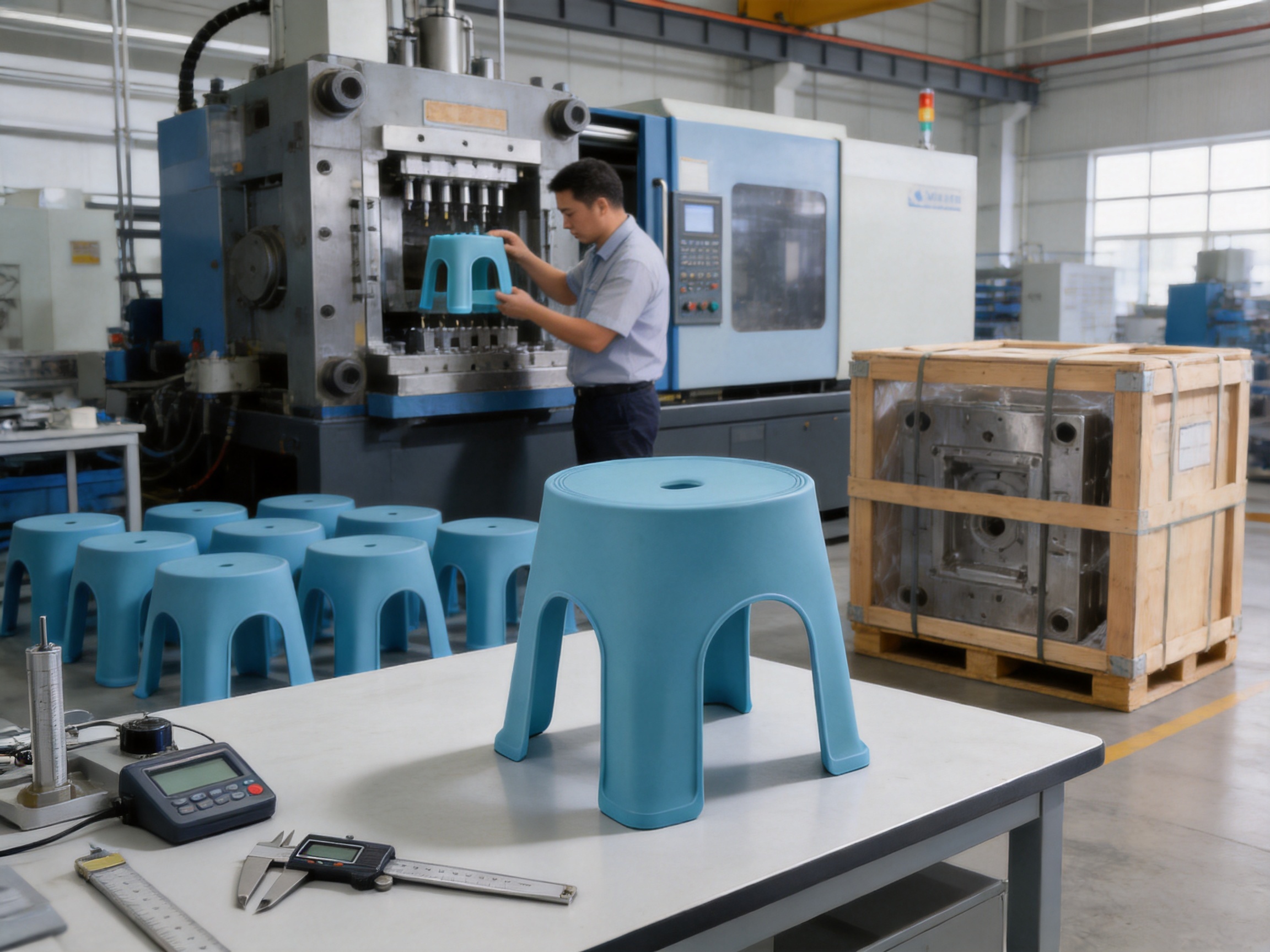
Plastic stools are simple-looking products that require careful engineering at every stage of mold development. A stool must support weight, remain stable on different floors, resist repeated use, and maintain a clean appearance after thousands or millions of molding cycles. For manufacturers, wholesalers, distributors, and household product brands, the quality of the injection mold directly influences production efficiency, product consistency, surface appearance, and total operating cost.
The Plastic Stool Mold 016 is designed for manufacturers seeking a dependable tooling solution for plastic stool production. It is supplied by Zhejiang Chenghui Mould Co., Ltd., an experienced China-based injection mold manufacturer serving the houseware and industrial product sectors. The company has operated since 1994 and specializes in molds for daily necessities, furniture, storage products, containers, and other plastic articles.
This article explains the value of the Plastic Stool Mold 016, the manufacturing capabilities behind it, the technical factors that influence stool mold performance, and the reasons a specialized mold factory can provide advantages over less experienced tooling suppliers. It also describes the mold development process, quality control practices, testing procedures, customization options, and purchasing considerations for international customers.
Why Plastic Stool Mold Quality Matters
A plastic stool is exposed to loads, impacts, friction, environmental changes, and frequent handling. Although the finished part may contain relatively few visible components, its mold must create accurate geometry throughout the seat, legs, support ribs, joints, edges, and underside structures. Small errors in these areas can result in rocking, uneven wall thickness, sink marks, warpage, short shots, weld lines, flash, or difficult ejection.
For a buyer, the mold is not simply a tool used to form plastic. It is a long-term production asset. A well-designed mold can support stable cycle times, lower rejection rates, predictable maintenance, and consistent product dimensions. A poorly designed mold can create recurring production problems that continue throughout the life of the tooling.
The Plastic Stool Mold 016 addresses the need for controlled, repeatable production of molded stools. Its value lies not only in the steel structure but also in the engineering process used to convert a product concept or drawing into reliable production tooling. Mold design, steel selection, cooling, gating, ejection, machining accuracy, assembly, trial molding, and inspection must work together.
For distributors and wholesalers, consistent molding quality is particularly important. A stool that varies from batch to batch may create complaints from retailers or end users. Differences in color, gloss, dimensions, flatness, and structural strength can make products appear unreliable even when the basic design remains unchanged. A stable mold helps protect the buyer’s product reputation and reduces unnecessary quality disputes.
Product Overview: Plastic Stool Mold 016
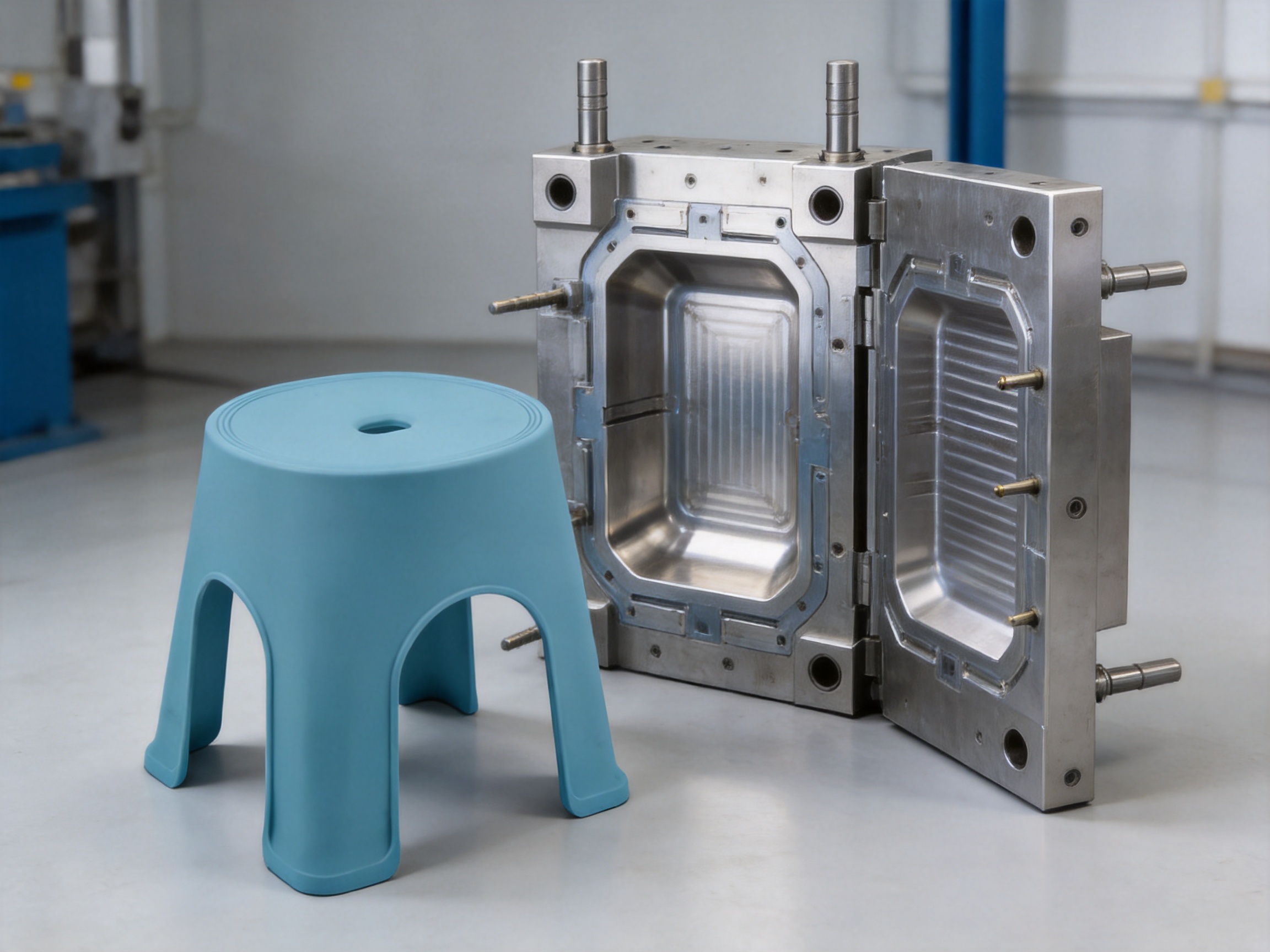
The Plastic Stool Mold 016 belongs to the plastic stool mold category within the broader houseware and industrial and logistics mold sectors. It is intended for injection molding applications in which molten thermoplastic material is injected into a precision-machined cavity and core, cooled under controlled conditions, and ejected as a finished stool component or complete molded product, depending on the confirmed tooling configuration.
The product can be developed for customers requiring original equipment manufacturing or original design manufacturing support. This makes it suitable for buyers who already have a stool drawing and need production tooling, as well as customers who need assistance refining a concept for manufacturability. Final technical specifications, including cavity arrangement, mold dimensions, steel grades, runner configuration, gate position, ejection system, and compatible injection machine, should be confirmed during project engineering.
A stool mold must balance several competing requirements. The cavity must reproduce the visible outer surfaces accurately, while the core must form the underside and internal support structures. The mold must provide sufficient cooling around areas with different wall thicknesses. It must also allow the finished part to release without distortion. If a stool includes deep legs, reinforcing ribs, anti-slip details, or complex underside features, the mold design may require special attention to draft angles, lifters, sliders, inserts, or other mechanisms.
The Plastic Stool Mold 016 can therefore be viewed as a production platform rather than a one-size-fits-all commodity tool. The exact configuration can be adjusted according to the customer’s stool design, resin selection, annual output, appearance requirements, and target injection molding equipment.

CHENGHUI Plastic Stool Mold 016
Key Advantages of the Plastic Stool Mold 016
Production-Oriented Tooling Design
One of the most important advantages of a professional stool mold is that it is designed for production rather than only for sample creation. A sample mold may produce an acceptable first article but still suffer from slow cycles, difficult ejection, poor cooling, or high maintenance requirements. Production tooling must remain stable across repeated use and support a practical manufacturing workflow.
For the Plastic Stool Mold 016, production-oriented development includes consideration of material flow, cavity filling, cooling balance, ejection reliability, parting-line visibility, mold strength, and access for future maintenance. These factors help manufacturers move from initial approval to sustained mass production with fewer interruptions.
Consistent Part Quality
Consistent part quality is a major advantage when compared with low-cost molds made without sufficient engineering analysis or process control. Dimensional consistency helps stools stack properly, fit packaging arrangements, and maintain a uniform appearance on retail shelves. Stable molding also supports predictable assembly when the stool includes separate feet, plugs, pads, or other components.
Consistency depends on more than machining accuracy. The mold must have a suitable filling pattern, uniform cooling, correct ejection timing, and appropriate venting. Chenghui Mould’s process covers design, drawing review, machining, assembly, mold trials, inspection, and after-sales support, allowing these factors to be reviewed as part of an integrated tooling project.
Suitability for Houseware Applications
Plastic stools are part of the daily-use houseware market, where appearance and function are equally important. Consumers expect smooth edges, clean surfaces, stable legs, and a product that is easy to clean. Manufacturers may also require a range of colors, surface finishes, textures, or branding features.
A mold supplier with experience in household products is familiar with the practical requirements of these applications. Chenghui Mould manufactures molds for tables, chairs, storage boxes, turnover boxes, laundry baskets, buckets, storage racks, trash cans, and related products. This broader experience is useful because many houseware products share common engineering challenges, including large molded surfaces, visible cosmetic areas, ribs, snap features, stacking requirements, and high-volume production.
Support for Custom OEM and ODM Projects
OEM customers generally provide their own product design and require a mold that accurately follows approved drawings. ODM customers may need additional support with product structure, moldability, appearance, and manufacturing details. The Plastic Stool Mold 016 can be discussed within either type of cooperation model.
Customization may involve stool dimensions, seat shape, leg geometry, reinforcement layout, logo placement, surface texture, wall thickness, packaging requirements, and resin selection. A professional supplier can review these requirements before steel cutting, identify possible risks, and suggest changes that improve molding performance without compromising the product concept.
Reliable Mold Trial Capability
Mold trials are essential because a design that looks correct in three-dimensional software must still perform under real injection molding conditions. Trial molding allows the tooling team to evaluate filling, pressure, cooling, ejection, part appearance, dimensions, and cycle behavior.
Chenghui Mould has professional injection molding machines for mold testing. This capability supports a more complete development process because the mold can be evaluated using actual equipment rather than being shipped immediately to the customer for the first test. Trial results can be recorded, adjustments can be made, and samples can be inspected before shipment or final acceptance.
Engineering Requirements for a High-Quality Stool Mold
Part Design and Moldability Review
The mold-making process should begin with a review of the stool design. Engineers examine wall thickness, draft angles, rib proportions, transitions, corners, openings, and potential undercuts. The goal is to ensure that the product can be filled, cooled, and ejected without unnecessary defects or complicated mechanisms.
Uniform wall thickness is generally beneficial because it reduces uneven shrinkage and helps control warpage. However, a stool often requires ribs or thicker structural areas to achieve strength. These features must be balanced carefully. Excessively thick sections may create sink marks or longer cooling times, while ribs that are too thin may not provide sufficient reinforcement or may become difficult to fill.
Draft is another important factor. Adequate draft helps the molded stool release from the core and cavity without scuffing or deformation. The required amount depends on the resin, surface texture, depth, and appearance requirements. Textured surfaces generally need more draft than polished surfaces because the plastic can grip the texture during ejection.
Gate and Runner Considerations
The gate controls how molten plastic enters the cavity. Its location affects filling balance, weld-line position, pressure requirements, visible gate marks, and potential distortion. Stool designs with broad seats or multiple legs may require a carefully planned flow path to avoid incomplete filling or excessive pressure differences between sections.
Runner design also influences material usage and production efficiency. Depending on the customer’s requirements, the tooling project may consider cold-runner or hot-runner solutions. The appropriate choice depends on resin type, expected production volume, part appearance, allowable material waste, machine capability, and budget.
A gate should ideally be located where its mark can be minimized or placed in a less visible area, while still providing effective filling. If the stool has a large visible seat surface, cosmetic requirements may influence the gate strategy. The final design should be confirmed through engineering analysis and mold trial results rather than selected only on the basis of initial cost.
Cooling System Design
Cooling is one of the most important factors affecting cycle time and part stability. Plastic must be cooled sufficiently before ejection so that the stool maintains its shape. Uneven cooling can create warpage, twist, dimensional variation, or residual stress.
A professional mold includes cooling channels arranged to remove heat from the cavity and core as evenly as practical. Areas with thicker sections, deep legs, or dense rib structures may require special attention because they cool more slowly. The mold design should also allow reasonable access for cleaning and maintenance.
Effective cooling can provide advantages over basic competitor tooling that focuses only on initial mold price. A mold with better thermal control may help reduce cycle times, improve dimensional consistency, and lower rejection rates. The actual result depends on the resin, machine, processing parameters, product structure, and factory conditions, but cooling design remains a key part of production economics.
Ejection System
The ejection system must remove the molded stool without leaving unacceptable marks or causing deformation. Ejector pins, sleeves, plates, lifters, or other components may be used according to the part geometry. Ejection points should be located in areas that can tolerate force and, where possible, remain hidden from the consumer’s view.
Large or deep molded products can require balanced ejection to prevent one side from releasing earlier than another. If the part sticks to the core, the production cycle may be interrupted or the product may be damaged. A reliable ejection system supports automation, reduces operator intervention, and helps maintain stable production.
Venting and Air Removal
Air trapped inside the cavity can cause short shots, burn marks, gas marks, hesitation, or poor surface quality. Proper venting allows displaced air and gases to escape as the cavity fills. Vent locations must be designed carefully to support filling while avoiding visible defects or excessive flash.
Venting requirements may vary according to resin type, injection speed, part geometry, and gate position. Mold trials help identify areas where additional venting or adjustment may be required. Attention to venting is especially valuable for stools with deep corners, ribs, narrow passages, or large flat surfaces.
Manufacturing Strengths Behind the Tooling
More Than Thirty Years of Experience
Zhejiang Chenghui Mould Co., Ltd. was founded in 1994 and has more than 30 years of experience in injection mold design and manufacturing. Long-term experience does not replace engineering discipline, but it provides valuable exposure to different resins, product structures, production environments, and customer expectations.
Experience in daily-use products is particularly relevant to stool tooling. Houseware molds must often combine functional strength with attractive appearance and economical production. They may also need to support rapid product launches, multiple color options, stacking, retail packaging, and high-volume output.
Integrated Production Workshop
Chenghui Mould operates its own production workshop with 104 advanced processing machines. An integrated workshop can improve communication between design, machining, assembly, and trial molding teams. It also allows the manufacturer to coordinate schedules and respond more efficiently when a tooling adjustment is needed.
When separate suppliers handle design, rough machining, precision machining, assembly, and testing, information can be lost between stages. An integrated manufacturer can maintain clearer control over technical data, process status, inspection results, and engineering changes. This is especially useful for customized stool molds where a small modification may affect several mold components.
Precision Machining and Process Control
Precision mold components require accurate machining, appropriate surface treatment, careful fitting, and inspection. The cavity and core must match the approved product geometry. Parting surfaces must close properly. Sliding or moving components must operate smoothly. Cooling channels and ejector holes must be positioned according to the design.
Standardized processes help reduce variation between projects. They also make it easier to trace a component from design through machining and final assembly. Quality management should include drawing review, material verification where applicable, dimensional inspection, component fitting, mold movement checks, trial molding, sample evaluation, and final confirmation.
Annual Capacity of More Than 1,500 Mold Sets
The company reports an annual production capacity of more than 1,500 mold sets. This capacity indicates experience in managing multiple mold projects and supporting customers with different product requirements. For buyers, capacity can be important when several molds must be coordinated for a product line or when a new project has a demanding delivery schedule.
Capacity should not be considered only as a numerical figure. A capable supplier must also maintain technical organization, production planning, skilled workers, inspection procedures, and communication systems. The combination of equipment, staff, and process management determines whether a mold project can move smoothly from concept to shipment.
International Market Experience
Chenghui Mould exports to the Middle East, Europe, America, Africa, Southeast Asia, and other regions. International experience can help a supplier understand different documentation expectations, packaging needs, quality standards, communication styles, and production environments.
Global customers may use different injection machines, resins, auxiliary equipment, and operating procedures. A mold should therefore be documented clearly, with information such as mold dimensions, lifting points, water connections, recommended processing conditions, spare parts, and trial results. Clear technical communication reduces the risk of problems after the tooling reaches the customer’s factory.
Comparison with Basic or Low-Cost Competitor Tooling
Price is an important factor when purchasing an injection mold, but the lowest quotation does not always represent the lowest total cost. A mold that appears inexpensive may require more adjustments, produce more rejected parts, consume more material, or need earlier repair. The better comparison is between the total expected cost of ownership and the production reliability required by the project.
| Evaluation Area | Production-Focused Stool Mold | Basic Low-Cost Tooling Risk |
|---|---|---|
| Product consistency | Designed for repeatable dimensions and stable molding conditions | Variation may appear between batches or across cavity areas |
| Cooling performance | Cooling layout is considered during engineering and trial molding | Uneven cooling may cause longer cycles or warpage |
| Ejection | Ejection is planned around part strength, appearance, and release behavior | Sticking, marks, or manual intervention may occur |
| Surface appearance | Parting lines, gate marks, texture, and polishing are reviewed | Cosmetic defects may require repeated correction |
| Project support | Includes design review, machining, assembly, testing, and follow-up | Support may be limited after shipment |
| Maintenance | Components and access points can be considered for long-term service | Maintenance may be difficult or require extensive disassembly |
| Production planning | Tooling is matched to product requirements and machine conditions | Machine compatibility may be considered too late |
This comparison does not mean that every low-cost mold is unreliable or that every premium mold is automatically successful. Performance depends on design, materials, workmanship, processing, and maintenance. However, a supplier with established engineering and manufacturing systems is generally better positioned to control the risks that affect stool production.
The Plastic Stool Mold 016 offers a stronger value proposition when the customer considers long-term productivity, not only the initial tooling quotation. For high-volume stool manufacturing, even a small reduction in rejection rate or cycle time can have a significant effect on total production cost. Stable tooling can also reduce the time required for operators to adjust machine settings from one production batch to another.
Material and Product Application Considerations
The final resin should be selected according to the required strength, stiffness, impact resistance, appearance, temperature performance, chemical resistance, and cost. Common plastic choices for stool production may include polypropylene, high-density polyethylene, acrylonitrile butadiene styrene, or other thermoplastics, depending on the product design and intended application.
Material selection affects mold design. Different resins have different shrinkage behavior, flow characteristics, processing temperatures, surface performance, and sensitivity to moisture or degradation. The mold supplier should receive the intended material information before finalizing critical dimensions and processing recommendations.
For household stools, polypropylene is often considered when a balance of toughness, light weight, chemical resistance, and cost is required. Other materials may be selected when a harder surface, enhanced appearance, higher stiffness, or particular environmental performance is needed. The appropriate decision should be made by the product owner and technical team based on actual use conditions.
Colorants, fillers, recycled content, flame retardants, and other additives can also influence processing. For example, filled materials may be more abrasive and may require additional attention to wear surfaces. Recycled material may vary in flow or contamination level. A mold project should identify these factors early to avoid unexpected trial results.
From Concept to Finished Mold
Step One: Requirement Collection
The project begins with information from the customer. Useful materials include product drawings, three-dimensional files, reference samples, target dimensions, resin information, expected annual output, preferred injection machine, surface requirements, packaging constraints, and delivery expectations.
If the customer has only a sketch or sample, the engineering team can help define the product structure and identify information that remains incomplete. Early communication is valuable because changes made before steel cutting are generally easier and less expensive than changes made after mold assembly.
Step Two: Product and Mold Design Review
Engineers review the product for moldability and production feasibility. They consider parting-line location, draft, wall thickness, ribs, gates, runners, cooling, ejection, venting, and possible undercuts. The review may also consider how the stool will be packed, stacked, transported, and used.
For a stool, the parting line should be managed carefully because it may appear on visible outer surfaces or along edges that consumers touch. A well-planned parting line can reduce visible mismatch and simplify finishing. It should also allow the mold to open and close without unnecessary complexity.
Step Three: Detailed Mold Design
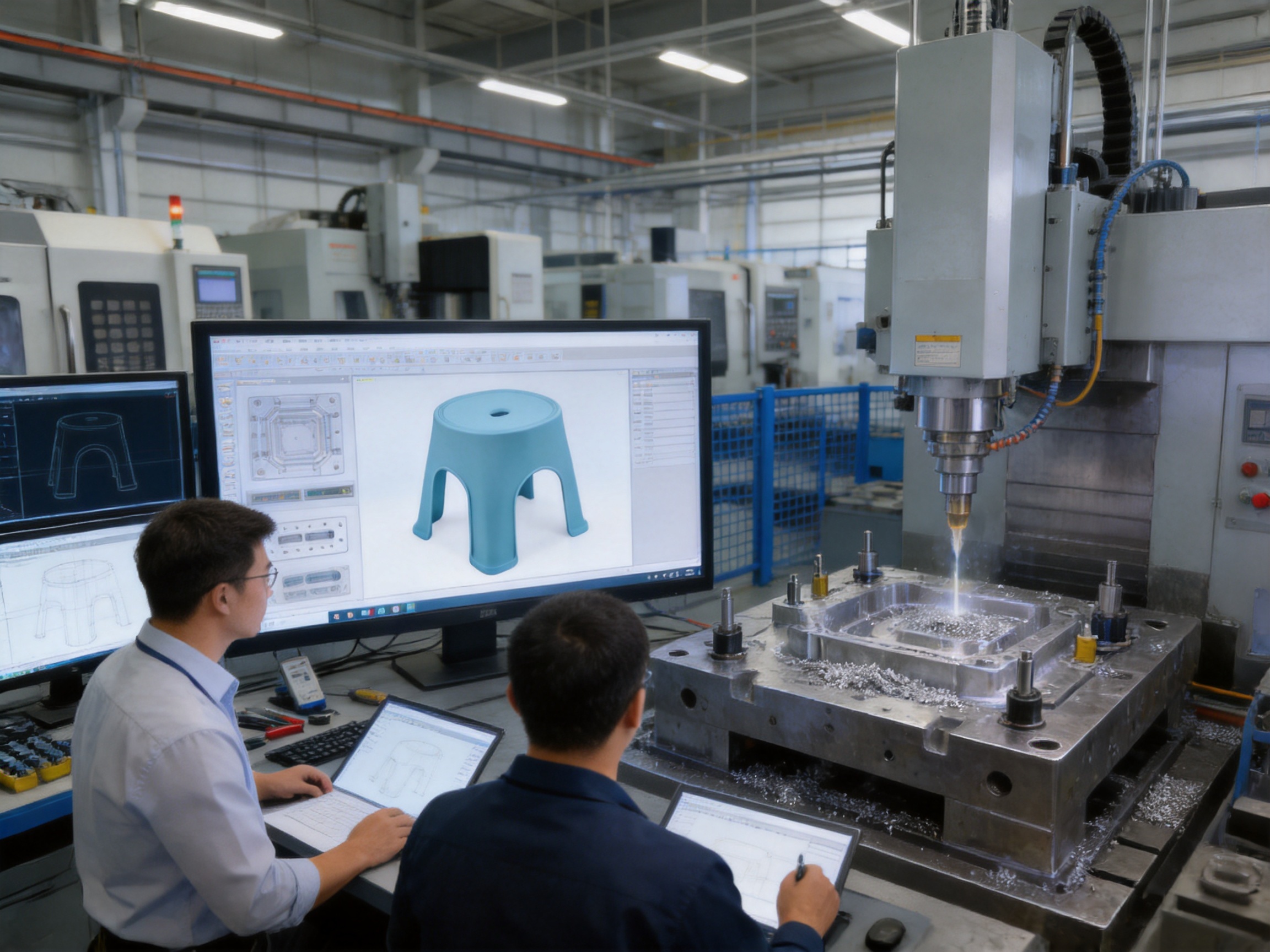
After the product structure is approved, the mold design is developed in detail. This includes the base, cavity, core, inserts, guide systems, ejection components, cooling channels, runner system, locating features, lifting arrangements, and other necessary elements.
Design review is an important opportunity for customers to confirm critical details. Questions may include whether the logo is molded into the stool, whether texture is required, whether the gate mark is acceptable in a particular area, whether interchangeable inserts are needed, and whether future product variations should be considered.
Step Four: Steel Preparation and Machining
After design approval, mold components are prepared and machined. Rough machining removes excess material, while precision processes create the final geometry. Depending on the component, manufacturing may include milling, drilling, electrical discharge machining, wire cutting, grinding, polishing, and other operations.
Different mold areas may have different requirements. Cosmetic surfaces need suitable finishing, while structural surfaces must meet dimensional and functional requirements. Moving parts require correct clearances and smooth operation. Machining quality at this stage influences assembly accuracy and trial performance.
Step Five: Assembly and Fitting
During assembly, the mold components are fitted together and checked for movement, alignment, cooling connections, ejection operation, and parting-surface contact. Skilled fitting is particularly important for large or complex stool molds because small alignment errors can produce flash, mismatch, uneven wear, or difficult opening.
The assembled mold should also be checked for safe handling. Lifting points, eye bolts, water connections, electrical interfaces for hot-runner systems if applicable, and identification marks should be arranged so the mold can be installed and serviced efficiently.
Step Six: Mold Trial and Sample Evaluation
The mold is tested on an injection molding machine using the intended or representative resin. The trial team observes filling behavior, pressure, temperature, cooling, ejection, cycle time, and sample appearance. Samples are checked for short shots, flash, sink, warpage, burn marks, weld lines, gate quality, and dimensional accuracy.
Trial molding is not simply a demonstration. It is a technical verification stage. If the results indicate that a vent, gate, cooling circuit, ejector position, or surface requires adjustment, the tooling team can make the necessary correction. Multiple trial stages may be used for projects with demanding appearance or dimensional requirements.
Step Seven: Inspection, Documentation, and Shipment
After the mold meets the agreed requirements, final inspection and documentation are completed. The documentation package may include approved samples, mold drawings, maintenance instructions, spare-part information, trial records, and recommended operating parameters, depending on the project agreement.
Proper packaging protects the tooling during international transportation. The mold should be cleaned, preserved against corrosion, secured internally, and packed in a suitable export crate. Clear identification and lifting information help the customer receive and install the mold safely.
Quality Control for Stool Mold Manufacturing
Quality control should be applied throughout the project rather than only at the final inspection. At the design stage, engineers verify that the product can be molded effectively. During machining, components are checked against drawings. During assembly, movement and fit are inspected. During trials, molded samples are evaluated under actual processing conditions.
Important quality control points include cavity and core dimensions, parting-line alignment, ejector movement, guide-pillar performance, cooling-channel integrity, insert fit, surface finish, gate condition, and mold opening and closing. The level of inspection should reflect the product’s complexity, expected production volume, and customer quality requirements.
For a stool, dimensional checks may include seat width, seat height, leg spacing, base flatness, overall height, wall thickness, and the position of reinforcing features. Functional checks may include stability, stacking behavior, load testing, and inspection of sharp edges. These tests may be carried out by the customer or arranged as part of a broader product validation program.
The mold supplier’s responsibility is to provide tooling capable of producing the approved product consistently. The customer remains responsible for confirming that the final stool meets the applicable market, safety, material, labeling, and product-use requirements. Clear allocation of responsibilities helps prevent misunderstandings during approval.
Benefits for Different Types of Customers
For Stool Manufacturers
Manufacturers need molds that fit their injection machines, production schedules, operators, and quality systems. The Plastic Stool Mold 016 can be engineered around the customer’s actual production conditions, including machine capacity, clamping force, injection volume, material, and desired output.
A well-supported mold can help the manufacturer shorten the time between installation and stable production. Trial information and technical documentation can also help machine operators establish suitable process parameters. For factories producing several houseware products, a reliable mold supplier can become a long-term partner for future tables, chairs, storage products, and containers.
For Wholesalers and Distributors
Wholesalers and distributors may not operate injection molding equipment themselves, but tooling quality still affects their supply chain. They need products that can be delivered in consistent batches, meet agreed specifications, and maintain an acceptable appearance during long-term purchasing programs.
Working with an experienced mold manufacturer can help distributors communicate more effectively with their selected molding factory. A documented mold design makes it easier to reproduce the product or arrange production with qualified partners. It can also reduce the risk of receiving samples that differ from the goods delivered later.
For Product Brands
Brands often require more than a standard stool. They may need a unique shape, custom logo, special texture, signature color, improved stacking, or packaging-friendly dimensions. OEM and ODM support allows these requirements to be considered before the mold is manufactured.
Brand owners should discuss intellectual property, tooling ownership, confidentiality, product approval, and change-control procedures at the beginning of the project. These commercial points are separate from machining quality but are essential to a successful long-term relationship.
For New Product Developers
A new product developer may have a promising concept but limited injection molding experience. In this situation, early moldability guidance can prevent avoidable problems. Engineers can identify thick areas, insufficient draft, difficult undercuts, weak ribs, unsuitable gate locations, and other issues before they become expensive tooling changes.
Developers can also use the project to establish a repeatable product development process: concept review, design improvement, prototype confirmation, mold construction, trial molding, product testing, and mass production. This structured approach supports more predictable launches.
Maintenance and Long-Term Mold Performance
Even a high-quality mold requires proper maintenance. Regular cleaning helps prevent residue, contamination, and corrosion. Cooling channels should be monitored for blockage or scale. Ejector pins, guide components, slides, and other moving parts should be lubricated according to the supplier’s recommendations.
Operators should avoid forcing the mold open or removing stuck parts with unsuitable tools. Uncontrolled impact can damage parting surfaces, ejectors, inserts, or cavity finishes. Any unusual noise, resistance, leakage, flash, or product change should be investigated promptly.
Maintenance records are useful for identifying wear patterns and planning replacement parts. If a stool is produced in very high volume, wear may eventually occur on gate areas, slides, ejectors, or textured surfaces. A supplier with manufacturing capability can help provide replacement components or recommend repair procedures.
Storage conditions are also important when the mold is not in use. The mold should be cleaned, dried, protected against corrosion, closed or secured according to the manufacturer’s recommendations, and stored in a stable environment. Water should be removed from cooling passages when freezing conditions are possible.
How to Prepare a Mold Inquiry
A complete inquiry helps the manufacturer prepare a more accurate technical proposal. Customers should provide the following information whenever possible:
Product drawings or three-dimensional files.
Reference photos or physical samples.
Target stool dimensions and weight.
Intended resin and any recycled or filled content.
Expected production volume and service life.
Preferred injection molding machine information.
Surface texture, polishing, color, and appearance requirements.
Logo, lettering, date-code, or identification requirements.
Packaging, stacking, and transportation expectations.
Target delivery date and approval schedule.
Customers should also explain which dimensions are critical and which areas allow design flexibility. For example, a product owner may require exact seat height and base diameter but allow a small change to an internal rib. This information gives engineers more options to improve moldability while protecting the product’s commercial function.
Why Choose an Experienced Mold Factory
The main advantage of an experienced mold factory is the ability to connect product design, tooling construction, trial molding, and after-sales service within one coordinated system. A stool mold is influenced by every one of these stages. A design decision affects machining. Machining affects assembly. Assembly affects trial molding. Trial results may require design or manufacturing adjustments.
Chenghui Mould combines more than three decades of industry experience with an in-house workshop, 104 advanced processing machines, professional injection molding machines for testing, and an annual production capacity exceeding 1,500 mold sets. These resources support customers that need both standard production efficiency and customized engineering service.
The company’s product experience extends beyond plastic stools to PET storage products, tables, chairs, furniture, storage boxes, turnover boxes, laundry baskets, buckets, storage racks, trash cans, and other daily-use or industrial products. This range demonstrates familiarity with product families that share common mold-making requirements.
For international buyers, the company’s export experience in the Middle East, Europe, America, Africa, Southeast Asia, and other regions provides additional support for cross-border cooperation. Communication, documentation, packaging, and after-sales response are important parts of a successful tooling project, especially when the mold will be installed far from the manufacturer.
Application and Customization Possibilities
The Plastic Stool Mold 016 can be considered for multiple stool product strategies, subject to engineering confirmation. A customer may require a compact stool for homes, a stronger stool for commercial use, a nesting stool for efficient storage, or a lightweight stool for mass retail distribution.
Customization may address the visible seat contour, leg angle, base geometry, reinforcement structure, anti-slip details, surface texture, handle openings, logo integration, and stacking interface. Different market segments may prioritize different qualities. A household product may emphasize comfort and appearance, while a commercial stool may place greater emphasis on strength, durability, and easy cleaning.
The mold can also be planned as part of a wider product family. If the customer expects future sizes or related chairs, it may be useful to discuss common design principles, interchangeable inserts, or standardized mold components. Early planning does not guarantee that future products can use the same mold, but it can help reduce unnecessary duplication in later projects.
Q&A About the Plastic Stool Mold 016
What type of product is the Plastic Stool Mold 016 intended to produce?
It is intended for injection molding plastic stool products. The exact stool structure, dimensions, resin, cavity arrangement, and mold specifications should be confirmed according to the customer’s approved design and production requirements.
Can the mold be customized?
Yes. The tooling project can be developed according to customer drawings, three-dimensional files, samples, branding requirements, material selection, surface finish, production volume, and injection machine conditions. OEM and ODM cooperation models are available for suitable projects.
What information should be supplied before requesting a quotation?
Customers should provide product drawings or samples, resin information, target output, preferred machine details, appearance requirements, critical dimensions, logo information, and expected delivery schedule. More complete information allows the supplier to evaluate mold structure and provide a more realistic quotation.
Why is mold trial molding important?
Trial molding verifies how the completed tool performs under real processing conditions. It allows the team to check filling, cooling, ejection, surface appearance, dimensions, warpage, flash, and cycle behavior. Trial results help identify any adjustment needed before the mold enters regular production.
Does the supplier have equipment for testing molds?
Chenghui Mould has professional injection molding machines for mold testing. This allows the manufacturer to conduct trial production and evaluate samples before the tooling is delivered, subject to the agreed project arrangement.
How does a stool mold influence production cost?
The mold affects cycle time, material waste, rejection rate, maintenance frequency, operator involvement, and production consistency. A higher-quality mold may provide better total economics over its service life, even if its initial quotation is not the lowest available.
What materials can be used for plastic stools?
The suitable material depends on the product’s strength, stiffness, impact, appearance, temperature, chemical, and cost requirements. Polypropylene, high-density polyethylene, acrylonitrile butadiene styrene, and other thermoplastics may be considered. The final choice should be confirmed with the product and processing teams.
Can the mold include a customer logo?
Logo integration can usually be discussed during product and mold design. The customer should provide approved artwork, dimensions, location, depth or height requirements, and any intellectual property instructions before detailed machining begins.
How can the mold be maintained?
Regular cleaning, lubrication, cooling-channel care, corrosion protection, inspection of moving components, and proper storage are recommended. Maintenance procedures should follow the supplier’s instructions and the customer’s production conditions.
Does the company serve international customers?
Yes. Chenghui Mould exports to the Middle East, Europe, America, Africa, Southeast Asia, and other regions. International buyers can discuss technical documentation, packaging, shipment preparation, installation requirements, and after-sales support during the project.
What makes this product different from a basic stool mold?
Its value is connected to production-focused engineering, customized development, integrated manufacturing, mold trial capability, quality control, and the supplier’s experience with houseware and industrial products. Customers should compare complete tooling performance and service, rather than only the initial purchase price.
Conclusion
The Plastic Stool Mold 016 is a practical tooling solution for manufacturers and product companies seeking dependable injection molding performance for plastic stools. Its success depends on the interaction of accurate design, suitable material selection, balanced filling, effective cooling, reliable ejection, careful machining, skilled assembly, and thorough trial molding.
Zhejiang Chenghui Mould Co., Ltd. brings more than 30 years of experience to this type of project. Its own workshop, 104 advanced processing machines, professional mold-testing injection machines, annual capacity of more than 1,500 mold sets, and international export experience provide a strong foundation for customized OEM and ODM tooling.
Compared with tooling developed only to meet a low initial price, a production-focused mold can provide greater value through consistent quality, reduced adjustment time, improved maintenance access, and more predictable mass production. These benefits are important for stool manufacturers, wholesalers, distributors, product brands, and new product developers competing in demanding houseware markets.
Customers considering the Plastic Stool Mold 016 should prepare complete product information and discuss the intended resin, machine, output, appearance, packaging, and service-life requirements at the beginning of the project. With clear communication and a structured process from concept review through final testing, the mold can become a reliable foundation for efficient and repeatable plastic stool production.
References
1. Injection Molding Handbook, general principles of thermoplastic injection molding, mold design, process control, and production troubleshooting.
2. Plastic Part Design for Injection Molding, guidance on draft angles, wall thickness, ribs, bosses, shrinkage, and moldability.
3. Mold Engineering and Design Practice, technical considerations for cavity and core design, cooling, ejection, gating, venting, and mold maintenance.
4. ISO 20457, Plastics moulded parts: tolerances and acceptance conditions for molded plastic components.
5. General industrial guidance on injection mold inspection, trial molding, dimensional verification, preventive maintenance, and tooling documentation.