
 Français
 Español
 عربى
Plastic bathtubs are large, highly visible household products that require more than a basic cavity and core arrangement. Their surfaces must be smooth, their walls must maintain consistent thickness, their rims must remain stable, and their overall geometry must support efficient demolding, trimming, assembly, packaging, and long-term use. For manufacturers, the mold is the foundation of all these requirements. A well-designed bathtub mold can improve product appearance, reduce production waste, stabilize cycle times, and support dependable mass production.
The CHENGHUI Plastic Bathtub Mold 005 is designed for manufacturers seeking a dependable tooling solution for plastic bathtub production. It represents the type of custom plastic injection mold developed by Zhejiang Chenghui Mould Co., Ltd., a professional mold manufacturer with more than 30 years of experience in injection mold design and production. The company focuses on molds for daily necessities, houseware, storage products, furniture, industrial containers, and other high-volume plastic products.
Although bathtub production requirements vary according to product dimensions, material, structure, surface finish, and production equipment, the fundamental objective remains the same: to create a mold that can repeatedly produce accurate, attractive, and functional parts. The Plastic Bathtub Mold 005 is positioned as a practical solution for OEM and ODM customers who need customized tooling supported by engineering, machining, mold testing, quality inspection, and after-sales service.
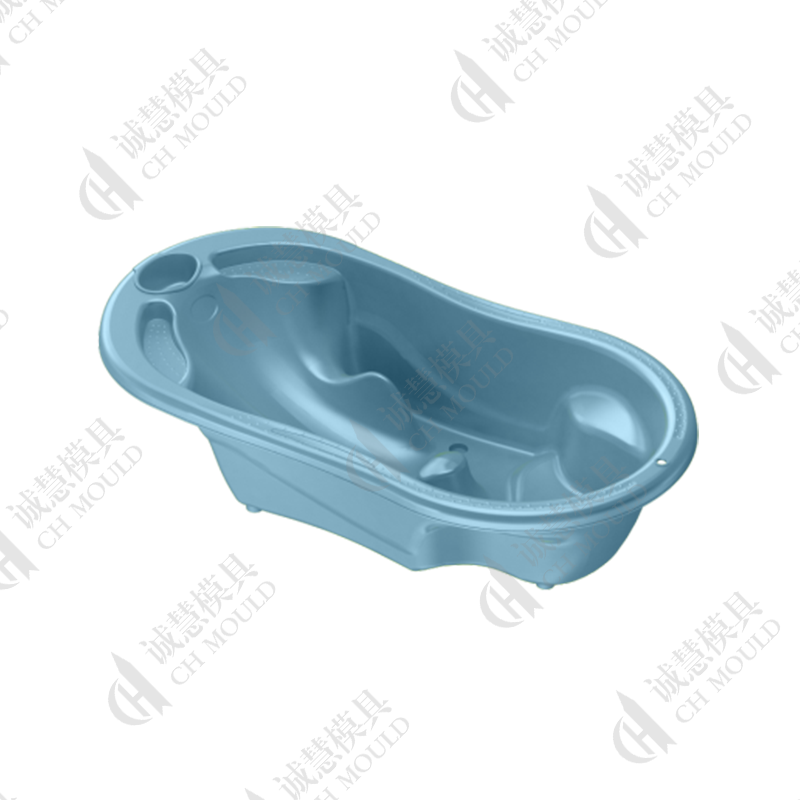
CHENGHUI Plastic Bathtub Mold 005
Understanding the Product and Its Manufacturing Role
A plastic bathtub mold is a precision tool used to form the internal and external shape of a bathtub during the molding process. Depending on the product design and selected production method, the mold may be used for injection molding, compression molding, or another thermoplastic forming process. The tooling structure normally includes a cavity, core, mold base, cooling channels, guide components, ejector components, inserts, and other elements needed for stable operation.
Large houseware products create special challenges for mold designers. A bathtub has a wide surface area, substantial depth, curved corners, a visible outer shell, and often an integrated rim or supporting structure. Any error in the mold can become visible as warpage, sink marks, weld lines, uneven gloss, dimensional deviation, or difficulty during demolding. Because of this, the design stage must consider not only the final appearance but also material flow, shrinkage, cooling behavior, ejection force, mold opening, and production efficiency.
The CHENGHUI Plastic Bathtub Mold 005 is suitable for customers that require a dedicated mold for a bathtub product or a related large household sanitary product. The exact mold configuration can be developed around the customer’s drawings, 3D model, target resin, injection machine, production volume, and market requirements. This flexibility is important because a bathtub intended for budget retail distribution may use a different design strategy from a premium product sold through specialized dealers.
Product development based on customer requirements
Custom tooling begins with a clear understanding of the product. Before manufacturing, the mold team reviews the bathtub’s overall dimensions, wall thickness, draft angles, handle areas, drain or support features, stacking requirements, surface finish, and packaging limitations. If the customer does not have a complete design, the manufacturer can assist with product development and mold-oriented design recommendations.
Design review is especially important for large products because small geometry problems can become expensive after steel cutting begins. For example, an insufficient draft angle may make ejection difficult, while an overly thin region may create filling problems or weak areas. A sharp internal corner may concentrate stress in the molded part and make polishing or machining more difficult. Early engineering review helps prevent these issues and creates a more practical path from concept to mass production.
A mold built for repeatable production
The value of a bathtub mold is determined not only by whether it can produce one acceptable sample. A production mold must continue to perform after repeated cycles. It must maintain alignment, retain surface quality, manage heat consistently, and allow maintenance technicians to access important wear parts. These factors influence the customer’s long-term operating cost.
A reliable mold also reduces the risk of interruptions during production. When a mold is properly engineered, the customer can spend less time correcting flash, adjusting ejection, compensating for inconsistent cooling, or responding to repeated dimensional problems. This supports more predictable manufacturing schedules and more consistent product quality.
Key Advantages of the Plastic Bathtub Mold 005
The principal advantage of the Plastic Bathtub Mold 005 is its focus on the practical requirements of large plastic household products. It is not simply a cavity shaped like a bathtub. It is a complete tooling project in which product design, material behavior, mold construction, testing, and production requirements must work together.
Large-format product design support
Bathtubs usually require a larger mold envelope than many everyday plastic products. The mold must be strong enough to withstand clamping pressure and repeated opening and closing while maintaining accurate alignment across a broad forming area. Mold design must also account for lifting, transportation, installation, and safe handling inside the customer’s workshop.
An experienced mold manufacturer can help determine an appropriate mold base, support structure, guide system, cooling arrangement, and ejection method. This design support helps reduce the risk of choosing a tool that is difficult to install or unsuitable for the intended injection machine.
Improved surface appearance
Bathtubs are appearance-sensitive products. Consumers notice surface gloss, texture, color consistency, and visible molding marks. A good mold surface can contribute to a more attractive finished product, provided that the material, molding parameters, and polishing or texturing requirements are also properly controlled.
Precision machining and careful finishing help create the required surface condition inside the cavity and on the core. The mold can be prepared for a polished surface, a textured surface, or a customer-specific appearance. The chosen finish can influence the product’s visual character, ease of cleaning, scratch visibility, and suitability for different market segments.
Consistent dimensions and wall geometry
Dimensional consistency is essential for a bathtub because the product must maintain its shape during use, storage, handling, and transportation. If the rim or base becomes distorted, assembly with accessories may be affected. If the sidewalls warp, stacking, packaging, or installation may become more difficult.
Consistent wall geometry depends on the product design, resin, gate arrangement, cooling balance, processing conditions, and mold accuracy. The mold manufacturer’s role is to identify potential risks during design and optimize the tooling so that the customer has a stronger foundation for stable molding.
Support for efficient demolding
Large molded parts can be difficult to eject because of their size, surface area, and possible vacuum effects. The mold therefore requires suitable draft, an appropriate parting line, and a balanced ejection strategy. Ejection components must apply force in a controlled way without damaging the bathtub surface or causing deformation.
Where the product design permits, the mold may incorporate ejector systems, air assistance, inserts, or other features that make release more reliable. The final configuration depends on the bathtub design and production equipment. The objective is to achieve smooth demolding while reducing cycle interruptions and operator intervention.
Adaptability for OEM and ODM programs
Different customers may need different sizes, capacities, colors, textures, stacking features, or accessory interfaces. A custom mold supplier must therefore be able to work from customer drawings and adapt the tooling to a specific product strategy. This is particularly valuable for wholesalers, distributors, retailers, and manufacturers developing private-label product lines.
Zhejiang Chenghui Mould Co., Ltd. provides OEM and ODM mold services, allowing customers to develop tooling around their own specifications. The company’s experience with household and industrial products enables it to approach bathtub tooling as part of a broader product-development program rather than as an isolated machining order.
| Requirement | Importance in Bathtub Mold Production | Expected Benefit |
|---|---|---|
| Accurate product geometry | Maintains the intended shape, capacity, rim profile, and functional features | More consistent finished products and fewer dimensional complaints |
| Balanced cooling | Helps manage shrinkage and thermal distortion across large surfaces | Improved stability and reduced warpage risk |
| Suitable draft angles | Allows the part to release from the mold without excessive force | Faster, safer, and more repeatable demolding |
| Reliable ejection | Distributes force across the product and protects visible surfaces | Fewer marks, cracks, and production interruptions |
| Controlled surface finish | Defines the visual and tactile quality of the bathtub | Better appearance and stronger market positioning |
| Robust mold construction | Supports repeated operation and maintenance | Longer service life and more dependable production |
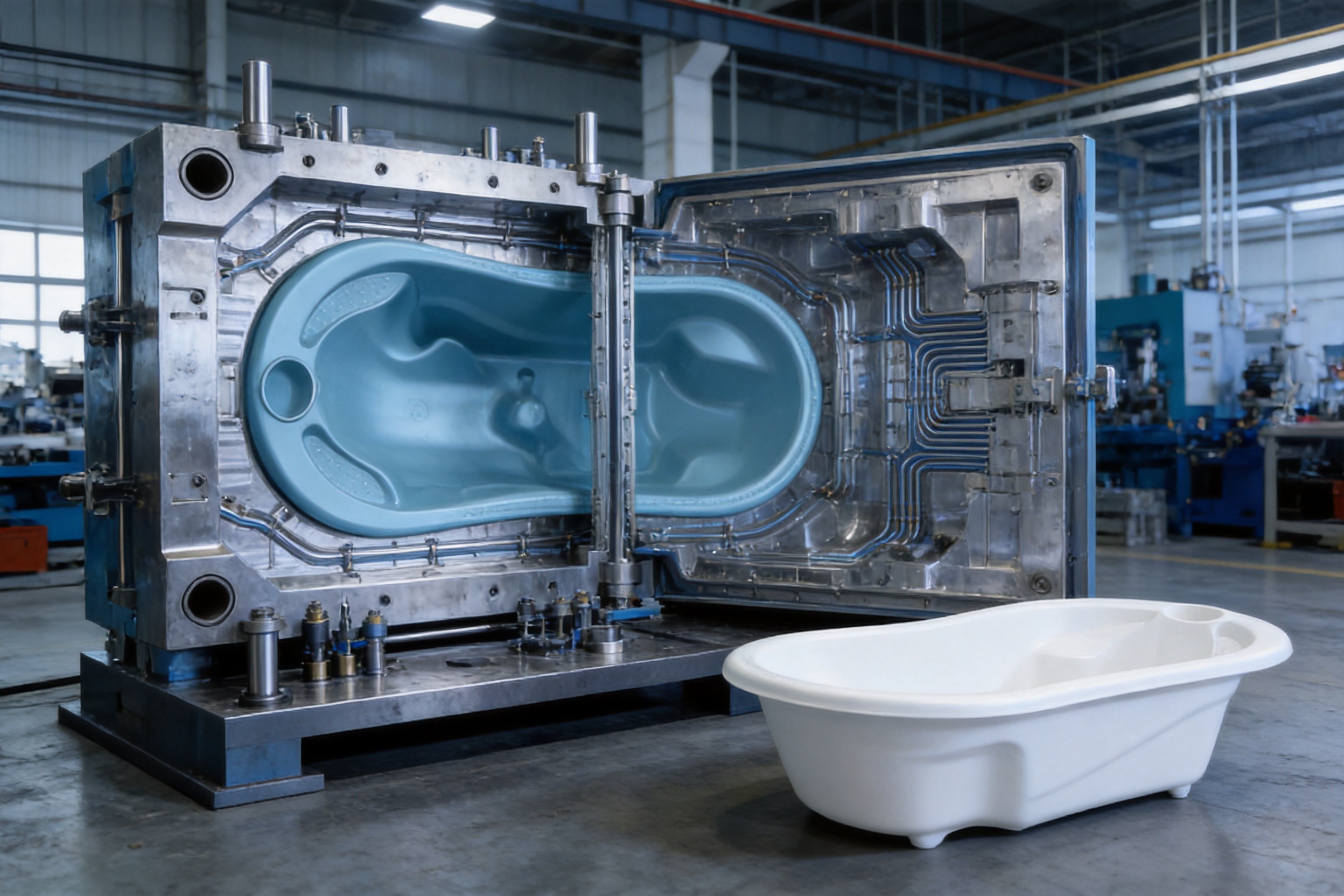
Advanced Manufacturing Processes
The quality of a mold is closely related to the quality of the manufacturing process used to produce it. Advanced equipment alone does not guarantee a successful result. The manufacturer must combine appropriate machinery with skilled programming, process control, measurement, inspection, and assembly experience.
Chenghui Mould operates its own production workshop with 104 advanced processing machines and professional injection molding machines for mold testing. This combination gives the company control over important stages of mold development and allows it to connect machining decisions with practical molding performance.
Engineering and 3D mold design
The process normally begins with product data review and mold feasibility analysis. Engineers examine the customer’s 3D model or drawings and identify areas that could affect filling, cooling, ejection, assembly, or maintenance. They also review the relationship between the bathtub size and the customer’s intended injection machine.
Computer-aided design tools are used to develop the mold structure, split the product into suitable core and cavity sections, position the parting line, design cooling channels, and establish the ejection arrangement. Mold flow and engineering analysis may be used where appropriate to evaluate filling balance, pressure distribution, weld-line risk, and possible air-trapping areas.
For a large product, design communication is particularly important. Changes to the rim, base, drain area, handles, or texture can influence steel construction and machining time. Clear approval procedures help ensure that the mold is manufactured according to the correct product revision.
Precision CNC machining
CNC machining is used to create accurate cavity, core, inserts, mold plates, and supporting components. Large surfaces require careful toolpath planning because uneven machining can affect surface finish and dimensional stability. Complex curved sections may require multiple machining operations, followed by high-speed finishing, polishing, or texturing.
The machining strategy must balance accuracy, efficiency, and tool life. Rough machining removes excess material efficiently, while semi-finishing and finishing operations bring the mold closer to its final geometry. Critical areas are inspected throughout the process rather than being checked only after all machining has been completed.
Electrical discharge machining and detail processing
Some mold features are difficult to produce using conventional cutting tools. Electrical discharge machining can be used for specific deep, narrow, or complex details, depending on the design. This process helps create accurate features in areas where tool access is limited.
EDM is not a substitute for good design. Electrode planning, reference positioning, surface requirements, and subsequent finishing must all be controlled. When properly integrated with CNC machining, EDM, wire cutting, grinding, and polishing, it contributes to a complete precision manufacturing process.
Grinding, fitting, and polishing
Flatness and alignment are important for mold plates, inserts, guide components, and sealing surfaces. Grinding operations help achieve the required precision on selected components. After machining, skilled mold fitters assemble and adjust the parts so that the core, cavity, slides, lifters, ejectors, and other mechanisms operate correctly.
Polishing is also a critical stage for bathtub molds because the finished product may have broad visible surfaces. The required polishing level depends on the customer’s design. A high-gloss surface, fine matte texture, or patterned texture requires different preparation and inspection methods. Poor polishing can create visible inconsistencies, while excessive polishing can change dimensions or soften important details.
Professional mold trials
Mold trials are used to evaluate whether the completed mold performs as intended. The mold is installed on suitable injection molding equipment, and trial parts are produced using an appropriate material and processing setup. Engineers inspect filling, ejection, cooling, parting-line performance, surface appearance, and dimensional results.
Trial molding may reveal issues that are not obvious in a digital design. For example, a broad section may cool more slowly than expected, a small area may trap air, or an ejection point may need adjustment. The mold can then be modified, polished, vented, or balanced before shipment.
Testing is especially valuable for OEM customers because it provides a practical opportunity to confirm the product before full-scale production. It also gives the customer useful information for setting molding parameters and training operators.
Quality Management for Large Household Molds
Quality management begins before machining and continues through assembly, trial, inspection, delivery, and after-sales support. A strong quality system reduces variation between projects and helps maintain traceability for critical components and design changes.
Material and component control
The selection of mold steel and standard components should reflect the expected production volume, resin characteristics, surface requirements, and maintenance plan. A mold intended for frequent production may require a different steel grade or wear strategy from a tool intended for a smaller product launch.
Components such as guide pillars, bushings, ejector pins, springs, hydraulic or mechanical mechanisms, and cooling fittings should be selected and installed according to the mold design. Correct fit and appropriate clearances help prevent premature wear and operating problems.
Dimensional inspection
Inspection can include component measurement, cavity and core verification, mold assembly checks, and comparison of trial parts with approved product data. Measurement equipment and inspection methods should be chosen according to the required tolerance and product complexity.
For large bathtub molds, inspection should focus on overall length, width, depth, rim geometry, base shape, key mounting areas, and the relationship between major surfaces. Where a customer has specified critical dimensions, those requirements should be documented and verified during the project.
Visual and functional inspection
Visual inspection evaluates polishing, texture, machining marks, parting lines, flash, ejector marks, and other visible characteristics. Functional inspection examines whether the mold opens smoothly, whether the ejection system works correctly, whether cooling connections are accessible, and whether the mold can be safely installed on the intended machine.
A mold that meets dimensional requirements but is difficult to operate may still create problems for the customer. For this reason, practical assembly and trial evaluation are important parts of the final quality process.
Why Manufacturing Experience Matters
Zhejiang Chenghui Mould Co., Ltd. was founded in 1994 and has accumulated more than 30 years of experience in mold design and manufacturing. This background is valuable because mold production involves many decisions that cannot be solved by drawings alone. Engineers and technicians learn from repeated projects how different product shapes, materials, processing conditions, and customer expectations influence the final result.
The company focuses on molds for daily necessities and related plastic products, including PET storage products, tables, chairs, furniture, storage boxes, turnover boxes, laundry baskets, buckets, storage racks, trash cans, and other household and industrial items. This product range demonstrates experience with both appearance-sensitive houseware and durable industrial products.
Bathtub tooling benefits from this broader experience. A bathtub shares certain challenges with other large houseware products, including broad surfaces, ergonomic forms, high-volume production, visible appearance, and the need for efficient handling. Experience with storage products and industrial containers also contributes knowledge of structural reinforcement, stacking, durability, and practical mold maintenance.
The company reports an annual production capacity of more than 1,500 mold sets. Capacity of this scale supports a structured production environment and allows the manufacturer to manage multiple projects while maintaining specialized resources for design, machining, assembly, testing, and quality control.
Advantages Compared with Basic or Low-Control Tooling
Customers comparing mold suppliers should look beyond the initial quotation. A low purchase price may not represent the lowest total cost if the mold requires repeated modifications, produces inconsistent parts, or causes frequent downtime. The more useful comparison includes design support, manufacturing control, trial quality, documentation, service, and long-term reliability.
More complete project coordination
A full-service mold factory can coordinate product review, mold design, machining, fitting, testing, inspection, and delivery. This reduces the communication gap that may occur when design, machining, testing, and repair are handled by unrelated suppliers.
Centralized project management also makes it easier to track revisions. When a customer changes the bathtub rim, adds a handle, modifies the base, or requests a new texture, the effect on the mold can be reviewed by the same engineering team responsible for production.
Better connection between design and production
Some suppliers specialize in design but outsource most manufacturing. Others focus on machining but provide limited product engineering. A manufacturer with its own production workshop can connect design decisions with actual machining capability and mold trial experience.
This connection helps the team select realistic tolerances, plan accessible machining areas, design serviceable mechanisms, and anticipate the practical requirements of injection molding. It can also help reduce unnecessary complexity that adds cost without improving product performance.
Reduced risk during mass production
Large household products are often manufactured in significant quantities. If a mold has a recurring issue, the resulting cost can include rejected parts, wasted material, machine downtime, labor, delayed delivery, and customer complaints. A carefully engineered mold helps reduce these risks by addressing likely problems before production begins.
Professional trials and inspection do not eliminate every possible molding issue, because final results also depend on resin quality, machine condition, process parameters, and operator practices. However, they provide a stronger tooling foundation and make it easier to identify whether a problem comes from the mold or from the molding process.
Long-term serviceability
A bathtub mold should be designed with future maintenance in mind. Wear components may eventually need replacement, cooling channels may require cleaning, and surface areas may need refurbishment after extended operation. Clear assembly practices and accessible components make these tasks more manageable.
After-sales support is another important advantage. Customers may need assistance with installation, trial adjustment, spare parts, mold maintenance, or future modifications. Chenghui Mould provides customized mold services from concept and drawing through sample development, machining, assembly, testing, quality inspection, and after-sales support.
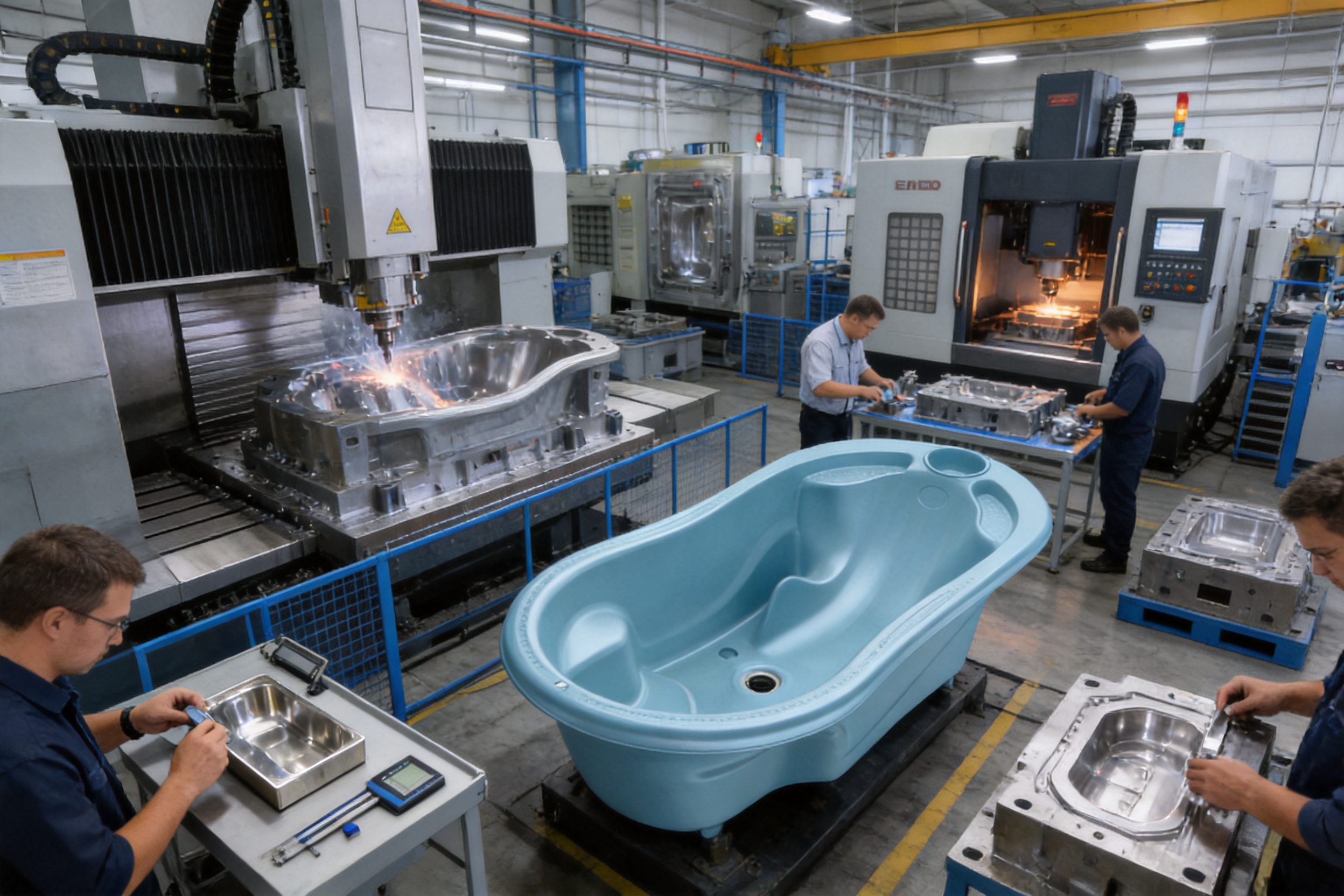
Application Opportunities for the Bathtub Mold
The Plastic Bathtub Mold 005 can be adapted for different commercial applications according to the customer’s product design. It may support bathtub products for household use, hospitality projects, rental properties, retail distribution, sanitary product wholesalers, or private-label brands. The final application depends on the product specification, material, regulatory requirements, and target market.
Household retail products
Household bathtubs must combine attractive appearance with practical functionality. Consumers may evaluate the product based on size, comfort, smoothness, cleaning convenience, stability, and overall visual quality. Mold design can support these goals by creating controlled surfaces, rounded corners, reinforced areas, and consistent geometry.
Wholesale and distribution programs
Wholesalers and distributors often require consistent supply across repeated orders. A reliable mold helps manufacturers produce matching batches over time, supporting more consistent inventory and fewer product variations. This is particularly important for customers selling through regional distribution networks or multiple retail channels.
Private-label and OEM products
Private-label customers may need a unique shape, logo area, texture, color strategy, or accessory interface. OEM tooling allows the customer to own or control a product design that is differentiated from standard catalog products. The mold supplier’s engineering team can help translate the product concept into a design suitable for repeatable molding.
Related large household products
The same engineering principles used for bathtub tooling can also apply to other large plastic houseware products. These may include wash basins, utility tubs, storage containers, large baskets, furniture components, and sanitary product parts. A mold factory with experience across these categories can transfer useful knowledge between projects while still customizing each tool for its specific product.
Important Technical Considerations Before Ordering
Customers planning a bathtub mold project should prepare as much information as possible before requesting a quotation. Good project data helps the mold supplier provide a more accurate recommendation and reduces delays during design approval.
Product dimensions and weight
The customer should provide the bathtub’s length, width, height, wall thickness, approximate weight, and important functional dimensions. These details influence mold size, machine requirements, material consumption, cooling design, and handling arrangements.
Material selection
Different thermoplastics behave differently during molding. The selected material can affect shrinkage, stiffness, impact resistance, surface finish, chemical resistance, processing temperature, and cooling time. The mold design should be reviewed against the intended resin rather than treated as independent from material selection.
Injection machine information
Machine details may include clamping force, maximum mold dimensions, tie-bar spacing, injection capacity, nozzle position, ejector stroke, and available hydraulic or electrical connections. Providing this information helps the mold manufacturer design a tool that can be installed and operated safely on the customer’s equipment.
Production volume and service-life expectations
Expected annual production and total lifetime volume influence the selection of steel, components, cooling strategy, and maintenance provisions. A customer planning continuous high-volume production may need a more durable configuration than a customer launching a limited regional product.
Surface and appearance requirements
The customer should specify whether the product requires a high-gloss finish, matte finish, leather texture, fine grain, logo detail, or another surface treatment. Surface requirements should be agreed before mold polishing and texturing begin because they affect both tooling cost and product appearance.
Inspection and approval standards
It is helpful to define how the trial parts will be evaluated. Approval criteria may include visual appearance, dimensional inspection, assembly fit, weight, cycle time, ejection performance, and packaging requirements. Clear standards reduce uncertainty between the supplier and the customer during final acceptance.
From Concept to Finished Mold
A professional mold project follows a sequence of controlled stages. The exact workflow may vary according to the customer’s project, but the following process provides a practical overview.
Stage one: Initial consultation
The customer provides product drawings, 3D data, photographs, samples, or a general concept. The mold team reviews the product and identifies missing information. At this stage, the parties discuss material, production volume, machine conditions, surface finish, delivery expectations, and inspection requirements.
Stage two: Design and feasibility review
Engineers analyze draft, parting lines, wall thickness, ribs, corners, gates, vents, cooling, ejection, and mold structure. Potential modifications are discussed with the customer before detailed manufacturing begins. This stage is intended to prevent costly changes later.
Stage three: Design approval and material preparation
After the mold design is approved, the manufacturer prepares the required steel, standard components, electrodes, inserts, and production documentation. Material and component planning should reflect the intended production volume and durability requirements.
Stage four: Precision machining
Major plates, cores, cavities, inserts, and mechanisms are machined using appropriate equipment. CNC machining, grinding, EDM, wire cutting, drilling, and other processes may be combined depending on the design. In-process inspection helps maintain accuracy as components move through production.
Stage five: Assembly and fitting
Skilled technicians assemble the mold and check alignment, movement, clearances, cooling connections, ejection, and parting-line contact. Hand fitting and finishing may be required for areas that must operate smoothly and seal correctly.
Stage six: Trial molding and correction
The mold is tested on suitable injection molding equipment. Trial parts are examined for filling, surface quality, dimensions, ejection marks, flash, warpage, and other issues. If necessary, corrections are made and additional trials are performed.
Stage seven: Final inspection and delivery
Once the mold meets the agreed requirements, final inspection and documentation are completed. The mold is prepared for shipment, with attention to preservation, lifting, packaging, and installation information. The customer can then proceed with production commissioning.
Operating and Maintenance Recommendations
Even a well-manufactured mold requires proper operation and maintenance. Customers should follow the manufacturer’s recommendations for installation, cooling, lubrication, cleaning, storage, and periodic inspection.
Before production, the mold should be checked for damage, contamination, loose components, blocked cooling channels, and correct connection of water and electrical systems. Operators should use appropriate mold-opening and clamping settings and avoid excessive force during ejection.
After production, the mold should be cleaned and dried according to the material and process conditions. Exposed steel surfaces may require suitable rust protection, particularly when the mold will be stored for an extended period. Ejector pins, guide components, slides, and other moving parts should be inspected and lubricated as recommended.
Regular maintenance can help identify wear before it affects product quality. A preventive schedule may include checking parting-line contact, measuring critical dimensions, cleaning cooling circuits, inspecting fasteners, examining ejector components, and confirming the condition of the cavity and core surfaces.
Company Capabilities and Global Service
Zhejiang Chenghui Mould Co., Ltd. is located in Nanshan Industrial Zone, Luoyang Street, Luqiao District, Taizhou City, Zhejiang Province. The company serves customers seeking custom plastic injection molds for household, industrial, and logistics applications.
Its manufacturing scope includes molds for pallets, crates, bins, storage products, furniture, tables, chairs, laundry baskets, buckets, trash cans, and other daily-use products. This broad portfolio gives the company experience with multiple product sizes, structural requirements, surface finishes, and production challenges.
The company exports molds to the Middle East, Europe, America, Africa, Southeast Asia, and other regions. International customers often require clear communication, reliable documentation, stable quality, and practical support during installation and trial production. A manufacturer experienced in export projects is better prepared to coordinate these requirements across different time zones, technical standards, and business practices.
Chenghui Mould’s stated mission is to create high-precision and reliable molds through skilled craftsmanship, advanced manufacturing, and continuous improvement. For customers considering the Plastic Bathtub Mold 005, this approach means that the project can be managed as a complete tooling program, from the first product discussion to final production support.
Frequently Asked Questions
What is the CHENGHUI Plastic Bathtub Mold 005?
It is a custom plastic bathtub mold developed for manufacturers that need tooling for a large household bathtub or a related plastic sanitary product. The final mold configuration is based on the customer’s product design, material, machine, production volume, and appearance requirements.
Can the mold be customized for different bathtub sizes?
Yes. Customization is a central part of the service. Customers can provide drawings, 3D models, samples, or product concepts. The engineering team can then develop the mold structure around the required dimensions, wall geometry, features, surface finish, and production conditions.
What information should be provided for a quotation?
Useful information includes product drawings or 3D data, dimensions, material, estimated product weight, annual production volume, target machine details, surface finish, delivery expectations, and any special requirements such as logos, handles, drain openings, textures, or assembly features.
How does the manufacturer help reduce warpage?
Warpage can be influenced by product geometry, material shrinkage, filling balance, cooling, ejection, and processing parameters. The mold team can review these factors during design and develop suitable cooling, gating, support, and ejection arrangements. Final molding parameters must also be optimized on the customer’s machine.
How is the mold tested before delivery?
The mold is installed on appropriate injection molding equipment and used to produce trial parts. Engineers inspect filling, cooling, ejection, dimensions, surface appearance, parting-line performance, and other agreed criteria. Corrections may be completed before final approval and shipment.
Can the mold be used for OEM and private-label products?
Yes. The company provides OEM and ODM mold services. Customers can develop their own bathtub design or request engineering assistance in converting a concept into a production-ready molded product.
What types of surface finishes are available?
Surface options may include polished, matte, textured, or customer-specific finishes. The correct choice depends on the product design, market positioning, cleaning requirements, scratch visibility, and material. Surface expectations should be confirmed before final mold finishing.
How long can the mold operate?
Service life depends on mold steel, resin, production volume, molding conditions, maintenance, and product design. The manufacturer can recommend a suitable construction according to the customer’s expected output and durability requirements.
Does the company provide after-sales support?
Yes. The service scope includes support related to mold testing, quality inspection, installation, maintenance, modifications, and other production needs. Specific support arrangements should be confirmed during the project discussion.
Why should a customer choose an experienced mold factory?
An experienced factory can identify design risks earlier, coordinate multiple manufacturing stages, understand the relationship between tooling and molding, and provide more practical guidance during trials. This can reduce modification costs and improve the chance of stable mass production.
Conclusion
The CHENGHUI Plastic Bathtub Mold 005 is a practical tooling solution for manufacturers seeking reliable, customized, and production-oriented plastic bathtub molds. Its value comes from the combination of product-focused engineering, precision machining, professional assembly, mold trials, inspection, and after-sales support.
Large plastic bathtubs require careful control of geometry, surface finish, cooling, ejection, alignment, and durability. A mold designed without sufficient attention to these factors can create problems throughout the product’s life cycle. By contrast, a professionally developed mold provides a stronger foundation for stable cycle times, consistent dimensions, attractive surfaces, and efficient mass production.
Zhejiang Chenghui Mould Co., Ltd. brings more than 30 years of mold manufacturing experience, an in-house production workshop, 104 advanced processing machines, professional injection molding equipment for mold testing, and experience across household and industrial product categories. Its OEM and ODM capabilities allow customers to develop tooling for specific products, market requirements, and production systems.
For wholesalers, distributors, retailers, and plastic product manufacturers, selecting the right mold supplier is a strategic decision. The best result is not simply a mold that produces an initial sample, but a dependable production asset that supports quality, efficiency, maintainability, and commercial growth. With appropriate product data, clear communication, and a structured engineering process, the Plastic Bathtub Mold 005 can support the development of durable and market-ready plastic bathtub products.
References
1. Zhejiang Chenghui Mould Co., Ltd. Company information and product manufacturing profile.
2. Zhejiang Chenghui Mould Co., Ltd. Plastic injection mold design, manufacturing, testing, and after-sales service information.
3. General principles of plastic injection mold design for large household products.
4. General practices for CNC machining, EDM processing, mold fitting, polishing, cooling, and ejection system development.
5. General quality management principles for custom OEM and ODM injection tooling.