
 Français
 Español
 عربى
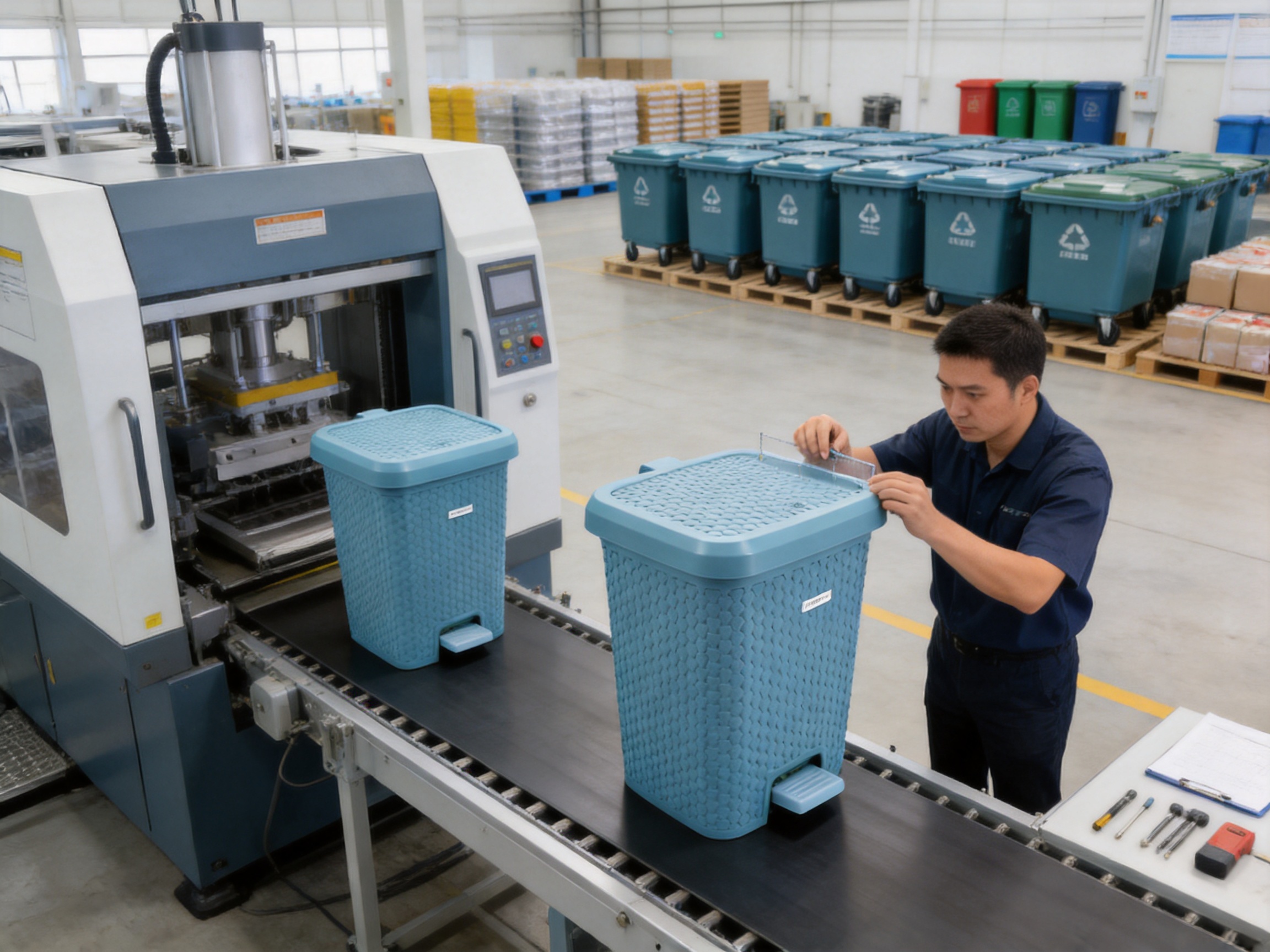
Industrial waste containers are essential products in factories, warehouses, commercial buildings, public facilities, transportation centers, residential communities, and municipal waste-management systems. Although a dustbin may appear to be a simple plastic product, its performance depends on many interconnected factors, including structural design, wall-thickness control, impact resistance, dimensional stability, mold precision, cycle efficiency, and production consistency. For manufacturers and distributors, the quality of the injection mold directly influences the quality, cost, appearance, and long-term market value of every finished container.
Industrial Dustbin Mold 003 is developed for manufacturers seeking dependable tooling for the production of durable plastic waste bins. The mold is suitable for high-volume injection molding applications in which repeatability, easy demolding, controlled production cycles, and stable product quality are essential. It is intended to support the manufacture of industrial dustbins with practical structures, smooth surfaces, reinforced load-bearing areas, and reliable performance during daily handling.
As a custom plastic injection mold, this tooling solution can be adapted to specific product drawings, container capacities, material requirements, molding machines, branding needs, and market standards. It is not limited to one universal configuration. Instead, the mold concept can be refined according to the customer’s product-development objectives, including external dimensions, handle structure, lid compatibility, caster installation, stacking requirements, drainage details, color, surface texture, and packaging method.
Zhejiang Chenghui Mould Co., Ltd. has more than 30 years of experience in the design and manufacture of injection molds for daily-use and industrial plastic products. Its capabilities cover dustbins, storage boxes, turnover boxes, laundry baskets, buckets, tables, chairs, furniture components, pallets, crates, and other molded products. With an in-house production workshop, advanced processing equipment, professional mold-testing injection machines, standardized procedures, and an annual production capacity of more than 1,500 mold sets, the company provides a complete tooling service from initial concept to after-sales support.
This article explains the principal features of Industrial Dustbin Mold 003, the design considerations behind industrial waste-container tooling, the production processes used to manufacture the mold, and the reasons this type of tooling can provide advantages over less carefully engineered alternatives.
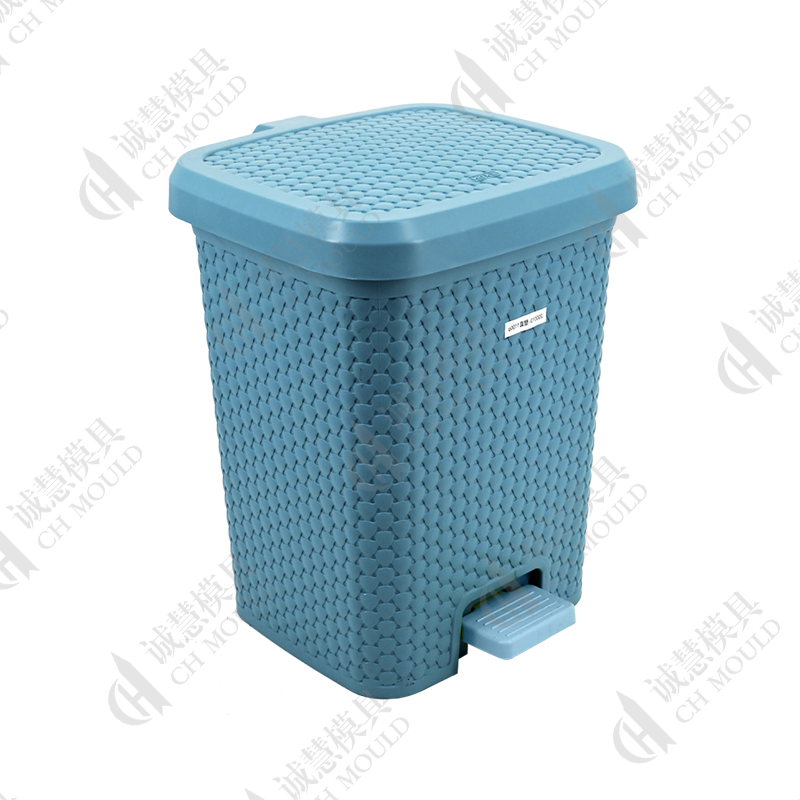
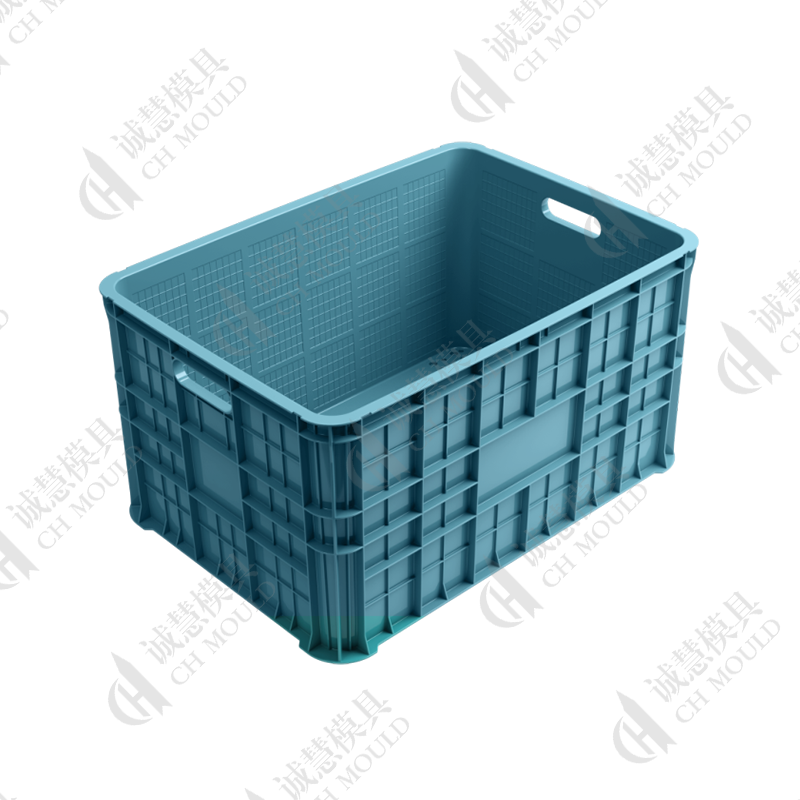
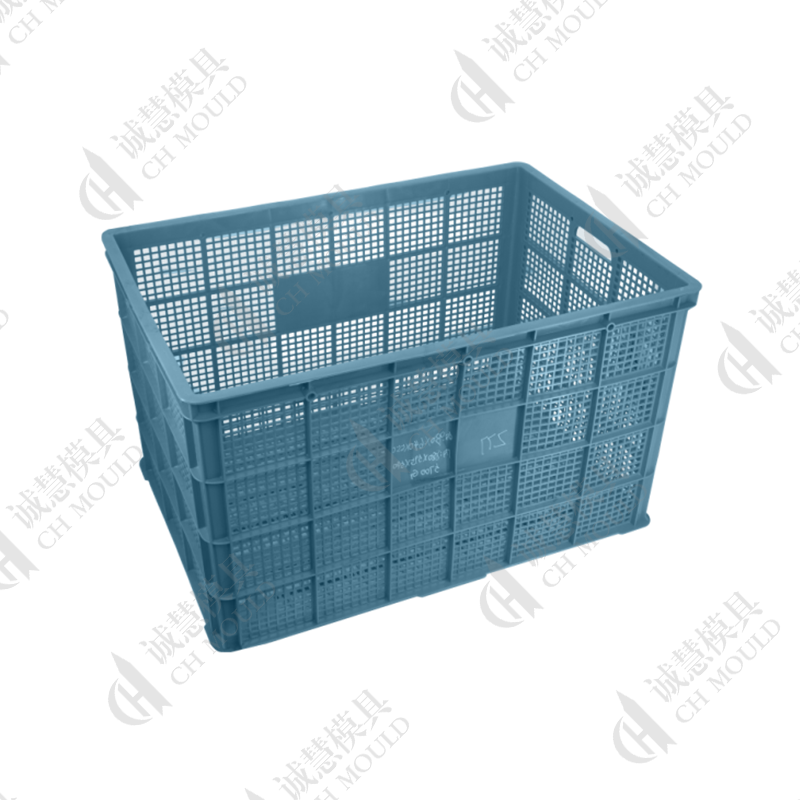
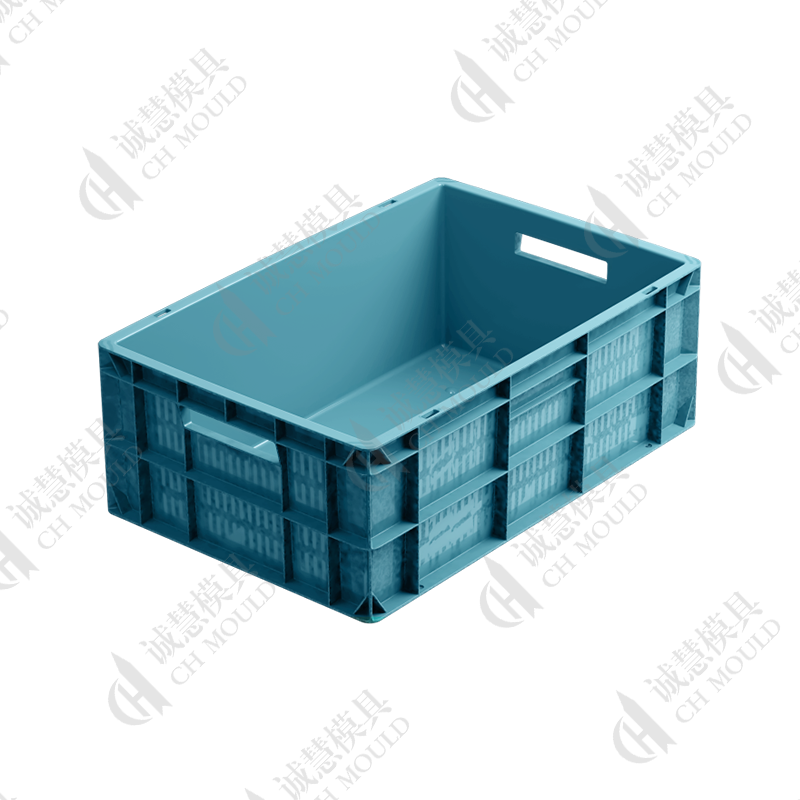
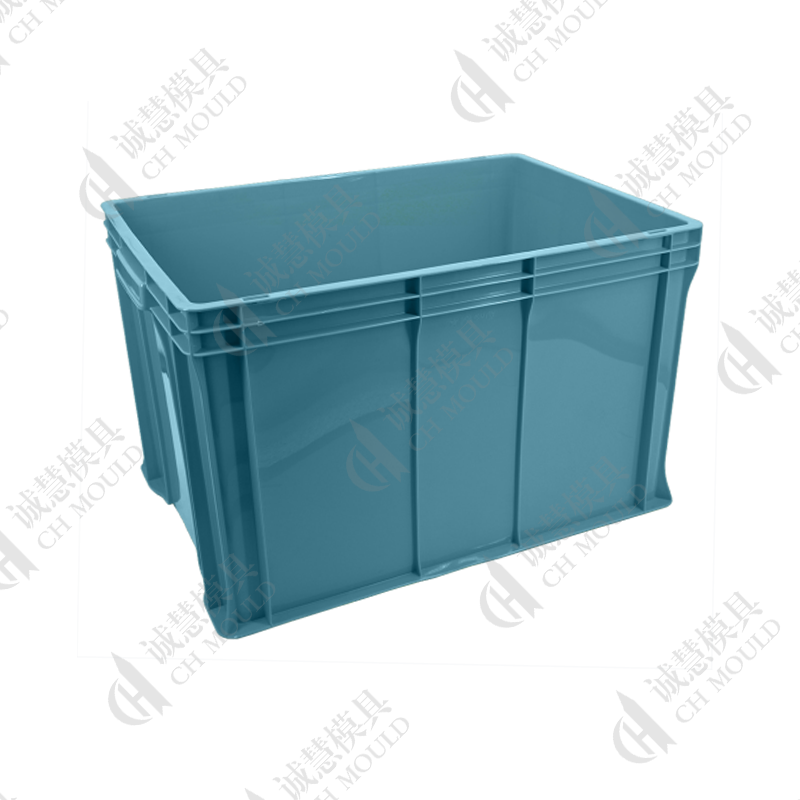
CHENGHUI Industrial Dustbin Mold 003
1. Product Positioning and Industrial Application
Industrial Dustbin Mold 003 is designed for plastic waste containers used in demanding environments. These containers may be placed indoors or outdoors and may be exposed to heavy use, rough handling, frequent cleaning, temperature changes, moisture, ultraviolet radiation, and contact with household, commercial, or industrial waste. The mold therefore needs to support a product structure that is both economical to manufacture and sufficiently robust for its intended service conditions.
Typical application environments include manufacturing workshops, logistics centers, food-processing facilities, office buildings, shopping centers, schools, hospitals, hotels, apartment complexes, public streets, construction sites, and waste-collection areas. Depending on the final design, the molded dustbin may be used for general waste, recyclable materials, organic waste, production scraps, packaging residues, or specialized collection programs.
The product category is particularly suitable for manufacturers that require repeatable production of medium- or large-volume plastic containers. A well-designed mold allows the producer to maintain consistent dimensions across thousands of cycles. This is important because many dustbins are sold in sets, distributed through wholesalers, or integrated into larger waste-management systems. If dimensions vary significantly from one production batch to another, lids may fit poorly, wheels may become misaligned, stacking may be difficult, and customers may experience premature product failure.
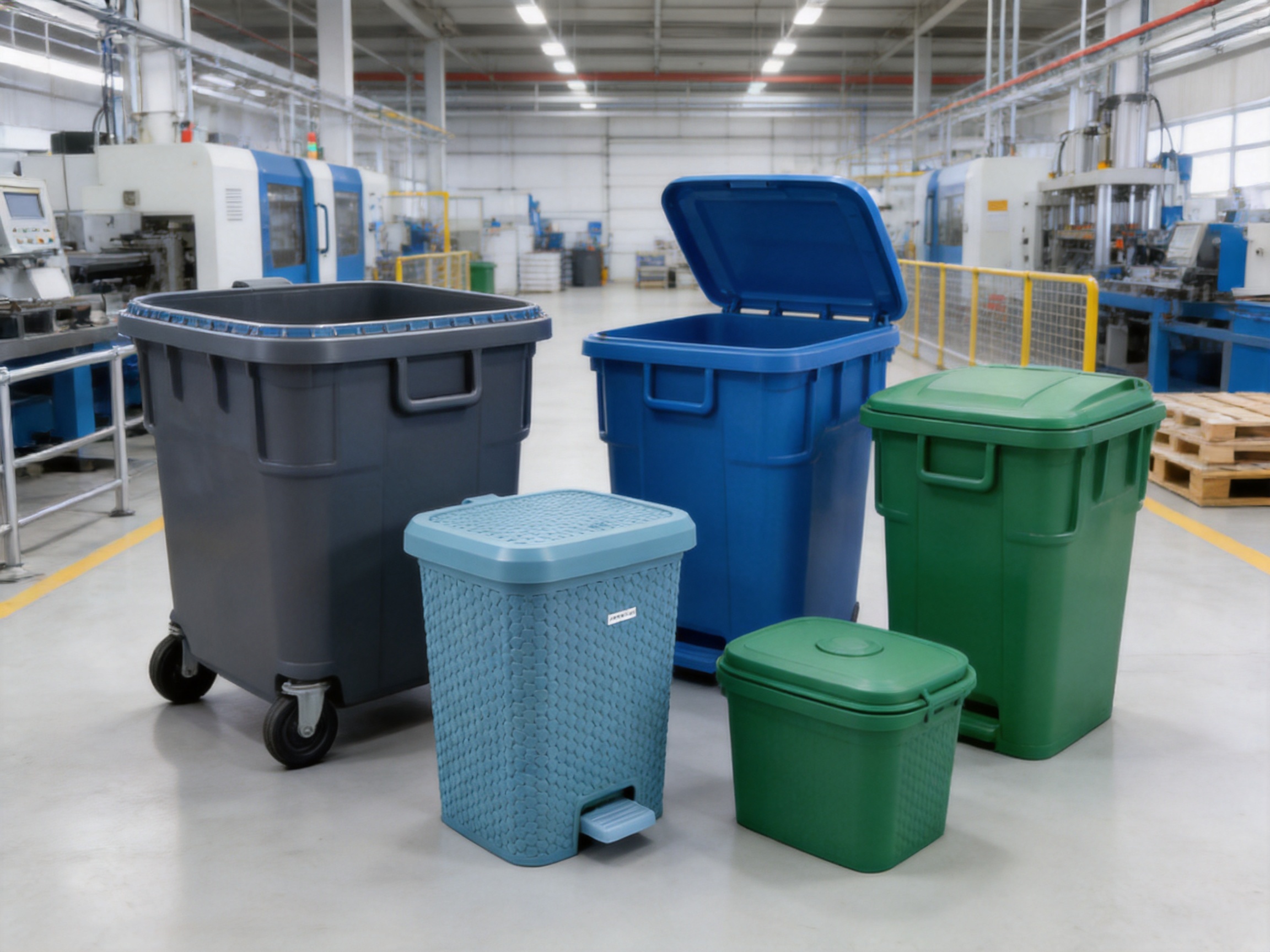
Industrial Dustbin Mold 003 can be developed around different container concepts. These may include open-top bins, bins with separate lids, bins with hinged covers, wheeled waste containers, recycling bins with color-coded bodies, and heavy-duty containers with reinforced rims. The final mold configuration should be established through product drawings, sample review, resin selection, machine analysis, and a detailed design-for-manufacturing assessment.
2. Core Product Advantages
2.1 Designed for Repeatable Mass Production
The primary advantage of a professional industrial dustbin mold is repeatability. A mold must reproduce the same product geometry over and over while maintaining stable dimensions, surface quality, and assembly compatibility. Industrial Dustbin Mold 003 is developed with production consistency as a central objective.
Consistent production supports easier quality control and reduces the need for extensive manual correction after molding. When the mold is properly balanced and accurately machined, the manufacturer can achieve more uniform filling, cooling, and ejection. This helps limit dimensional variation, deformation, sink marks, short shots, flash, and other defects that can reduce the commercial value of the finished dustbin.
For wholesalers and distributors, repeatability also improves supply reliability. Products made from stable tooling can be replenished with fewer differences between shipments. This is especially valuable when a customer has established a waste-container system and expects replacement bins to match the original products in size, appearance, and accessory compatibility.
2.2 Strong Structural Performance
Plastic dustbins are frequently lifted, dragged, pushed, stacked, emptied, cleaned, and exposed to impact. The container body must therefore be engineered to resist cracking and deformation. Mold design plays an important role in supporting this performance by accurately forming reinforced edges, corner transitions, ribs, handles, wheel supports, base structures, and other load-bearing features.
Industrial Dustbin Mold 003 can be customized to create structural reinforcement without adding unnecessary material to every area of the product. This approach helps the manufacturer achieve a practical balance between strength and weight. Strategic ribs and reinforced zones may improve rigidity while preserving an efficient overall wall structure. Smooth transitions between thick and thin areas can also reduce stress concentration and improve molding stability.
The rim is particularly important because it may experience repeated contact with lids, lifting equipment, collection vehicles, and handling personnel. A precisely formed rim helps maintain the opening shape and supports better lid alignment. Similarly, the bottom area requires careful consideration because it bears the weight of the container and its contents. Molded support details can improve stability when the bin is placed on uneven industrial or outdoor surfaces.
2.3 Efficient Material Distribution
Material distribution affects product weight, strength, appearance, cooling behavior, and production cost. Excessively thick sections can create sink marks, longer cooling times, internal stress, and unnecessary resin consumption. Sections that are too thin may produce short shots, weak areas, or incomplete filling. A carefully developed mold works together with the product design to encourage balanced filling and predictable cooling.
During mold development, the engineering team can review wall thickness, rib geometry, corner radii, gate location, runner arrangement, and cooling layout. These factors help determine how molten plastic moves through the cavity and how the product solidifies. By identifying potential problems before steel machining is completed, the manufacturer can reduce modification work and improve the probability of a successful first trial.
Efficient material use is especially important in the industrial dustbin market because these products are generally produced in large quantities. Even a small reduction in average product weight can create meaningful savings across a long production run. At the same time, weight reduction must never compromise the structural requirements of the container. The objective is a balanced, technically justified design rather than simply using less material.
2.4 Smooth and Practical Surface Quality
The external appearance of a dustbin affects customer perception, cleaning convenience, and brand presentation. A professional mold can support smooth visible surfaces, controlled parting lines, consistent textures, and clean transitions around handles and reinforced sections. Depending on the customer’s requirements, the product may use a polished finish, a matte texture, a functional anti-scratch texture, or a customized surface pattern.
Surface quality must be considered together with demolding. A surface that looks attractive but creates excessive friction during ejection may reduce production efficiency or cause marks on the product. Draft angles, texture depth, ejection-force distribution, and local geometry all influence whether the molded dustbin can be removed smoothly from the cavity.
For commercial and public-use containers, a practical surface is often more valuable than an overly decorative one. It should be easy to wipe, resistant to visible scuffing, and compatible with common cleaning procedures. The mold design can be adjusted to match the intended usage environment and the customer’s visual identity.
3. Mold Design Considerations
3.1 Product Geometry and Draft Angles
Industrial dustbins commonly include tapered walls to support nesting, demolding, storage, and transportation. The taper must be carefully controlled because it affects both product capacity and mold release. Insufficient draft may cause the product to stick in the cavity, while excessive draft may reduce internal volume or alter the visual proportions of the container.
Designers evaluate the relationship between external walls, internal walls, ribs, handles, corners, bottom features, and lid interfaces. Every area that contacts the mold requires suitable release consideration. If the dustbin includes deep recesses, undercuts, locking structures, or integrated hinges, the mold may require sliders, lifters, inserts, collapsible components, or other specialized mechanisms.
Draft analysis is usually performed during the early design stage. This allows potential interference areas to be corrected before detailed mold construction. Early review is more efficient than discovering release problems after the mold has been machined and assembled.
3.2 Gate and Runner Planning
The injection system determines how molten plastic enters and travels through the mold. Gate location is particularly important for large products such as industrial dustbins because the cavity may have a considerable flow length and broad surface area. An unsuitable gate position can produce weld lines in weak locations, uneven filling, visible flow marks, excessive pressure requirements, or unbalanced shrinkage.
Depending on the product size, resin, machine, and appearance requirements, the mold may use a cold-runner system, hot-runner system, edge gate, tab gate, fan gate, pin gate, or another suitable arrangement. The best solution is determined through engineering analysis rather than by using one standard layout for every project.
A balanced runner system helps distribute material more evenly and can support stable filling across the cavity. For certain designs, a hot-runner arrangement may reduce runner waste and improve cycle efficiency. For other applications, a conventional runner system may offer a practical balance of maintenance simplicity, tooling cost, and production reliability.
3.3 Cooling System Design
Cooling is one of the most important factors in injection-mold performance. Plastic must be cooled sufficiently before ejection, but excessive cooling time reduces output. Uneven cooling can cause warpage, residual stress, dimensional inconsistency, and deformation around thick sections or reinforced features.
The cooling layout for an industrial dustbin mold should follow the actual geometry of the product. Large flat walls, thick corners, base structures, rims, and handle areas may require different cooling considerations. Water channels should be positioned to remove heat efficiently while preserving mold strength and avoiding interference with screws, inserts, ejection components, and other mechanisms.
Good cooling design can shorten cycle times and improve product stability. It also reduces the likelihood that one side of the container will shrink differently from another. For manufacturers operating multiple shifts, these benefits can produce meaningful improvements in daily output and production predictability.
3.4 Ejection and Demolding
The ejection system must remove the molded dustbin without damaging its surfaces or distorting its shape. Depending on the design, the mold may use ejector pins, ejector plates, stripper plates, air assistance, lifters, or a combination of these methods.
Large products require evenly distributed ejection force. If force is concentrated in a small number of locations, the product may bend, show ejector marks, or remain partially attached to the mold. Ejection points should therefore be positioned according to the product’s structural areas and expected demolding resistance.
The mold-opening sequence also influences production safety and cycle efficiency. Moving components must operate smoothly, and the mold should provide sufficient clearance for part removal, operator access, robotic handling, or automated downstream equipment. A well-planned ejection system reduces interruptions and supports stable operation over long production runs.
3.5 Mold Steel and Wear Resistance
Material selection for the mold affects service life, repairability, surface quality, and total ownership cost. The appropriate steel grade depends on production volume, plastic resin, product size, surface requirements, corrosion exposure, and expected maintenance conditions.
Industrial dustbin molds may operate for many thousands or millions of cycles. Repeated injection pressure, clamping force, thermal changes, ejection movement, and cleaning procedures gradually affect mold components. Wear-resistant steel and properly treated working surfaces can help preserve dimensional accuracy and reduce unplanned maintenance.
Corrosion resistance may also be important, especially when the mold is exposed to humid conditions, water-based cleaning, or resins that contain additives. The mold builder can recommend suitable steels, heat treatments, coatings, inserts, and maintenance procedures according to the customer’s production plan.
4. Manufacturing Process and Quality Control
4.1 Product Review and Technical Communication
Professional mold manufacturing begins before cutting steel. The engineering team first reviews the customer’s drawings, three-dimensional data, product samples, resin requirements, annual output expectations, injection-machine parameters, and quality standards. This stage is used to identify risks and establish the technical foundation for the project.
Important questions include the required product capacity, target weight, wall thickness, material type, shrinkage rate, surface finish, color, assembly method, lid structure, wheel installation, packaging arrangement, and acceptable dimensional tolerances. The customer may also specify restrictions related to gate marks, parting lines, ejector marks, texture, logo placement, or recycling content.
Clear communication at this stage prevents misunderstandings later. It also allows the mold manufacturer to suggest improvements that may lower production cost or increase tool reliability without changing the fundamental product concept.
4.2 Moldflow and Design Verification
Digital design verification can be used to review filling behavior, pressure requirements, cooling performance, weld-line locations, air-trap risks, shrinkage, and possible warpage. These analyses are valuable for large or complex dustbins because small design problems can become expensive when the cavity is already completed.
Engineering review may also include mold-opening simulation, interference checking, draft analysis, ejection analysis, and cooling-channel verification. The purpose is to confirm that the design is practical to manufacture, assemble, test, maintain, and operate.
A well-organized design process reduces the likelihood of repeated steel modifications. It also supports better communication between the mold factory and the injection-molding customer, particularly when the project involves overseas production or multiple approval stages.
4.3 CNC Machining and Precision Processing
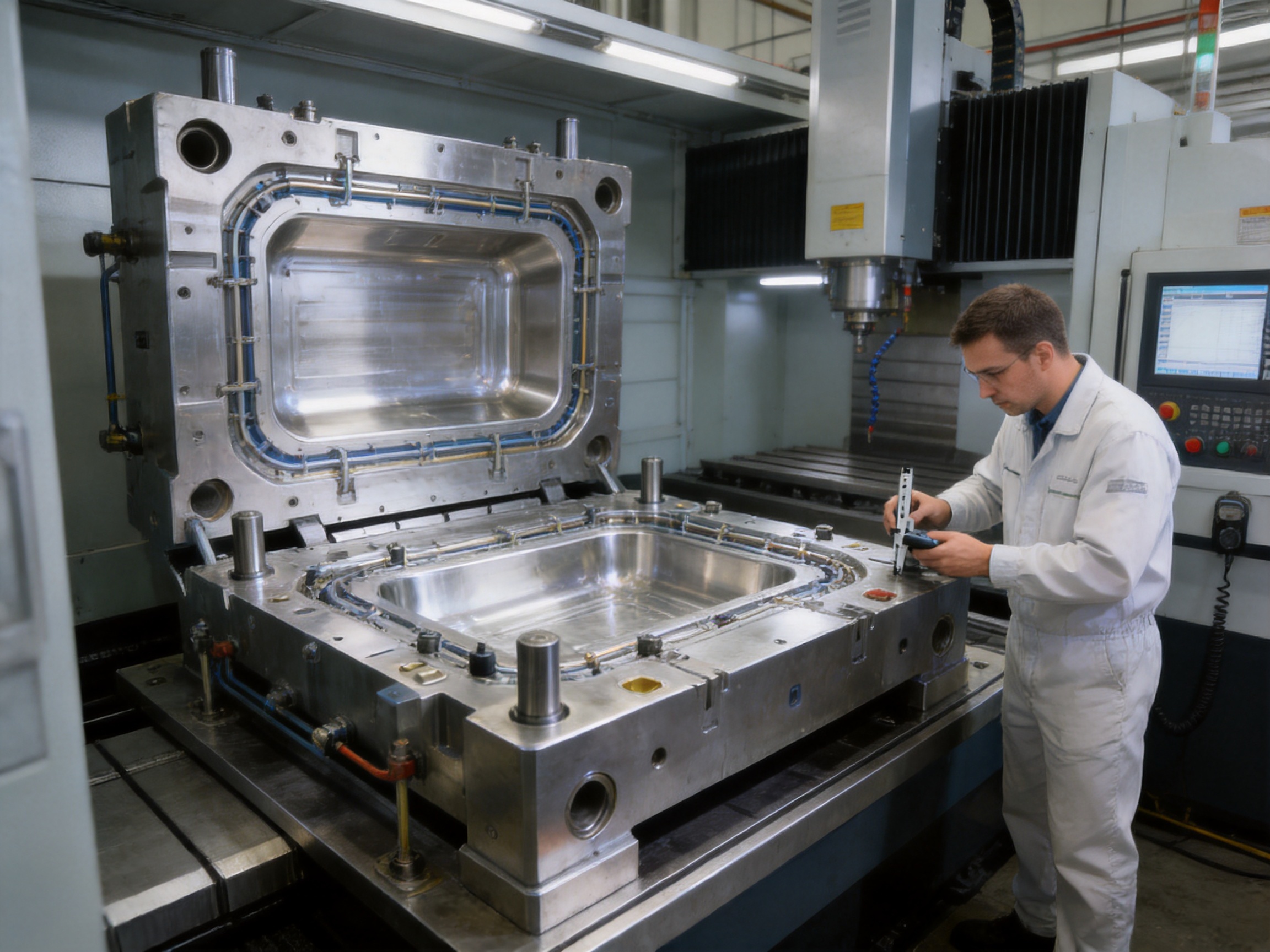
After design approval, the mold components are produced through a sequence of precision machining operations. These may include cutting, milling, drilling, high-speed machining, electrical discharge machining, wire cutting, grinding, polishing, and other specialized processes.
The company operates 104 advanced processing machines, giving it substantial in-house manufacturing capability. This equipment supports the production of cavity and core components, mold bases, inserts, slides, lifters, cooling channels, ejection components, and other tooling elements. Internal processing can improve coordination between departments and provide better control over critical dimensions.
CNC machining creates the main geometry of the mold, while EDM and wire-cutting processes support intricate details, narrow slots, sharp internal features, and difficult-to-machine areas. Grinding and polishing help achieve the required precision and surface quality. Each process contributes to the final performance of the tool.
4.4 Assembly and Fitting
Precision machining alone is not sufficient. Mold components must be assembled and fitted so that they move correctly and maintain the designed alignment. Skilled technicians inspect parting surfaces, guide systems, inserts, sliders, lifters, ejection components, cooling connections, and other functional areas.
Fitting work is especially important for large dustbin molds because the mold may contain broad cavity surfaces and substantial moving components. Small alignment errors can lead to flash, uneven wear, difficult opening, or premature failure. Careful assembly helps ensure that the mold operates smoothly and that the product remains consistent during testing and mass production.
4.5 Trial Molding and Product Evaluation
Before shipment, the mold is tested on professional injection-molding equipment. Trial molding allows engineers to evaluate filling, packing, cooling, ejection, cycle behavior, surface appearance, dimensional accuracy, and assembly compatibility. The resulting samples are reviewed against the approved product requirements.
Trial results may lead to process adjustments or controlled mold modifications. These could include changes to injection speed, holding pressure, cooling time, ejection timing, gate dimensions, venting, polishing, or local steel correction. The goal is to deliver a mold that is ready for the customer’s production environment rather than merely a tool that appears complete visually.
Testing also helps establish initial molding parameters. Although final settings may vary according to the customer’s machine and resin supplier, trial data provides a useful starting point for production engineers. This can shorten the commissioning period after the mold reaches the customer’s factory.
4.6 Final Inspection and Documentation
Quality management continues through final inspection. Mold components, product samples, cooling circuits, ejection action, dimensions, surface condition, and appearance are checked before delivery. Documentation may include product inspection records, mold operation instructions, spare-parts information, test reports, and maintenance recommendations.
Complete documentation is valuable for overseas customers, distributors, and manufacturers operating multiple production sites. It helps production teams understand the tool, perform routine maintenance, and respond more efficiently if adjustments are required in the future.
5. Competitive Advantages Compared with Less-Optimized Tooling
| Evaluation Area | Industrial Dustbin Mold 003 Approach | Potential Limitation of Basic Tooling | Customer Benefit |
|---|---|---|---|
| Product consistency | Controlled machining, fitting, trial molding, and inspection | Greater variation between batches | More reliable dimensions and easier quality control |
| Structural performance | Support for reinforced rims, corners, bases, handles, and load-bearing zones | Weak areas or unnecessary material concentration | Better durability with balanced material use |
| Production efficiency | Planned runner, cooling, and ejection systems | Longer cycles, unstable filling, or difficult demolding | Higher output and fewer interruptions |
| Design flexibility | Custom development based on drawings, samples, resin, and machine conditions | Limited adaptation to specific product requirements | More suitable tooling for regional and market-specific needs |
| Service life | Appropriate steel, treatment, precision fitting, and maintenance planning | Faster wear or more frequent repair | Lower long-term tooling risk |
| Project support | Concept review, design, machining, testing, inspection, and after-sales assistance | Fragmented communication between suppliers | Simpler project coordination |
5.1 Better Balance Between Weight and Strength
One common weakness of poorly designed dustbin tooling is that the finished product may be either excessively heavy or insufficiently strong. Excessive weight raises resin costs, transport costs, and handling difficulty. Insufficient strength leads to cracking, distortion, and customer complaints.
Industrial Dustbin Mold 003 supports a more balanced approach through careful consideration of ribs, corners, wall thickness, base design, and material flow. The mold does not simply reproduce a large hollow shape; it is developed to support the functional requirements of a real industrial container.
5.2 More Predictable Production Cycles
Production efficiency depends on more than the injection machine’s rated capacity. Mold cooling, ejection, filling stability, and operator intervention all influence the true cycle time. A mold that requires repeated manual assistance or frequent process correction may reduce output even if its nominal cycle appears acceptable.
By reviewing cooling and ejection during design and validating the tool through test molding, the manufacturer can help create a more predictable production process. Stable cycle performance is particularly valuable for companies supplying large orders to wholesalers, municipal contractors, and commercial customers.
5.3 Reduced Modification Risk
Late-stage mold modifications can delay product launch and increase project expense. They may also affect surface appearance, delivery schedules, and the customer’s confidence in the tooling supplier. Digital review, precise machining, careful assembly, and trial molding reduce the risk of major corrections after the first test.
Some adjustment is normal in injection-mold development, especially for large products with complex flow behavior. The advantage of an experienced mold manufacturer is the ability to identify likely issues early and address them systematically rather than relying on repeated trial and error.
5.4 Suitable for OEM and ODM Projects
Many industrial dustbin buyers do not want an off-the-shelf product. They may require a specific capacity, color system, brand identity, lid design, wheel arrangement, handle shape, or regional compliance feature. Custom tooling allows the product to reflect the customer’s market strategy.
The OEM and ODM service capability provided by Chenghui Mould supports projects from initial concept through mold testing. Customers can provide drawings, samples, product ideas, or performance requirements. The engineering team can then help convert those requirements into a manufacturable mold structure.
6. Company Manufacturing Strengths
6.1 More Than Three Decades of Experience
Founded in 1994, Zhejiang Chenghui Mould Co., Ltd. has accumulated more than 30 years of experience in plastic injection mold development. This experience covers many everyday and industrial product categories, including household containers, furniture products, storage products, turnover boxes, pallets, laundry baskets, buckets, trash cans, and related articles.
Experience across multiple product categories is valuable because many mold-design principles are interconnected. Lessons learned from storage boxes, crates, or furniture components can contribute to better solutions for dustbin rims, ribs, handles, bases, and surface requirements. At the same time, experience with large household and industrial products helps the engineering team understand the practical challenges of broad cavities, long flow paths, large cooling areas, and substantial ejection forces.
6.2 In-House Processing Capability
The company operates its own production workshop with 104 advanced processing machines. In-house manufacturing gives the project team greater control over machining schedules, component quality, design changes, fitting work, and test preparation. It also makes communication more direct because engineering, machining, assembly, and testing teams can coordinate within the same organization.
This integrated capability can be especially useful when a mold requires an adjustment after trial molding. Instead of sending components through several unrelated suppliers, the factory can evaluate the issue and organize the necessary processing and fitting work through its internal production system.
6.3 Professional Injection Mold Testing
Testing on professional injection-molding machines allows the mold builder to verify whether the tool performs as intended. This is an important advantage over suppliers that manufacture the mold but do not have adequate testing capabilities.
Trial molding provides practical evidence of filling, cooling, ejection, product appearance, and dimensional stability. It also allows the team to check whether the mold is compatible with the planned resin and general machine conditions. For large dustbin tooling, this stage can reveal issues that are difficult to identify through drawings alone.
6.4 Standardized Processes and Quality Management
Standardized processes help make quality less dependent on individual judgment. Design review, material selection, machining, inspection, assembly, testing, and packaging should all follow defined procedures. Such consistency is important when a manufacturer is handling many projects for different markets and product categories.
Strict quality management supports the company’s goal of delivering molds that are accurate, reliable, and suitable for mass production. It also helps establish traceability throughout the project, from the original customer requirements to the final mold inspection and shipment.
6.5 International Market Experience
Chenghui Mould exports molds to the Middle East, Europe, America, Africa, Southeast Asia, and other regions. International project experience requires attention to communication, drawings, time zones, packaging, delivery coordination, documentation, and after-sales response.
Different markets may have different preferences regarding product appearance, waste classification, container dimensions, resin selection, labeling, and operating conditions. A mold factory with international experience is better positioned to discuss these differences and support customers who sell through overseas distribution channels.
7. Customization Options for Industrial Dustbin Mold 003
The final tooling configuration should be determined by the customer’s product and business objectives. Common customization areas include container volume, external dimensions, wall thickness, taper, lid design, handle configuration, wheel supports, stacking features, drainage structure, locking features, surface texture, logo placement, and color separation.
Customers may also request special details for recycling programs. For example, separate container colors may identify paper, plastic, glass, organic waste, or general refuse. The mold can be designed to support a consistent product platform while allowing different visual or functional versions.
Material selection is another important customization factor. Common injection-molding resins for waste containers may include polypropylene, high-density polyethylene, or other suitable thermoplastics. The best resin depends on impact requirements, stiffness, temperature conditions, chemical exposure, outdoor use, recycling content, and customer cost targets.
When recycled material is used, the product and mold should be evaluated carefully because recycled resin may have different flow, shrinkage, moisture, color, and contamination characteristics than virgin material. The mold design and process window may need to accommodate these differences.
Surface texture can also be customized. A textured surface may reduce the visibility of scratches and fingerprints, while a smoother surface may be preferred for easy cleaning or a more refined appearance. The selected texture should be reviewed together with draft angles and demolding requirements.
8. Commercial Value for Wholesalers and Distributors
For wholesalers and distributors, tooling quality affects more than the manufacturing process. It influences product availability, return rates, customer satisfaction, logistics costs, and the ability to build a consistent product range.
A reliable dustbin mold helps manufacturers maintain steady supply during seasonal demand or large project orders. Consistent products are easier to package, catalog, display, and sell. They also support repeat purchasing because customers can order additional units that match their existing waste-management equipment.
Durability is a strong commercial advantage. Industrial users are less likely to replace containers frequently when the products resist impact, deformation, and everyday wear. A durable product can therefore support a stronger market reputation than a low-cost alternative that fails prematurely.
Efficient material distribution and stable cycle performance may also improve the manufacturer’s cost structure. These savings can be used to remain competitive, improve margins, or invest in packaging and distribution. The value of a mold should therefore be assessed over its complete production life rather than only by its initial purchase price.
9. Recommended Project Workflow
9.1 Requirement Collection
The customer begins by providing product drawings, three-dimensional files, samples, photographs, capacity targets, material information, expected output, and machine details. If the product is still at the concept stage, basic sketches and functional requirements can be used as a starting point.
9.2 Technical Assessment
The mold engineering team reviews the product for draft, wall thickness, ribs, parting lines, gates, cooling, ejection, shrinkage, and manufacturability. Possible risks and recommended changes are communicated before final design approval.
9.3 Mold Design Approval
A detailed mold design is prepared for customer review. The design may include the mold structure, cavity and core arrangement, runner system, cooling channels, ejection system, inserts, sliders, material specifications, and estimated operating considerations.
9.4 Machining and Assembly
After approval, the factory processes mold components using appropriate cutting, CNC, EDM, wire-cutting, grinding, polishing, and fitting operations. Inspection is performed throughout the manufacturing process to control critical dimensions.
9.5 Trial Molding and Corrections
The completed mold is tested using suitable injection-molding equipment. Product samples are evaluated for appearance, dimensions, filling, demolding, deformation, and assembly. If required, controlled corrections are completed before final acceptance.
9.6 Delivery and After-Sales Support
After inspection and approval, the mold is prepared for shipment with relevant documentation and maintenance information. The factory can continue to provide technical communication and after-sales assistance as the customer begins mass production.
10. Maintenance and Long-Term Mold Performance
Even a well-manufactured mold requires proper maintenance. Routine cleaning, lubrication, cooling-channel inspection, vent cleaning, fastener checks, and moving-component inspection can help preserve mold performance. Maintenance intervals should be based on production volume, resin type, cycle conditions, and environmental exposure.
The mold should be cleaned after production, particularly when the resin contains additives or when the tooling is used in a humid environment. Water should be removed from cooling circuits when the mold will be stored for an extended period, and exposed steel surfaces should receive suitable rust protection.
Operators should also monitor changes in product quality. New flash, difficult ejection, visible flow marks, increased cycle time, uneven cooling, or dimensional drift may indicate wear, blockage, misalignment, or process changes. Early attention can prevent a small issue from becoming a major repair.
Spare components may be recommended for high-volume projects. Items such as ejector pins, seals, wear plates, inserts, springs, or selected moving components can be prepared according to the mold structure and expected production schedule. Planned spare parts reduce downtime when replacement becomes necessary.
11. Frequently Asked Questions
Q1: What type of product is Industrial Dustbin Mold 003 designed to manufacture?
It is designed for injection-molded industrial plastic dustbins and related waste containers. The final product may be configured for commercial, municipal, household, warehouse, factory, or public-environment applications according to the customer’s requirements.
Q2: Can the mold be customized for different dustbin sizes?
Yes. The mold can be developed around customer-supplied drawings, samples, or product concepts. Dimensions, capacity, wall thickness, taper, lid structure, handles, wheel supports, textures, and other details can be reviewed during the engineering stage.
Q3: Which plastics can be used?
The suitable resin depends on the required impact resistance, stiffness, temperature performance, chemical resistance, outdoor exposure, recycled-content target, and cost. Polypropylene, high-density polyethylene, and other appropriate thermoplastics may be considered after technical review.
Q4: How does the mold help improve product durability?
The mold supports accurate formation of reinforced rims, corners, bases, ribs, handles, and other structural features. It also helps maintain consistent wall thickness and balanced material distribution, which can reduce weak points and deformation when the product is correctly designed and processed.
Q5: How can the mold reduce production costs?
Cost efficiency may come from balanced material use, stable cycle times, efficient cooling, reliable ejection, reduced defect rates, and longer mold service life. The actual savings depend on product design, resin, machine conditions, production volume, and process settings.
Q6: Does the manufacturer test the mold before delivery?
Yes. The company has professional injection-molding machines for mold testing. Trial molding is used to evaluate filling, cooling, ejection, appearance, dimensions, and general production performance before shipment.
Q7: Can the mold include a customized logo or surface texture?
Logo placement, lettering, texture, and other surface features can generally be incorporated if they are included in the approved product design. Their feasibility depends on the location, depth, draft, appearance requirements, and demolding conditions.
Q8: What information should a customer provide for a quotation?
Useful information includes product drawings or samples, three-dimensional data if available, estimated dimensions and capacity, resin type, target weight, annual output, injection-machine specifications, surface requirements, lid or accessory details, and the intended market.
Q9: How long can the mold last?
Service life depends on steel selection, production volume, resin characteristics, injection pressure, cycle conditions, maintenance, and product geometry. A suitable steel grade and proper maintenance plan can support long-term production, but the expected cycle requirement should be discussed before manufacture.
Q10: Does the company provide after-sales support?
Yes. Chenghui Mould provides technical communication and after-sales support related to mold operation, maintenance, testing, and production adjustments. Specific support arrangements can be confirmed according to the project and delivery requirements.
12. Conclusion
Industrial Dustbin Mold 003 is a practical tooling solution for manufacturers that need reliable, repeatable, and scalable production of plastic waste containers. Its value lies not only in forming the basic shape of a dustbin, but also in supporting structural strength, efficient material use, stable cooling, smooth ejection, consistent appearance, and dependable mass production.
Compared with basic or poorly optimized tooling, a professionally engineered mold can provide better control of dimensions, lower defect risk, more predictable cycle performance, improved product durability, and greater flexibility for OEM and ODM development. These advantages are important for manufacturers supplying wholesalers, distributors, commercial projects, municipal users, and international markets.
Zhejiang Chenghui Mould Co., Ltd. combines more than 30 years of experience with an in-house production workshop, 104 advanced processing machines, professional injection-molding equipment, standardized manufacturing procedures, strict quality management, and a complete service process. From concept review and mold design to machining, assembly, trial molding, inspection, delivery, and after-sales support, the company is equipped to assist customers developing industrial dustbins and other daily-use plastic products.
For companies planning a new waste-container product or upgrading an existing production system, the most effective approach is to review the product and mold together. A well-balanced design, appropriate material, accurate tooling, controlled processing, and disciplined maintenance create the foundation for a dustbin that performs reliably in demanding environments and remains commercially competitive over the long term.
References
1. Injection Molding Handbook, principles of plastic flow, mold construction, cooling, ejection, and production control.
2. Plastics Engineering Fundamentals, guidance on thermoplastic behavior, shrinkage, wall-thickness design, and material selection.
3. Design for Injection Molding, recommendations for draft angles, ribs, bosses, corners, gates, parting lines, and manufacturability.
4. Mold Steel Selection and Heat Treatment Practices, general principles for wear resistance, corrosion control, hardness, and service life.
5. Industrial Waste-Container Design Guidelines, considerations for structural performance, handling, cleaning, stacking, and environmental use.
6. Company-provided technical information concerning plastic injection mold design, manufacturing equipment, product categories, testing capability, production capacity, and international service experience.