
 Français
 Español
 عربى
Plastic chairs are widely used in homes, offices, schools, restaurants, public facilities, event venues, and commercial spaces. Their popularity comes from a practical combination of affordability, lightweight construction, easy maintenance, weather resistance, and flexible design. However, producing a dependable plastic chair at scale requires much more than an attractive product concept. The injection mold must control every essential detail, including wall thickness, structural ribs, leg strength, surface appearance, dimensional accuracy, assembly interfaces, cooling performance, and ejection reliability.
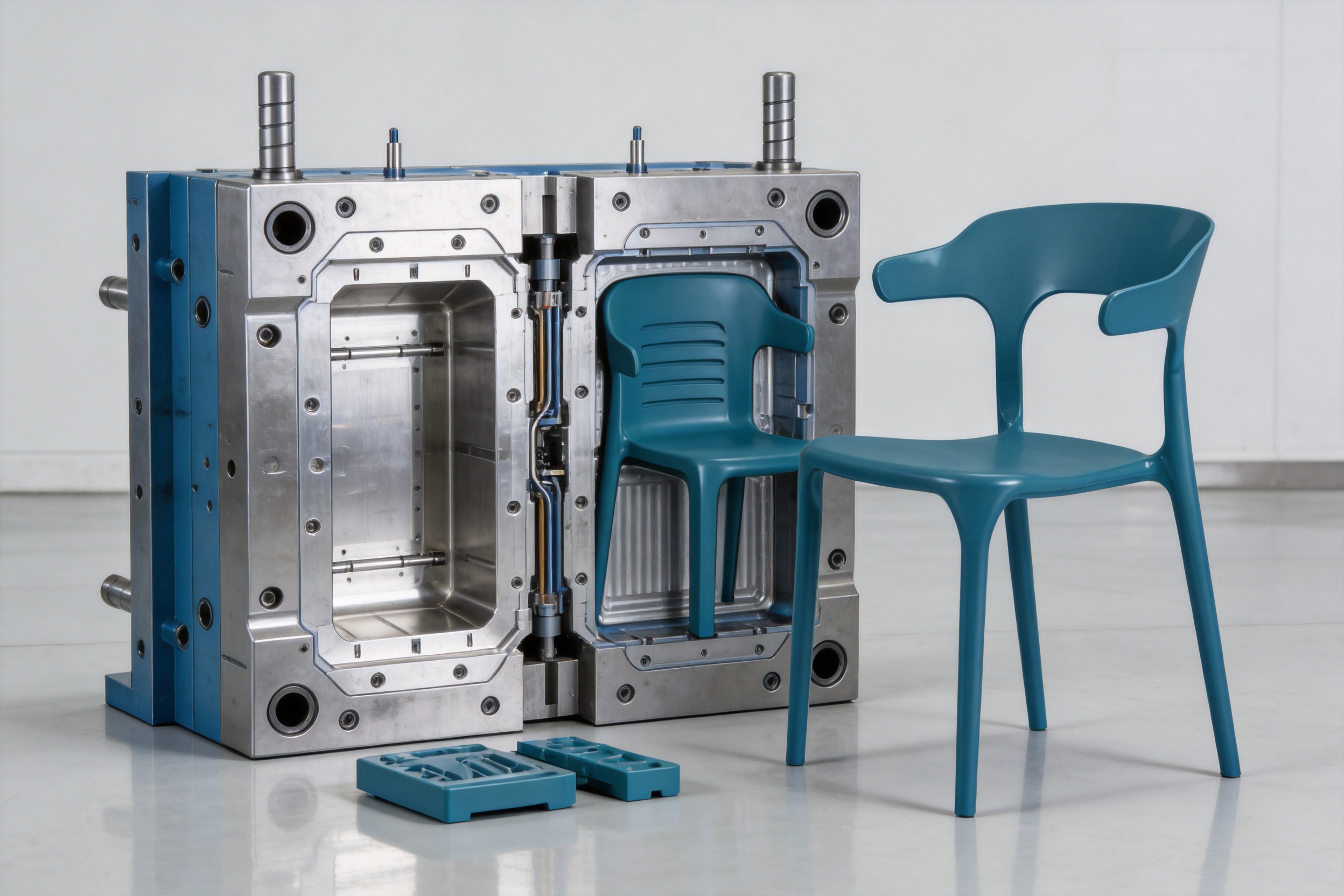
Plastic Chair Injection Mold 014 is developed for manufacturers seeking a stable and efficient tooling solution for plastic chair production. It is designed around the requirements of injection molding, where repeatability, balanced filling, controlled cooling, and long-term durability directly influence the final chair’s quality and production cost. By combining practical mold engineering with precision machining and systematic inspection, this type of tooling can help chair manufacturers achieve consistent parts during extended production runs.
The mold is suitable for customers that require custom plastic chair manufacturing, OEM production, or ODM development. It can be adapted to the selected chair design, resin, machine specification, appearance standard, and expected production volume. With professional design review and trial molding, the tooling process can address potential problems before mass production begins, reducing corrective work and helping the finished chair meet commercial requirements.
Why the Chair Mold Determines Finished Product Quality
In injection molding, the mold is the production system that transforms molten plastic into a finished product. The injection machine supplies heat and pressure, but the mold determines the shape, surface, cooling path, and release behavior of the chair. A poorly designed mold may still produce an initial sample, but it can create serious problems during continuous manufacturing. These problems may include warpage, sink marks, short shots, weld lines, flash, uneven gloss, difficult ejection, dimensional variation, and premature mold wear.
A plastic chair is particularly demanding because it is a large molded article with broad visible surfaces and load-bearing sections. The backrest, seat, armrests, legs, support ribs, and foot areas must work together as one structural product. Large flat or gently curved areas can be vulnerable to deformation if filling and cooling are not balanced. Thick junctions can retain heat and develop sink marks. Long flow paths can increase pressure loss. Deep ribs and narrow passages can complicate ejection and create local stress.
Plastic Chair Injection Mold 014 focuses on the engineering relationship between the chair design and the production process. The objective is not simply to reproduce the external outline. The objective is to create a tool that can manufacture chairs consistently, release them safely, support an efficient cycle, and maintain acceptable appearance and performance throughout its service life.
For wholesalers, distributors, furniture manufacturers, and project buyers, mold quality directly affects the reliability of supply. A stable mold helps reduce production interruptions, sorting requirements, material waste, and customer complaints. It also supports more predictable delivery schedules because the manufacturer can operate the injection machine with fewer unexpected adjustments.

CHENGHUI Plastic Chair Mold 014
Product Overview and Application Scope
Plastic Chair Injection Mold 014 belongs to the category of plastic chair injection tooling. It is intended for the production of molded chair components or complete one-piece chair designs, depending on the final product structure and the customer’s technical drawings. The tool can be developed for chairs used in domestic, commercial, educational, hospitality, institutional, and outdoor environments.
The mold development process begins with an evaluation of the target chair. Important input information includes the three-dimensional product file, two-dimensional drawings, resin type, color requirements, expected annual output, injection machine parameters, chair weight, dimensional tolerances, surface finish, and packaging method. If the customer does not yet have a complete design, the manufacturer can participate in design refinement and moldability analysis.
Common design considerations include the following:
• Chair size and overall envelope
• Seat height, seat depth, and backrest angle
• Structural support and load-bearing areas
• Rib layout and reinforcement design
• Draft angles for safe release
• Gate location and filling balance
• Ejector position and ejection force
• Cooling channel layout
• Surface texture or polishing requirements
• Acceptable parting lines and weld-line locations
• Compatibility with the customer’s injection molding equipment
These factors must be considered together. For example, increasing the number of reinforcement ribs may improve chair stiffness, but it may also create thicker intersections that require improved cooling. A textured surface can conceal minor visual variation, but texture depth influences draft requirements and ejection force. A gate location that reduces visible marks may require a different runner arrangement or a larger injection capacity.
Engineering Advantages of the Mold Design
Balanced Filling for Large Molded Surfaces
A chair usually has broad surfaces and relatively long flow paths. If molten plastic reaches different areas at significantly different times, the finished part may show uneven packing, visible weld lines, or dimensional differences. The mold design therefore requires an appropriate gating and runner strategy.
Depending on the chair structure and resin selection, the mold may use a carefully positioned cold runner, hot runner, or a combination of flow-control features. The final arrangement is determined through product analysis and customer requirements. The aim is to guide the melt into the cavity with a balanced flow pattern while controlling pressure, filling time, and packing behavior.
Balanced filling can improve the consistency of the seat, backrest, armrests, and leg sections. It can also reduce excessive pressure in one area of the cavity. More uniform pressure distribution supports more stable dimensions and helps limit stress that could later contribute to warpage.
Controlled Wall Thickness and Structural Integrity
Plastic chair performance depends on both the product geometry and the material distribution created by the mold. Excessively thick areas may cool slowly and produce sink marks, while very thin areas may cause short shots or weak sections. The mold must reproduce the intended wall structure accurately and maintain the relationship between cosmetic surfaces and internal supports.
When the chair design includes ribs, bosses, curved transitions, or reinforced leg joints, these features must be machined and aligned precisely. Properly formed transitions help distribute loads and reduce abrupt changes in material thickness. The result is a more stable molded part with improved resistance to everyday handling and use.
Reliable Ejection of the Finished Chair
Large molded chairs can develop significant holding force because of their surface area. Safe ejection is therefore a central part of mold engineering. An unsuitable ejection system may leave marks on visible surfaces, distort thin sections, or cause the product to stick inside the cavity.
Plastic Chair Injection Mold 014 is developed with attention to ejection balance. Ejector elements are positioned according to the chair’s structural areas and release direction. Where appropriate, the design may use ejector pins, sleeves, blocks, lifters, or other mechanisms suited to the product geometry. The objective is to distribute release force instead of concentrating it in a small number of locations.
Good ejection design offers several benefits. It helps protect the chair surface, reduces the risk of deformation, shortens operator intervention, and supports a repeatable cycle. It also reduces the possibility that the operator will need to use excessive manual force or tools to remove a molded part.
Efficient Cooling and Cycle Stability
Cooling is one of the most important factors in injection molding productivity. After filling and packing, the plastic must cool sufficiently before the chair can be ejected. If cooling is uneven, the part may warp or shrink inconsistently. If cooling is too slow, the cycle becomes unnecessarily long and production capacity decreases.
The mold cooling system is planned around the shape and thickness of the chair. Channels are arranged to remove heat from critical zones, including the seat, backrest, thick structural connections, and other areas that may otherwise remain hot. The cooling layout must also allow practical machining, sealing, maintenance, and connection to the customer’s temperature-control equipment.
A stable cooling system helps the manufacturer obtain more consistent cycle times and dimensional results. It also contributes to better energy management because the injection machine does not need to compensate continuously for unpredictable thermal behavior. For high-volume chair production, these improvements can have a meaningful effect on operating cost.
Durable Parting and Sliding Structures
The parting line is the interface where mold halves meet. It must be accurately fitted to limit flash while also allowing the chair to release correctly. Large chair molds may include complex parting surfaces, shut-offs, inserts, sliders, or angled features. These areas require careful machining and inspection because small inaccuracies can affect both appearance and mold life.
Where the chair includes undercuts or side openings, sliding components may be required. Such components must move smoothly, return accurately, and withstand repeated production cycles. Guide systems, wear plates, locking surfaces, and lubrication points are selected to support reliable operation and practical maintenance.
Precision in these structures gives the mold an advantage over low-cost tooling that may rely on rough fitting or insufficient support. A mold that is carefully fitted is less likely to develop flash, misalignment, or accelerated wear during mass production.
Material and Mold Construction Considerations
The choice of mold steel depends on production volume, plastic resin, surface requirements, expected service life, and budget. Different areas of the mold may require different material properties. Core and cavity sections need suitable hardness, toughness, polishability, and resistance to wear. Inserts may be used where replacement or localized maintenance is expected.
For chair molds intended for regular commercial production, steel selection should support repeated thermal cycling, mechanical loading, and contact with the selected plastic. If reinforced engineering plastics are used, the abrasive effect of glass fiber or other additives may require greater attention to wear resistance. If a high-gloss appearance is needed, the steel must also support the required polishing standard.
The mold base must provide adequate rigidity. A large cavity should not deflect excessively under injection pressure or clamping force. Strong support reduces the risk of parting-line movement and helps maintain alignment between core and cavity. Properly sized guide pillars, guide bushes, support plates, and backing structures contribute to stable operation.
Surface treatment may be considered for selected components, particularly where sliding movement or wear is significant. The specific treatment depends on the steel grade and the required production conditions. The purpose is to extend service life, reduce friction, and maintain dimensional performance over time.
Manufacturing Process from Design to Finished Tool
The quality of Plastic Chair Injection Mold 014 is influenced by every manufacturing stage. A reliable mold factory must control the entire process rather than treating machining, fitting, testing, and inspection as separate activities. Chenghui Mould combines product analysis, mold design, precision machining, assembly, trial molding, and quality control within its own manufacturing operation.
1. Product Review and Moldability Analysis
The first stage is a technical review of the chair design. Engineers study the product model and identify areas that may create molding difficulties. These can include insufficient draft, sharp corners, uneven wall thickness, difficult undercuts, trapped air, excessive rib density, or unsuitable gate locations.
During this stage, the engineer also considers the customer’s injection machine. The projected mold dimensions, clamping requirements, injection volume, opening stroke, ejector stroke, and nozzle position should be compatible with the selected equipment. Early compatibility checks help avoid costly changes after the mold has been manufactured.
Design review can include filling analysis, cooling analysis, warpage assessment, and injection pressure estimation where appropriate. These tools do not replace practical engineering experience, but they provide useful information for comparing design options and locating potential risks before machining begins.
2. Three-Dimensional Mold Design
After product review, the mold structure is developed in a three-dimensional design environment. The design includes the mold base, cavity and core, runners, gates, cooling channels, ejection system, guide components, inserts, sliders, lifters, fasteners, and maintenance access points.
Engineers must ensure that the mold can be assembled, opened, cleaned, inspected, and repaired. A design that produces a good first sample but is difficult to maintain may create long-term production problems. Practical access to wear parts, cooling connections, ejector components, and sliding mechanisms is therefore an important design consideration.
The design is checked against the product geometry to confirm that the parting line, draft angles, ejection direction, and cavity details are appropriate. This stage is also an opportunity to optimize material use and reduce unnecessary machining complexity without compromising performance.
3. Precision CNC Machining
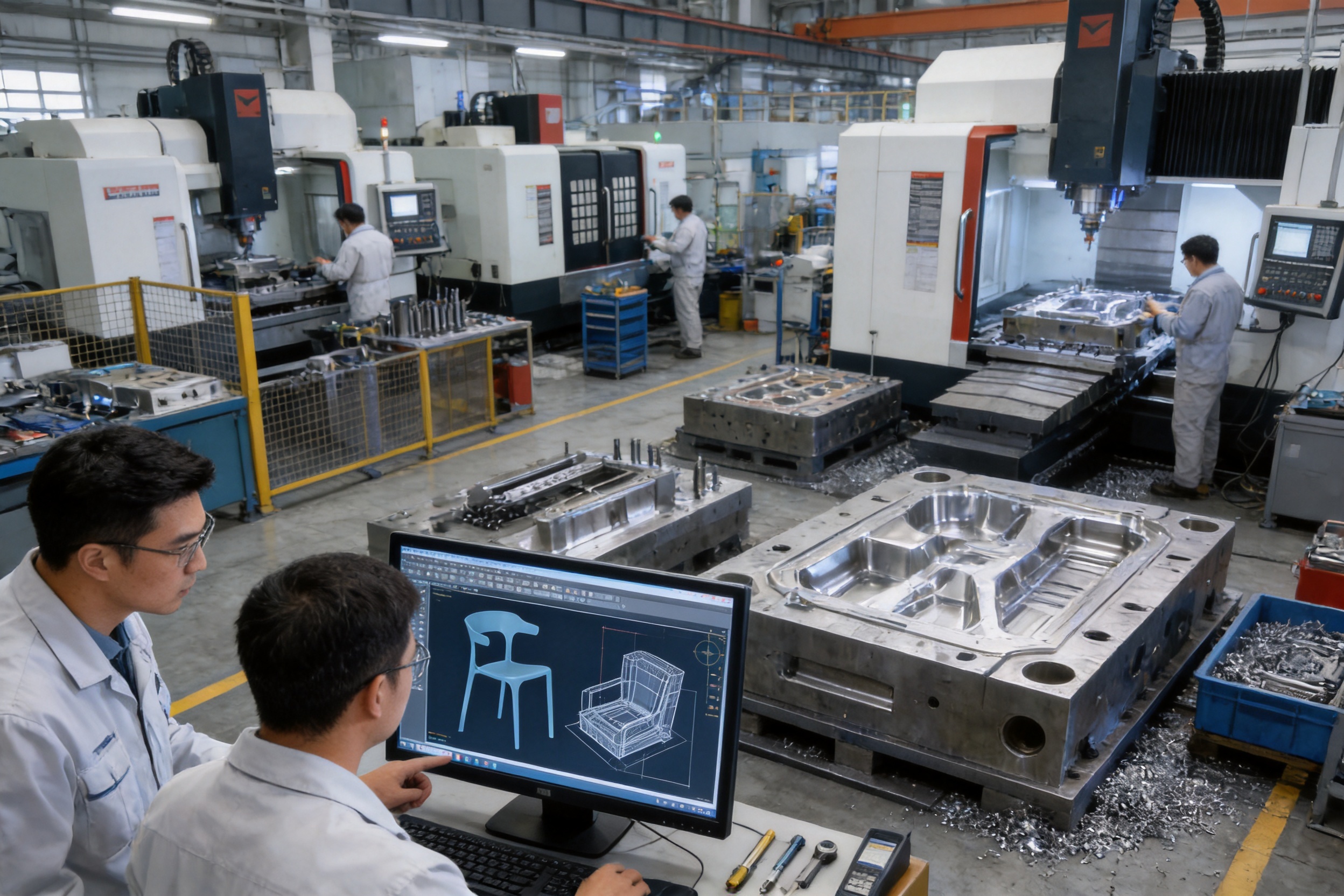
Once the design is approved, steel components are prepared and machined. CNC machining is used to produce complex cavity and core surfaces, structural pockets, inserts, and other components requiring accurate geometry. The quality of the machining process affects the final fit, product dimensions, surface finish, and amount of manual correction required during assembly.
Advanced processing equipment supports stable machining across multiple components. Proper workholding, tool selection, cutting parameters, coolant control, and coordinate management are essential for achieving consistent results. Large mold components require particular attention to rigidity and thermal stability because distortion during machining can affect alignment.
The manufacturer operates 104 advanced processing machines, providing an equipment foundation for mold manufacturing and supporting the production of multiple mold components through organized internal processing. The availability of dedicated equipment can improve scheduling control and reduce dependence on fragmented external processing.
4. Electrical Discharge Machining and Detail Processing
Some mold details cannot be produced efficiently through conventional cutting alone. Electrical discharge machining can be used for deep ribs, narrow slots, sharp internal features, and geometries that require a controlled electrode process. This method is valuable for reproducing complex details accurately while maintaining the intended relationship between adjacent surfaces.
Fine machining, drilling, tapping, grinding, and surface preparation are also performed as required. Each process contributes to the final assembly accuracy. The goal is to ensure that mold components fit correctly and that the cavity reproduces the approved chair design without unwanted steps, mismatch, or roughness.
5. Mold Assembly and Fitting
After machining, the components are inspected and assembled. Skilled technicians check guide systems, parting surfaces, inserts, ejectors, sliders, cooling channels, and fastening points. Fitting work may include hand polishing, spotting, alignment correction, edge treatment, and contact verification.
Assembly quality is especially important for a large chair mold because small errors can become visible across a broad product surface. The core and cavity must close evenly, and the ejection system must move without binding. Sliding components need accurate travel and positive return. Cooling circuits must be tested for leakage before the mold is connected to an injection machine.
6. Trial Molding and Process Verification
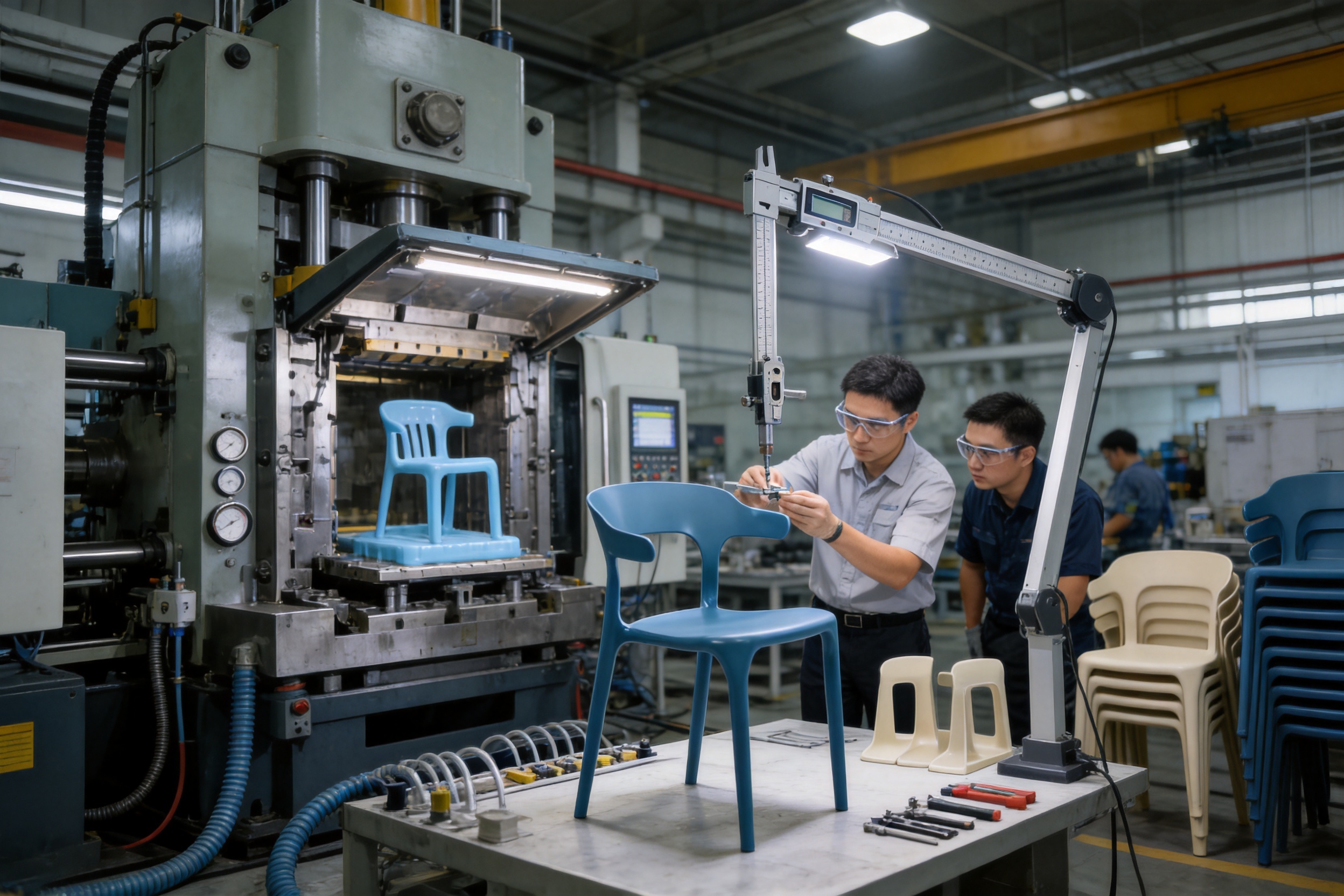
Trial molding is used to verify whether the completed mold performs as intended. The mold is installed on a suitable injection molding machine and tested with the selected or comparable plastic material. Engineers and technicians examine filling behavior, appearance, part release, dimensions, cycle stability, and operating safety.
Trial samples may reveal opportunities for adjustment. For example, the team may refine injection speed, holding pressure, mold temperature, cooling time, or ejection settings. If a design or tooling correction is necessary, the issue is recorded and addressed through controlled modification rather than informal trial-and-error.
Testing on professional injection molding machines provides valuable information that cannot be obtained from machining inspection alone. It confirms how the mold behaves under actual thermal and mechanical conditions and helps the customer receive tooling that is more prepared for production.
7. Final Inspection and Delivery Preparation
Before delivery, the mold is checked against the approved design and quality requirements. Inspection may include dimensional measurement, visual examination, parting-line verification, cooling and hydraulic checks, ejection operation, component identification, and trial sample review.
Documentation can include mold specifications, recommended molding parameters, maintenance instructions, spare-part information, and sample approval records. Clear documentation helps the customer install and operate the mold correctly and supports future maintenance.
Manufacturing Strengths of the Supplier
Zhejiang Chenghui Mould Co., Ltd., also known as Chenghui Mould or CH Mould, was founded in 1994 and has more than 30 years of experience in injection mold design and manufacturing. Its long operating history provides experience with the practical requirements of daily-use plastic products, including furniture, storage products, containers, baskets, buckets, racks, and other household and industrial articles.
The company has its own production workshop and operates 104 advanced processing machines. This internal manufacturing capability supports better coordination between design, machining, assembly, trial molding, and quality inspection. It also allows the company to maintain closer control over production status and technical communication.
Chenghui Mould reports an annual production capacity of more than 1,500 mold sets. Such capacity is valuable for buyers that need a supplier capable of handling repeated projects, product families, replacement tooling, or multiple molds for different chair models. Production scale can also support standardized procedures and a broader experience base across different product geometries.
The company’s service covers the complete development cycle, including concept review, drawing, sample development, machining, assembly, mold trials, quality inspection, and after-sales support. This integrated approach reduces the number of separate technical interfaces that a customer must manage. It also makes it easier to trace decisions from the original product concept through to the finished tool.
International customers can benefit from the company’s export experience in the Middle East, Europe, America, Africa, Southeast Asia, and other regions. Different markets may have different expectations for appearance, product strength, packaging, mold documentation, and production efficiency. Experience with international projects can support clearer communication and more practical delivery coordination.
Advantages Compared with Basic or Low-Cost Chair Molds
Price is an important factor in tooling procurement, but the initial mold quotation does not represent the complete cost of ownership. A low-cost mold may require more adjustments, have a shorter service life, produce inconsistent parts, or create longer cycle times. These hidden costs can exceed the initial savings during mass production.
Plastic Chair Injection Mold 014 offers several potential advantages when compared with basic tooling approaches:
| Evaluation Area | Basic or Low-Cost Tooling Risk | Precision-Oriented Mold Advantage |
|---|---|---|
| Product consistency | Dimensional variation may increase during production | Accurate machining and controlled processing support repeatable parts |
| Filling performance | Unbalanced flow can cause weld lines, short shots, or excess pressure | Gate and runner planning supports more balanced cavity filling |
| Cooling | Uneven or limited cooling may create warpage and long cycles | Cooling is planned around critical product sections |
| Ejection | Concentrated force may leave marks or deform the chair | Ejection is arranged around structural and release requirements |
| Mold life | Premature wear may lead to flash, mismatch, or frequent repairs | Suitable materials, fitting, and wear control support longer service |
| Maintenance | Inaccessible components can increase downtime | Service access and replaceable details can be considered during design |
| Project support | Limited assistance may leave the buyer to solve molding issues | Design, trial molding, inspection, and after-sales support are integrated |
| Production planning | Unstable cycle behavior may affect delivery schedules | Trial verification supports more predictable mass production |
These advantages are especially important for chairs sold through wholesale and distribution channels. Buyers in these markets often need large quantities with consistent appearance and dimensions. A single unstable mold can affect thousands of products, increasing inspection, rework, returns, and customer service costs.
Support for OEM and ODM Projects
OEM customers may already have a complete chair design and require a mold supplier to manufacture the tooling according to approved specifications. In this situation, the mold manufacturer reviews the product files, confirms technical feasibility, recommends any necessary moldability changes, and proceeds with the agreed tooling design.
ODM customers may need broader assistance. They may have a market concept, target price, general dimensions, or functional requirements but not a finished product model. The supplier can contribute to structure development, appearance refinement, material selection, draft design, rib optimization, and prototype evaluation.
For both OEM and ODM projects, early communication is essential. The customer should provide information about intended use, loading conditions, color, surface finish, stacking requirements, packaging, production region, and expected output. These details influence the mold structure and help prevent a mismatch between the tool and the commercial product.
A chair intended for occasional indoor use may have different requirements from a chair designed for restaurants, schools, outdoor events, or institutional applications. The material, reinforcement, surface texture, UV expectations, and quality standard may all change. The mold must be developed with the actual application in mind rather than relying on a generic chair template.
Plastic Material and Product Performance
The appropriate resin should be selected according to the chair’s intended use, required strength, impact resistance, appearance, cost, and environmental conditions. Common plastic choices for molded chairs may include polypropylene, high-impact polypropylene compounds, or other materials selected by the product designer. The final material should be confirmed through technical evaluation and, where necessary, product testing.
Material flow behavior influences gate design, filling pressure, cooling, shrinkage, and surface appearance. A resin with a different melt flow rate may require changes to injection speed, temperature, holding pressure, or cooling time. Reinforced materials may improve stiffness but can also increase wear on mold components and influence surface texture.
The mold supplier can help review the relationship between material selection and mold design, but the customer remains responsible for confirming that the chosen resin meets applicable product safety and performance requirements. For commercial chair projects, load testing, stability testing, impact testing, and environmental testing may be appropriate depending on the market and application.
Color and additives also influence production. Dark colors may reveal flow marks or gloss variation differently from light colors. Flame-retardant, UV-resistant, mineral-filled, or recycled materials may require specific processing considerations. Sharing this information at the design stage allows the tooling team to make more informed decisions.
Surface Appearance and Product Branding
The chair’s appearance is often a major purchasing factor. A smooth, textured, matte, or glossy surface can communicate different levels of quality and can influence how visible minor marks become. The mold surface must be prepared to the required standard, whether the product calls for polishing, fine texture, leather grain, or another finish.
Surface treatment should be consistent across visible areas. Uneven polishing or texture depth may create noticeable differences between cavity sections. The parting line should be positioned where it is acceptable for the product and should be fitted accurately to limit flash.
Brand logos, decorative patterns, product codes, and anti-slip features can be incorporated into the chair design when required. These details must be evaluated for draft, depth, filling, release, and cleaning. Raised or recessed markings should not create unnecessary stress concentrations or interfere with ejection.
When a customer intends to use the same basic chair design in multiple colors or markets, the mold should be planned for repeatable production across those variations. Clear cavity identification, process documentation, and sample approval can help maintain consistency between production batches.
Quality Control and Inspection Approach
Quality control for a plastic chair mold should begin before steel is cut. Design reviews, material verification, equipment calibration, and process planning all influence the final result. A complete quality approach includes incoming inspection, in-process checks, assembly inspection, trial molding, and final approval.
Typical inspection points may include:
• Steel grade and component identification
• Mold base dimensions and flatness
• Core and cavity dimensions
• Parting-line fit and shut-off condition
• Guide pillar and guide bush alignment
• Ejector movement and return position
• Slider and lifter travel
• Cooling channel leakage and connection condition
• Surface finish and texture consistency
• Trial sample dimensions and appearance
• Flash, sink marks, short shots, warpage, and weld lines
• Mold opening, closing, and safety operation
Measurement equipment and inspection methods should be selected according to the required tolerance and product complexity. For large chair components, dimensional control may involve coordinate measurement, gauges, comparison with the approved three-dimensional model, and sample fitting checks.
Trial samples should be evaluated not only for appearance but also for production behavior. The team should observe whether the chair releases cleanly, whether the cycle remains stable, whether the mold temperature is balanced, and whether the ejection system leaves unacceptable marks. This practical evaluation helps distinguish a mold that merely produces a sample from a mold that is ready for continuous production.
Production Efficiency and Cost Management
The total cost of a chair mold includes purchase price, installation, trial adjustment, maintenance, energy consumption, cycle time, scrap, labor, and replacement parts. A well-engineered mold may provide economic value even when its initial quotation is higher than a basic alternative.
Cycle time is one of the most important factors in high-volume production. Cooling often represents a large portion of the cycle, so a well-planned cooling system can improve output without compromising product stability. Faster cycles are beneficial only when the molded chair remains dimensionally consistent and sufficiently cooled for safe ejection.
Scrap reduction also contributes to profitability. Defective chairs require material, machine time, labor, and handling but cannot be sold as planned. By improving filling balance, cooling consistency, and ejection performance, the mold can help reduce avoidable defects.
Maintenance cost should be considered over the expected production life. Replaceable inserts, accessible wear components, clear lubrication points, and accurate documentation can reduce downtime. Preventive maintenance is generally more economical than waiting for flash, sticking, or dimensional failure to appear in finished products.
For wholesalers and distributors, production reliability has an additional commercial value. Consistent chair dimensions make packaging and stacking more predictable. Stable color and surface quality reduce sorting. Reliable output makes it easier to fulfill repeat orders and maintain customer confidence.
Maintenance Recommendations for Long-Term Mold Life
Even a precision mold requires proper maintenance. The maintenance schedule should be adapted to production volume, plastic material, cycle conditions, and environmental factors. After each production run, the mold should be cleaned and protected according to the steel and surface requirements.
Routine maintenance may include checking the following items:
• Parting surfaces for contamination or damage
• Ejector pins and sleeves for wear or sticking
• Sliders and lifters for smooth movement
• Guide systems for lubrication and alignment
• Cooling channels for blockage, leakage, or corrosion
• Gate and runner areas for wear or residue
• Fasteners and locating components for looseness
• Cavity and core surfaces for scratches or impact marks
• Hydraulic or pneumatic connections where used
Cooling water quality should be managed carefully. Scale or corrosion inside channels can reduce heat-transfer efficiency and create temperature imbalance. If the mold uses a temperature-control system, the customer should follow appropriate filtration, water treatment, and flushing procedures.
When the mold is stored, it should be dried, protected against corrosion, and kept in a suitable position. Moving parts should be secured as recommended. A maintenance record should note production cycles, repairs, component replacement, and any changes to molding parameters.
Project Workflow for International Buyers
International customers usually benefit from a structured project workflow. The process can begin with an inquiry containing the product model, drawings or three-dimensional file, estimated order quantity, intended material, injection machine information, and target delivery schedule.
The supplier then reviews the project and identifies required clarifications. A technical discussion may cover draft angles, gate position, cooling arrangement, surface treatment, mold steel, expected mold life, spare parts, trial standards, and shipping requirements. Once the design and quotation are confirmed, the project proceeds through mold design, approval, machining, assembly, trial molding, correction if needed, final inspection, and delivery.
Clear approval points help control changes. Product modifications after machining has started can affect cost and schedule, so customers should confirm the chair design, logo, texture, material, and critical dimensions before final mold release.
Communication should include both commercial and technical information. A complete project record may contain approved drawings, mold layout, steel specifications, trial reports, sample photographs, measurement results, recommended processing parameters, and maintenance instructions. These records help the buyer’s engineering and production teams manage the tool after arrival.
Why Choose a Specialized Daily-Use Product Mold Manufacturer
Daily-use products place special demands on injection molds because they are often produced in large quantities and are expected to have consistent appearance and practical durability. Experience with chairs, tables, storage boxes, turnover crates, baskets, buckets, racks, trash cans, and related products helps a mold manufacturer understand common structural and production challenges.
A specialist is more likely to recognize the relationship between product usability and tool design. For example, a chair cannot be judged only by its cosmetic surface. The leg geometry, seat support, backrest flexibility, stacking behavior, and contact areas all influence market acceptance. The mold must reproduce these functional details while maintaining efficient production.
Chenghui Mould’s focus on daily necessities provides a relevant foundation for chair mold projects. Its experience includes household and industrial products with different sizes, materials, surface requirements, and production volumes. This product knowledge supports practical recommendations rather than purely theoretical mold construction.
Application Benefits for Different Customer Groups
Furniture Manufacturers
Furniture manufacturers can use the mold to develop proprietary chair models or expand an existing product range. A reliable mold supports repeat production and allows the manufacturer to control quality more closely. It can also help coordinate chair production with assembly, packaging, and distribution operations.
Wholesalers and Distributors
Wholesalers and distributors that source private-label products can benefit from OEM and ODM tooling support. The mold can be developed around target market preferences, packaging dimensions, color options, and commercial positioning. Consistent parts improve the ability to supply repeat orders across different regions.
Hospitality and Institutional Suppliers
Suppliers serving hotels, restaurants, schools, event organizers, and public facilities may require large quantities of chairs with consistent dimensions and appearance. Mold stability is important because project deliveries are often scheduled around opening dates, events, or institutional procurement deadlines.
Product Development Companies
Design firms and product developers can work with the supplier during the transition from concept to production. Engineering feedback at an early stage can prevent a visually attractive but difficult-to-mold design from reaching the machining stage without correction.
Safety, Compliance, and Responsible Product Development
The mold itself is one part of a broader product development system. The customer should confirm that the final chair complies with the regulations, safety standards, material restrictions, and performance requirements applicable in the intended market.
Depending on the application, the finished chair may require stability testing, static load testing, impact testing, durability testing, flammability assessment, chemical compliance documentation, or environmental evaluation. The mold should reproduce the approved design consistently so that test results remain relevant during mass production.
Material traceability and process records can also support responsible manufacturing. If recycled content, restricted substances, or special additives are used, the customer should coordinate material documentation with the product and quality teams. Consistent processing helps prevent unexpected differences between approved samples and commercial production.
Customer Questions and Answers
What type of product is Plastic Chair Injection Mold 014 designed to produce?
It is designed for plastic chair injection molding applications. The final cavity structure depends on the customer’s chair design, dimensions, material, surface requirements, and production plan. It may be developed for a one-piece chair or for a specific molded chair component.
Can the mold be customized for an OEM chair design?
Yes. The mold can be developed according to customer-provided drawings, three-dimensional files, samples, or technical specifications. The design is reviewed for draft, filling, cooling, ejection, machine compatibility, and production feasibility before manufacturing.
Does the supplier support ODM development?
Yes. For customers that do not have a finished product model, the supplier can participate in concept review, structure refinement, moldability analysis, sample development, and tooling design. The specific scope should be confirmed at the beginning of the project.
What information should be provided for a quotation?
Useful information includes the chair model or drawings, three-dimensional product file, target material, estimated production volume, expected mold life, injection machine specifications, surface finish, color requirements, packaging needs, and delivery destination. More complete information supports a more accurate quotation and schedule.
How does the mold support large-volume production?
Large-volume production requires stable filling, effective cooling, reliable ejection, durable components, and repeatable assembly. The mold is engineered and trialed with these factors in mind. Proper maintenance and suitable molding parameters are also necessary to achieve the intended service life.
Can different plastic materials be used?
The suitable material depends on the product design and performance requirements. Different resins may have different flow, shrinkage, cooling, and wear characteristics. Material selection should be confirmed before the final mold design because it can affect gates, cooling, processing conditions, and expected tool life.
How is surface appearance controlled?
Surface appearance is controlled through product design, steel preparation, polishing or texturing, parting-line treatment, filling balance, and molding parameters. The required appearance standard should be approved through drawings, samples, or reference panels before final production.
What is the purpose of mold trial molding?
Trial molding verifies how the completed mold performs under actual injection conditions. It helps evaluate filling, cooling, ejection, appearance, dimensions, cycle stability, and safety. Trial results can identify any adjustment required before the mold is shipped or released for mass production.
Does the supplier provide after-sales support?
After-sales support is included in the company’s service approach. Technical communication can cover installation, trial operation, molding parameters, maintenance, spare parts, and corrective guidance. The exact support arrangement depends on the project and customer requirements.
Where is the manufacturer located?
Zhejiang Chenghui Mould Co., Ltd. is located in Nanshan Industrial Zone, Luoyang Street, Luqiao District, Taizhou City, Zhejiang Province, China. The company serves domestic and international customers.
How can a customer discuss a chair mold project?
Customers can contact the company through its sales and management communication channels and provide product drawings, samples, technical requirements, and expected quantities. Early technical communication is recommended so that the mold structure can be aligned with the customer’s equipment and production goals.
Conclusion
Plastic Chair Injection Mold 014 is intended for manufacturers that need more than a basic cavity capable of producing an initial sample. A successful chair mold must support stable filling, controlled cooling, safe ejection, accurate dimensions, attractive surfaces, practical maintenance, and reliable performance during mass production.
The mold’s value comes from the relationship between engineering design, manufacturing precision, trial verification, and long-term service support. For a large and structurally complex product such as a plastic chair, these factors directly influence production efficiency and commercial quality.
Chenghui Mould brings more than 30 years of injection mold experience, an internal production workshop, 104 advanced processing machines, professional injection molding equipment for mold testing, and an annual capacity exceeding 1,500 mold sets. Its experience with household and industrial products supports a practical approach to chair tooling, from early concept review through final inspection and after-sales assistance.
For furniture manufacturers, wholesalers, distributors, and product developers, a precision-oriented chair mold can reduce production uncertainty and support more consistent supply. With customized OEM and ODM services, international project experience, and integrated tooling capabilities, Plastic Chair Injection Mold 014 provides a strong foundation for efficient, repeatable, and commercially dependable chair production.
References
1. Society of Plastics Engineers, Injection Molding Fundamentals and Process Control.
2. The American Society of Mechanical Engineers, General Principles of Product Design and Manufacturing Quality.
3. International Organization for Standardization, Quality Management Systems: Requirements and Guidance.
4. International Organization for Standardization, Plastics Injection Molding and Dimensional Evaluation Practices.
5. Society of Manufacturing Engineers, Mold Design, Tooling Materials, and Production Engineering Principles.
6. Association of Plastics Recyclers, Guidance on Plastics Material Selection and Responsible Product Development.
7. Standard engineering references for injection mold cooling, ejection design, polymer flow, shrinkage, and warpage control.