
 Français
 Español
 عربى
A plastic stool may appear to be a simple household product, but producing a safe, attractive, durable, and consistently dimensioned stool requires carefully engineered tooling. The mold determines the stool’s surface quality, structural strength, cycle efficiency, assembly compatibility, and long-term production cost. For manufacturers, wholesalers, distributors, and product developers, selecting the right plastic stool mold is therefore one of the most important decisions in the entire injection molding project.
The CHENGHUI Plastic Stool Mold 022 is designed for manufacturers seeking dependable tooling for high-volume plastic stool production. It belongs to a broader range of injection molds developed for daily-use products, household furniture, storage products, and industrial applications. Its development is supported by Zhejiang Chenghui Mould Co., Ltd., an experienced Chinese mold manufacturer with more than 30 years of involvement in plastic injection tooling.
This article explains the essential features of a professional plastic stool mold, the advantages that distinguish well-engineered tooling from low-cost alternatives, and the manufacturing processes that help achieve stable production. It also examines mold design, material selection, cooling, ejection, quality control, maintenance, customization, and supplier evaluation.

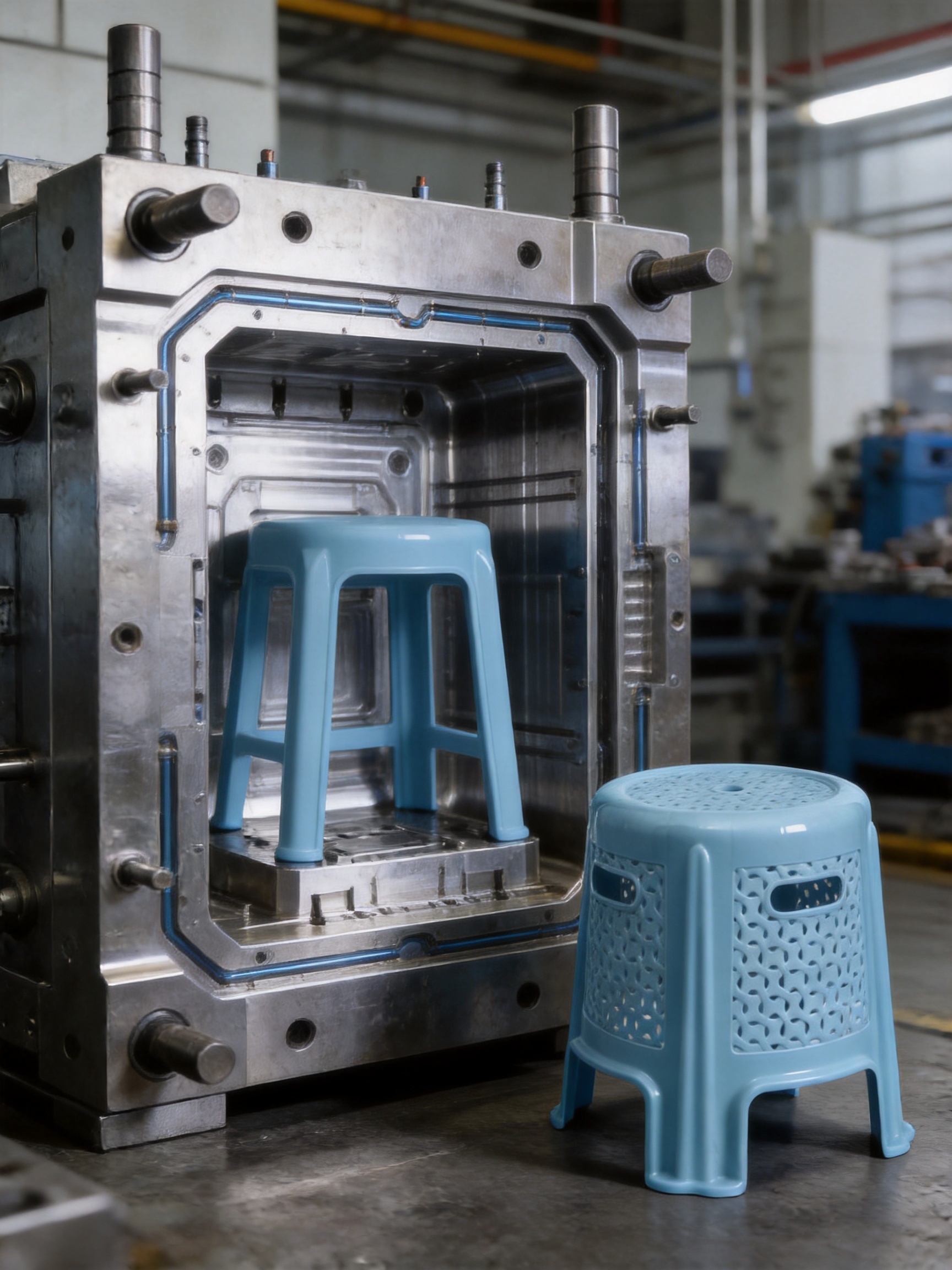
CHENGHUI Plastic Stool Mold 022
1. Why Plastic Stool Mold Quality Matters
Plastic stools are used in homes, kitchens, workshops, retail stores, schools, offices, gardens, and commercial facilities. They are expected to support repeated loads, resist impact, remain stable on different floors, and maintain an appealing appearance after extended use. These requirements place significant demands on the injection mold.
A poorly designed mold can create many production problems. Uneven wall thickness may lead to warpage or weak areas. Inadequate venting may cause burn marks, short shots, or trapped air. An unbalanced runner system can produce inconsistent filling between different areas of the product. Weak ejection design may leave marks on visible surfaces or deform the legs and support structure. Poor cooling may extend cycle times and create dimensional variation from one batch to another.
These defects do not merely affect appearance. They can increase scrap rates, interrupt production, generate customer complaints, and reduce confidence in the product. For wholesalers and distributors, inconsistent stool quality can also lead to returns and damage to brand reputation.
A high-quality mold addresses these issues before production begins. Through careful product analysis, flow planning, steel selection, machining, polishing, assembly, trial molding, and inspection, the mold can be prepared for repeatable mass production. This approach reduces the total cost of ownership even when the initial tooling investment is higher than that of a basic, poorly controlled mold.
1.1 The mold as the foundation of product performance
The stool’s final properties are influenced by the plastic resin, injection machine, processing parameters, and post-molding handling. However, the mold remains the foundation of the process. It determines the geometry that the resin must fill and the way the molded part cools and leaves the tool.
For example, a stool with multiple legs, reinforcing ribs, curved surfaces, and a broad seat requires a balanced filling strategy. The mold must support the structural details without creating unnecessary weld lines or stress concentrations. It must also provide sufficient cooling near thick sections, because thick plastic cools more slowly and can shrink differently from thinner areas.
Professional mold design considers these relationships as a complete system rather than treating each detail separately. The result is tooling that supports stable production, predictable dimensions, and a more efficient manufacturing cycle.
2. Product Overview: Plastic Stool Mold 022
The CHENGHUI Plastic Stool Mold 022 is a dedicated injection mold solution for manufacturing plastic stools. It is intended for manufacturers that need repeatable tooling for daily-use furniture products and related household applications.
The mold can be developed around the customer’s selected stool design, resin, production volume, machine capability, surface requirements, and target market. Depending on the final product specification, the tooling may be adapted for different seat shapes, leg configurations, reinforcing structures, textures, colors, and dimensional standards.
Customization is especially important in stool production because the product may be sold for different purposes. A lightweight household stool may prioritize easy handling and economical resin consumption. A workshop or commercial stool may require greater load-bearing capacity and reinforced support areas. A children’s stool may need rounded edges, smooth surfaces, and specific safety considerations. A design intended for export may need packaging optimization and compliance with the expectations of a particular market.
By using a mold manufacturer capable of handling design development, machining, assembly, testing, and inspection in one coordinated process, customers can reduce communication gaps between separate suppliers. This integrated approach helps ensure that the final mold reflects the intended product design and manufacturing goals.
2.1 Typical application environments
Plastic stools produced from this type of mold may be used in residential interiors, balconies, gardens, cafés, restaurants, workshops, classrooms, dormitories, retail environments, and temporary event spaces. Their commercial value comes from a combination of affordability, portability, ease of cleaning, and resistance to everyday moisture.
The same basic mold concept can also support variations in product styling. Manufacturers may request a minimalist stool with a smooth modern appearance, a utility stool with visible reinforcing ribs, a stackable stool for commercial use, or a compact stool intended for storage and transport. Tooling details must be adjusted according to the intended product rather than copied from a generic design.
2.2 Design features that influence the mold
Several product characteristics strongly influence plastic stool mold construction:
First, the seat shape affects filling behavior, cooling, and surface appearance. A large flat seat may require careful control of shrinkage and warpage, while a contoured seat can require more complex cavity machining.
Second, the number and angle of the legs influence parting-line selection, ejection, and mold opening. Sloped or tapered legs may require draft angles that allow smooth release from the cavity.
Third, reinforcing ribs improve structural performance but can also create sink marks if they are too thick. Rib design must balance strength with moldability.
Fourth, the desired surface texture determines the finishing method. Glossy surfaces require careful polishing, while textured surfaces require controlled etching or a comparable finishing process.
Fifth, stacking or nesting requirements affect the external geometry and may require special attention to draft, tolerances, and contact areas. A stool that must be stacked efficiently needs consistent dimensions and carefully controlled clearances.
3. Major Advantages of a Professionally Engineered Stool Mold
The competitive advantages of a high-quality plastic stool mold are usually found in its repeatability, efficiency, maintainability, and adaptability. These benefits can be more valuable than a lower purchase price because the mold will influence production performance for many years.
3.1 Stable dimensional consistency
Dimensional consistency is essential when stools are produced in large quantities. The seat height, leg spacing, support geometry, and contact points must remain within acceptable tolerances. If these dimensions vary significantly, stools may wobble, stack unevenly, or fail to meet customer expectations.
Precision machining and controlled mold assembly help maintain accurate cavity and core geometry. Proper alignment between mold halves reduces mismatch and protects the parting surface. Stable cooling and a balanced filling system further reduce variation caused by uneven shrinkage.
For distributors, dimensional consistency also improves packaging and warehousing. Products with predictable dimensions are easier to stack, count, label, and transport.
3.2 Improved structural reliability
A stool mold must support the production of a part that can withstand normal loading and repeated handling. Mold design cannot replace proper product engineering, but it can help reproduce the intended load-bearing geometry accurately.
Reinforcing ribs, corner transitions, leg junctions, and support blocks require particular attention. Abrupt changes in wall thickness may create stress concentrations, while poorly formed rib connections may reduce strength. A well-designed cavity reproduces these areas with clean transitions and appropriate draft.
When the customer provides load requirements or test criteria, the mold design team can use that information to review the product structure before steel cutting. This early evaluation may identify opportunities to improve the stool without compromising appearance or manufacturability.
3.3 Better surface appearance
Household furniture is often judged first by its surface finish. Flow lines, weld lines, ejector marks, scratches, burns, and visible parting-line defects can make a stool appear inexpensive even when its structure is adequate.
Surface quality depends on cavity polishing, texturing, venting, gate location, resin selection, processing conditions, and ejection design. A professional mold manufacturer coordinates these elements rather than treating polishing as an isolated final step.
Visible areas can be protected from unnecessary ejector marks. The parting line can be positioned in a less prominent location when product geometry allows. Texture depth can be selected to support both visual quality and reliable demolding.
3.4 Efficient molding cycles
Cycle time has a direct effect on production cost. Every unnecessary second reduces output and increases the cost per stool. Cooling is often the longest stage of the injection cycle, so the cooling system deserves detailed attention.
Properly arranged cooling channels help remove heat more evenly from the cavity and core. This can reduce warpage, stabilize dimensions, and shorten cooling time. The exact design depends on the stool’s shape, wall thickness, steel layout, and available machine conditions.
A balanced runner and gate arrangement can also improve filling efficiency. When the plastic flows smoothly into the cavity, the processor may be able to use suitable injection pressure and speed without creating excessive shear, hesitation, or air entrapment.
3.5 Reduced maintenance risk
A production mold must be maintained throughout its service life. Wear components, ejector systems, guide elements, seals, and cooling connections may eventually require inspection or replacement. A mold designed with accessible, standardized, and replaceable components is easier to maintain.
Clear documentation is also valuable. Mold drawings, component lists, trial records, and maintenance recommendations help the production team identify issues quickly. An experienced mold supplier can provide guidance on cleaning, lubrication, storage, cooling-water management, and periodic inspection.
3.6 Flexibility for product customization
Manufacturers frequently need to adapt a stool for a new market, color, surface texture, or product family. A mold may be customized at the beginning for a particular design, or it may be developed with carefully considered interchangeable features where practical.
Customization can include logo areas, textured surfaces, revised leg geometry, color-specific appearance requirements, modified dimensions, or different packaging objectives. Not every change can be made without new tooling, but early discussion with the mold manufacturer allows the customer to understand which features are adjustable and which are fixed.
4. Advanced Manufacturing Process
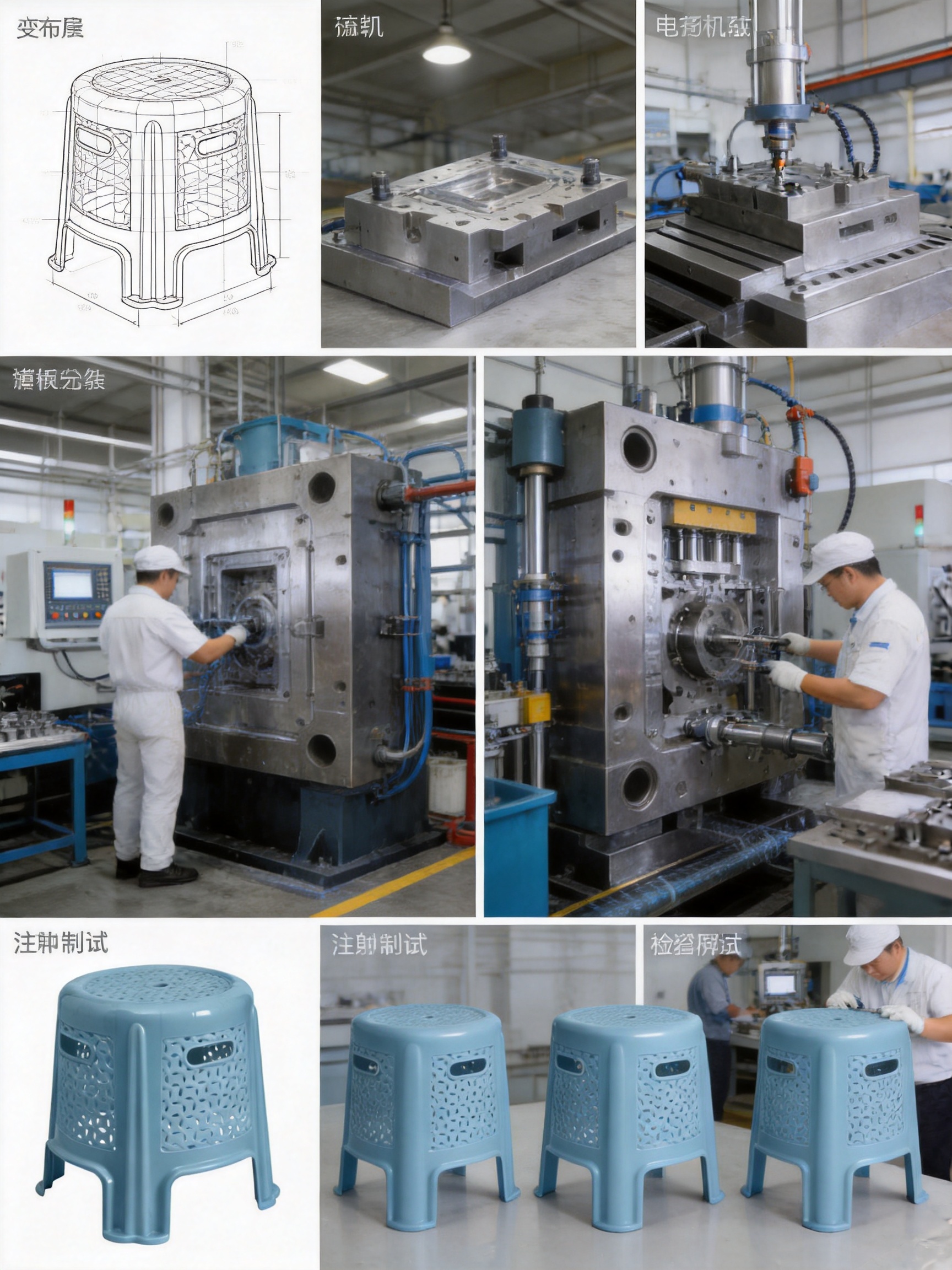
The performance of a plastic stool mold depends not only on the design concept but also on how accurately that concept is converted into steel. Chenghui Mould operates its own production workshop and uses a large base of advanced processing equipment, including 104 processing machines and professional injection molding machines for mold testing.
This manufacturing capacity supports a coordinated workflow from initial engineering through final validation. It also gives the manufacturer greater control over scheduling, machining consistency, assembly quality, and trial adjustments.
4.1 Product and mold design review
The process begins with a review of the customer’s product concept, drawings, three-dimensional data, reference samples, or functional requirements. Engineers examine the stool’s overall dimensions, wall thickness, draft angles, ribs, corners, parting areas, ejection surfaces, and appearance requirements.
This review is intended to identify potential production risks before machining begins. If a region is too thick, difficult to eject, poorly vented, or likely to warp, the issue can be discussed with the customer at an early stage. Early correction is usually faster and less expensive than modifying completed mold steel.
The design review should also consider the injection machine. Mold dimensions, clamping requirements, shot size, injection pressure, ejection stroke, and available cooling connections must be compatible with the selected equipment.
4.2 Mold flow and filling analysis
For complex or large stool designs, flow analysis can help evaluate gate location, filling balance, weld-line risk, air-trap positions, and likely pressure requirements. The purpose is not to replace practical engineering judgment but to provide additional information before manufacturing.
A suitable gate location should support uniform filling while minimizing visible marks and unwanted weld lines in critical areas. If the stool has several legs or widely separated structural sections, the filling pattern must be considered carefully so that one region does not fill significantly earlier than another.
Venting is equally important. Air trapped inside the cavity can prevent complete filling and create burn marks. Proper venting allows displaced air and gases to escape without causing flash or damaging the product surface.
4.3 Steel and component selection
Tool steel selection depends on production volume, resin characteristics, surface requirements, corrosion exposure, expected wear, and maintenance conditions. A high-volume stool mold may require materials and treatments that support long service life under repeated injection cycles.
Components exposed to sliding, impact, or repeated movement must be selected and treated appropriately. Guide pillars, bushings, ejector components, inserts, and wear plates all contribute to long-term mold reliability.
The choice of steel should not be based on cost alone. A cheaper material may increase polishing difficulty, wear faster, or create maintenance problems. Conversely, selecting the most expensive material for every application may not be economically necessary. The appropriate choice is the one that matches the customer’s production plan and product requirements.
4.4 Precision machining
Modern machining equipment is used to create the cavity, core, inserts, cooling channels, runner features, and other mold components. Computer-controlled machining supports repeatable dimensions and complex geometry.
Different operations may be used for roughing, semi-finishing, finishing, drilling, electrical discharge machining, and surface preparation. Each stage has a defined purpose. Rough machining removes material efficiently, while finishing operations establish the final geometry and surface condition.
Machining accuracy is particularly important in areas where the cavity and core must meet precisely. Misalignment may create flash, mismatch, uneven wall thickness, or premature wear. Accurate datum management and inspection throughout the process help prevent these problems.
4.5 EDM and detail reproduction
Electrical discharge machining can be used for deep, narrow, or intricate features that are difficult to produce by conventional cutting. It is useful for certain corners, ribs, slots, and detailed geometry.
After EDM, the affected surfaces may require additional finishing depending on the desired appearance. The finishing method must preserve the intended dimensions and texture. Experienced technicians understand that excessive polishing can alter a small feature, while insufficient finishing can leave an undesirable surface pattern.
4.6 Polishing and texturing
Polishing is performed according to the required product appearance. A high-gloss stool requires a different finishing strategy from a stool with a fine matte texture. The objective is to create a consistent surface that releases reliably and meets the customer’s visual expectations.
Textured surfaces can improve grip, conceal minor flow marks, and create a distinctive design language. However, texture depth and direction must be compatible with draft angles. If texture is too deep for the available draft, the part may stick during ejection or show scuffing.
4.7 Mold assembly
During assembly, technicians fit the cavity, core, inserts, ejector system, guide components, cooling elements, and other parts into a complete mold. Alignment is checked carefully to ensure smooth opening and closing.
The assembly stage is also an opportunity to identify practical issues such as interference, difficult access, insufficient clearance, or inconvenient maintenance points. A mold that is easy to operate and service can provide greater value than one that merely produces acceptable parts during its first trial.
4.8 Mold trial and correction
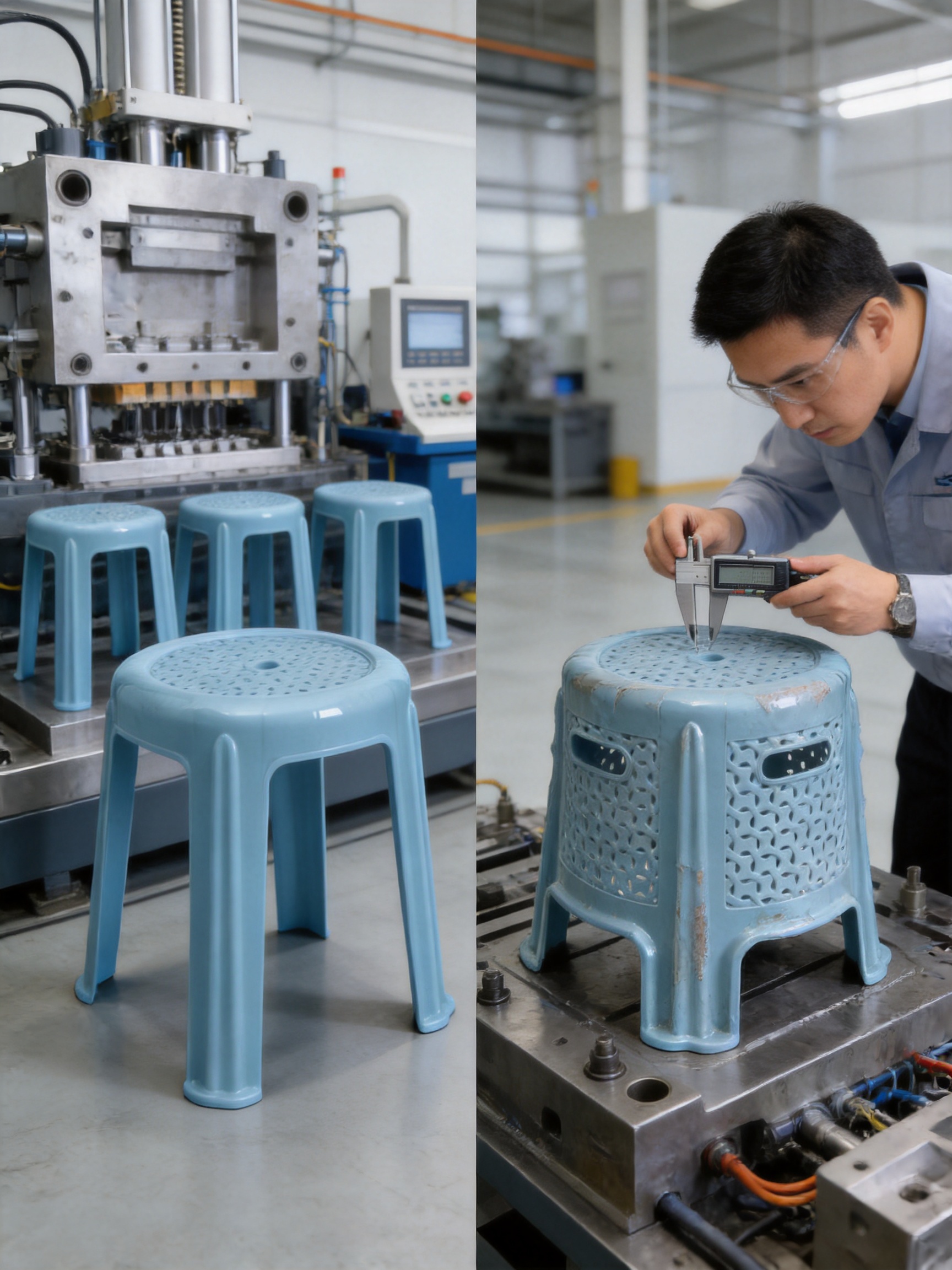
Trial molding is a critical stage because it demonstrates how the completed mold performs under actual injection conditions. Chenghui Mould has professional injection molding machines for mold testing, allowing technicians to evaluate filling, ejection, cooling, appearance, and dimensional behavior.
Trial samples are reviewed for short shots, flash, sink marks, warpage, weld lines, burn marks, scratches, ejector marks, and dimensional deviation. Processing parameters may be adjusted, and minor mold corrections may be made when necessary.
A responsible supplier does not consider the project complete simply because the mold can produce one acceptable sample. The objective is stable and repeatable production. Trial records and inspection results help establish a reference for future manufacturing.
5. Comparison with Low-Cost or Generic Competitor Tooling
Plastic stool molds are available from many suppliers, but apparent price differences do not always reflect the full value of the tool. A low quotation may exclude important engineering work, trial corrections, documentation, or after-sales support.
| Evaluation Area | Professional Stool Mold | Low-Cost or Generic Tooling | Impact on the Buyer |
|---|---|---|---|
| Product analysis | Reviews structure, draft, filling, cooling, and ejection before machining | May rely on a standard design with limited engineering review | Early risk reduction and fewer design-related defects |
| Dimensional control | Uses controlled machining, alignment, and inspection procedures | May show inconsistent tolerances or mismatch | More stable stool dimensions and fewer rejected parts |
| Cooling system | Designed according to geometry and heat distribution | May use basic or poorly positioned channels | Improved cycle time and lower warpage risk |
| Surface finish | Polishing or texturing is matched to the product requirement | May provide inconsistent finish or visible tool marks | Better appearance and stronger market acceptance |
| Trial molding | Samples are evaluated and corrections are made systematically | Trial may be limited or poorly documented | Greater confidence before mass production |
| Maintenance | Uses serviceable components and provides technical guidance | Replacement and maintenance planning may be limited | Lower downtime risk over the mold’s working life |
| Customization | Supports product-specific design, surface, and functional requirements | May offer only minor changes to a fixed mold concept | Better alignment with target markets and product positioning |
| Production integration | Design, machining, assembly, testing, and inspection are coordinated | Multiple processes may be outsourced without unified control | Clearer communication and more predictable scheduling |
A low-cost mold can sometimes be suitable for a short production run or a simple product with limited appearance requirements. However, buyers should calculate the complete operating cost. Frequent adjustments, high scrap, extended cycles, unstable quality, and unexpected maintenance may exceed the initial savings.
For wholesalers and distributors, a stable mold is particularly important because production interruptions can affect delivery schedules. A mold that supports predictable output helps manufacturers fulfill larger orders and respond more quickly to market demand.
6. Material and Processing Considerations
The mold must be designed for the selected plastic resin. Common stool materials may include polypropylene, high-impact polypropylene blends, polyethylene, or other engineering and commodity polymers selected according to cost, stiffness, impact resistance, colorability, and environmental conditions.
Each material behaves differently during injection and cooling. Resin viscosity affects filling pressure and gate design. Shrinkage affects dimensions and mold compensation. Reinforced materials may increase stiffness but also create greater wear or directional shrinkage. Recycled content may influence flow behavior, color consistency, odor, and mechanical properties.
The customer should communicate the intended resin and any recycled or mineral-filled content before the mold design is finalized. If the material changes later, the mold may still be usable, but processing conditions and product performance should be reassessed.
6.1 Wall thickness and rib design
Uniform wall thickness is a fundamental principle in injection molding. Large variations can create sink marks, internal stress, warpage, or uneven cooling. Ribs should generally be designed to reinforce the part without creating excessively thick intersections.
For a stool, ribs are commonly important beneath the seat and around the leg connections. The correct design depends on the intended load, resin, product dimensions, and appearance. A mold manufacturer can help the customer balance structural support with resin consumption and cycle efficiency.
6.2 Draft and ejection
Draft angles allow the molded stool to separate from the cavity and core. Without adequate draft, textured or deep surfaces may drag against the mold and cause scratches, deformation, or difficult ejection.
The ejection system must apply force in locations that can tolerate it. Ejector pins, sleeves, plates, or other mechanisms should be positioned to release the part evenly. Ejection force that is concentrated in a weak area may bend a leg or leave a visible mark.
6.3 Cooling and shrinkage
Plastic shrinks as it cools. Different sections of a stool may cool at different rates, particularly where ribs, bosses, corners, or thick junctions are present. The cooling system should therefore support balanced heat removal rather than simply adding as many channels as possible.
Water temperature, flow rate, channel diameter, and circuit arrangement all influence cooling performance. During trial molding, the supplier can evaluate whether the part is releasing cleanly and whether additional parameter or mold adjustments are necessary.
7. Quality Management and Inspection
Quality management must cover both the mold and the molded sample. Chenghui Mould emphasizes precision equipment, standardized processes, and strict quality management as part of its manufacturing approach.
Inspection may include checking steel dimensions, cavity and core alignment, component movement, cooling-channel integrity, ejector operation, surface condition, and sample dimensions. The exact inspection plan should reflect the customer’s requirements and the complexity of the mold.
7.1 Mold inspection
Mold inspection confirms that the tool has been manufactured according to the approved design. Important checks may include parting-line fit, cavity dimensions, insert seating, guide-system movement, ejector return, cooling connections, and overall mold opening.
Technicians should also check for sharp edges, interference, burrs, incorrect clearances, or areas that could damage the product during operation. These practical details can influence the mold’s reliability even when the main cavity dimensions are correct.
7.2 Sample inspection
Samples should be examined visually and dimensionally. Critical measurements may include overall length, width, height, seat flatness, leg spacing, contact-point geometry, and stacking clearances where applicable.
Appearance inspection should consider color uniformity, gloss or texture, weld-line visibility, sink marks, flash, burn marks, scratches, and ejector marks. If the product will be sold in a market with specific safety or performance expectations, additional testing may be appropriate.
7.3 Documentation
Useful project documentation can include approved product drawings, mold drawings, component lists, trial parameters, sample inspection reports, and maintenance instructions. These records help the customer operate the mold correctly and communicate with future production teams.
Documentation also supports troubleshooting. If a defect occurs after several months of production, earlier trial records may help determine whether the cause is a processing change, material change, cooling issue, or mold wear.
8. Custom OEM and ODM Support
Many stool manufacturers do not want an off-the-shelf mold. They need a product that fits a particular price point, customer group, packaging method, or visual identity. OEM and ODM support allows the mold project to begin with the customer’s commercial objective rather than with a fixed catalog design.
OEM tooling may be developed from the customer’s existing drawings or product files. The supplier converts the design into a manufacturable mold while preserving the required dimensions, appearance, and functions.
ODM support may involve more participation from the mold manufacturer in product development. Engineers can help refine the stool’s structure, draft, ribs, filling strategy, ejection, and surface details. This is useful for buyers who understand their market but do not have a complete internal mold engineering team.
8.1 From concept to production
A typical project sequence may include concept discussion, product data review, mold design, design confirmation, steel preparation, machining, assembly, first trial, sample evaluation, corrections, final trial, inspection, and delivery.
Chenghui Mould provides services covering concept development, drawing preparation, sample development, machining, assembly, mold trials, quality inspection, and after-sales support. Having these stages coordinated by one experienced manufacturer can simplify project management and reduce the risk of contradictory technical decisions.
8.2 International customer support
Chenghui Mould exports molds to the Middle East, Europe, America, Africa, Southeast Asia, and other regions. International buyers often need clear communication about product files, mold standards, shipping preparation, spare components, machine compatibility, and installation support.
Before placing an order, customers should clarify the preferred mold standard, metric or imperial requirements, spare-part expectations, sample approval process, shipping terms, and technical documents. Clear communication at the beginning helps avoid delays near the completion stage.
9. Company Manufacturing Strengths
Zhejiang Chenghui Mould Co., Ltd., also known as Chenghui Mould or CH Mould, was founded in 1994. With more than 30 years of experience, the company has developed expertise in injection molds for daily necessities and related industrial products.
Its product experience includes PET storage products, tables, chairs, furniture, storage boxes, turnover boxes, laundry baskets, buckets, storage racks, trash cans, and other household and industrial products. This broad application experience is relevant to plastic stool production because many of the same engineering principles apply across large molded products: structural reinforcement, controlled filling, balanced cooling, smooth ejection, surface quality, and repeatability.
The company operates its own production workshop with 104 advanced processing machines and professional injection molding machines for mold testing. This equipment base supports the production of more than 1,500 mold sets annually, according to the company’s supplied information.
Production capacity alone does not guarantee quality, but it can provide valuable advantages when combined with experienced engineers, organized workflow, and inspection discipline. In-house coordination may improve response time during machining, assembly, and trial correction. It can also make it easier to monitor progress and keep technical decisions connected across different departments.
9.1 Experience across household and industrial products
Plastic household products often share challenges with industrial products. They must be economical, durable, easy to clean, and suitable for repeatable mass production. Industrial products may place greater emphasis on impact resistance and dimensional stability, while household products may place greater emphasis on appearance and user comfort.
Experience across both areas helps a mold manufacturer understand the balance between function, appearance, material consumption, and production efficiency. This is useful when developing a stool that must be attractive enough for retail sale but strong enough for frequent daily use.
9.2 Continuous improvement
The company states that its mission is to create high-precision and reliable molds through skilled craftsmanship, advanced manufacturing, and continuous improvement. For a customer, continuous improvement should be visible in practical behavior: better design review, clearer documentation, more reliable trial procedures, improved machining control, and responsive after-sales support.
A mold is a long-term production asset. The supplier’s willingness to support adjustments, answer technical questions, and provide maintenance guidance can be as important as the initial manufacturing process.
10. Selecting the Right Mold Supplier
When comparing plastic stool mold suppliers, buyers should evaluate more than catalog images or quoted prices. The following questions can help identify whether a supplier is capable of delivering production-ready tooling.
10.1 Does the supplier understand the complete product?
The supplier should be willing to discuss the stool’s intended load, resin, annual volume, appearance, packaging, machine, and target market. A supplier that asks only for a basic drawing may overlook important production risks.
10.2 Can the supplier provide engineering feedback?
Professional suppliers should identify difficult areas and suggest practical improvements. They should explain how changes to wall thickness, ribs, draft, gates, cooling, or ejection may influence cost and performance.
10.3 Is the manufacturing process controlled internally?
In-house machining and assembly can simplify communication and improve control, although outsourced processes are not automatically unsuitable. Buyers should ask which stages are performed internally, how subcontracted work is inspected, and who is responsible for final quality.
10.4 Is there a clear trial and approval procedure?
The supplier should explain how many trial stages are expected, which machine will be used, what sample information will be provided, and how corrections will be handled. Sample approval criteria should be discussed before the first trial.
10.5 What happens after delivery?
Customers should ask about installation support, spare parts, maintenance instructions, correction responsibilities, and technical communication after delivery. A supplier that provides after-sales support is more likely to view the project as a long-term partnership rather than a one-time transaction.
11. Cost of Ownership and Return on Tooling Investment
The purchase price of a plastic stool mold is only one part of the economic calculation. Buyers should also consider cycle time, scrap rate, service life, maintenance cost, labor requirements, energy consumption, and production stability.
A mold with an efficient cooling system may produce more parts per day. A mold with reliable ejection may reduce operator intervention. A mold with better dimensional consistency may reduce inspection and rework. A mold with replaceable wear components may remain productive for a longer period.
These benefits can make a professionally designed mold more economical over its full working life. The correct evaluation is not simply “Which supplier has the lowest quotation?” but “Which mold provides the lowest reliable cost per acceptable stool over the planned production volume?”
Buyers should also consider future demand. If the stool is expected to become a long-term product, investment in durable steel, efficient cooling, strong components, and accurate machining may be justified. If the product is intended for a short promotional run, the mold strategy may be different.
12. Maintenance Recommendations
Even a high-quality mold requires correct maintenance. Before and after production, operators should inspect the mold for resin residue, moisture, corrosion, damage, unusual wear, and movement problems.
Cooling channels should be managed carefully because scale, rust, or contamination can reduce heat-transfer performance. Cooling-water quality and flow should be monitored according to the production environment.
Moving components should receive appropriate lubrication, but excessive lubricant should be avoided because it can contaminate the molded product or attract dust. Ejector movement should be checked regularly to ensure that pins or plates return correctly.
When the mold is stored, the cavity and core should be cleaned and protected according to the supplier’s instructions. The mold should be closed or stored in a condition that minimizes exposure to humidity and accidental impact. Maintenance records can help identify gradual wear before it causes product defects.
13. Frequently Asked Questions
Q1: What type of product is the Plastic Stool Mold 022 designed to produce?
The mold is designed for plastic stool production through injection molding. Its final configuration can be adapted to the customer’s stool design, material, dimensions, surface requirements, and production objectives.
Q2: Can the mold be customized for a new stool design?
Yes. Customization may include the seat shape, leg structure, reinforcing ribs, texture, logo area, dimensions, draft angles, gate arrangement, cooling system, and ejection layout. The exact possibilities depend on the product geometry and the stage at which changes are requested.
Q3: Which plastic materials can be used?
The suitable material depends on the product design and performance requirements. Common options may include polypropylene and other thermoplastics used for household furniture. The selected resin should be confirmed before final mold design because shrinkage, flow, wear, and processing conditions vary between materials.
Q4: How does mold cooling affect stool quality?
Cooling affects cycle time, dimensional consistency, surface appearance, and warpage. A balanced cooling system removes heat more uniformly and helps the stool release in a stable condition. Poor cooling can create longer cycles and greater variation between parts.
Q5: Why is mold trial molding important?
Trial molding verifies how the completed tool performs under injection conditions. It allows the manufacturer to review filling, ejection, cooling, surface quality, flash, warpage, and dimensions. Trial results can lead to processing adjustments or minor mold corrections before mass production.
Q6: Can the mold be used by an overseas manufacturer?
Yes, provided that the mold is designed for the customer’s injection machine and technical standards. Machine dimensions, clamping requirements, shot size, ejection, cooling connections, and control preferences should be confirmed during the engineering stage.
Q7: What makes a professional stool mold better than a low-cost mold?
A professional mold generally provides stronger engineering review, more consistent machining, better cooling and ejection design, more systematic trial molding, improved documentation, and stronger after-sales support. These advantages can reduce scrap, downtime, maintenance, and quality complaints.
Q8: How long can a plastic stool mold last?
Service life depends on steel selection, resin type, production volume, processing conditions, maintenance, and product geometry. A mold designed for high-volume production and maintained correctly can provide long-term service, but the expected life should be discussed with the supplier based on the specific project.
Q9: Does the stool mold need special maintenance?
It requires normal injection mold maintenance, including cleaning, lubrication, cooling-system management, inspection of ejector and guide components, corrosion prevention, and periodic review of wear areas. The supplier should provide maintenance recommendations suited to the finished mold.
Q10: What information should a buyer provide when requesting a quotation?
The buyer should provide product drawings or three-dimensional data, material information, estimated production volume, stool dimensions, surface requirements, machine specifications, target market, packaging objectives, and any load or safety requirements. More complete information allows the supplier to prepare a more accurate proposal.
14. Conclusion
A plastic stool mold is a long-term manufacturing asset that influences product quality, production efficiency, operating cost, and customer satisfaction. The CHENGHUI Plastic Stool Mold 022 is positioned as a customized injection tooling solution for manufacturers seeking stable production of household and commercial plastic stools.
Its potential advantages come from product-specific engineering, precision machining, controlled assembly, professional trial molding, efficient manufacturing coordination, and the broader experience of an established mold manufacturer. Chenghui Mould has operated since 1994, maintains an in-house production workshop with 104 advanced processing machines, uses injection molding machines for mold testing, and reports an annual capacity of more than 1,500 mold sets.
For buyers, the most important decision is to match the mold design with the intended product, material, machine, volume, and market. A successful project should begin with a complete product review and continue through careful design confirmation, machining, testing, sample approval, delivery, and maintenance support.
When these stages are managed systematically, the result is more than a tool that produces a stool. It is a production system designed to deliver consistent dimensions, attractive surfaces, reliable structural performance, efficient cycles, and dependable output over the mold’s working life.
References
1. Chenghui Mould. Company information and manufacturing capability materials supplied for the plastic stool mold project.
2. International Organization for Standardization. General principles and technical considerations for plastics injection molding.
3. Society of Plastics Engineers. Injection molding design, processing, tooling, and quality-control principles.
4. Technical literature on thermoplastic shrinkage, cooling-system design, mold ejection, and dimensional stability.
5. Industrial mold engineering references covering cavity and core construction, runner balance, venting, polishing, texturing, and preventive maintenance.